New Penn Vet research moves science closer to a solution to male infertility
By converting human skin or blood cells into stem cells and coaxing them into early-stage human sperm cells, researchers are furthering the understanding of how sperm cells are formed.
2 min. read
In a breakthrough that could bring scientists closer to a solution to male infertility, a team of researchers from Penn’s School of Veterinary Medicine have found a way to take cells such as skin or blood cells from the human body, convert them into stem cells, and then coax those into early-stage human sperm cells.
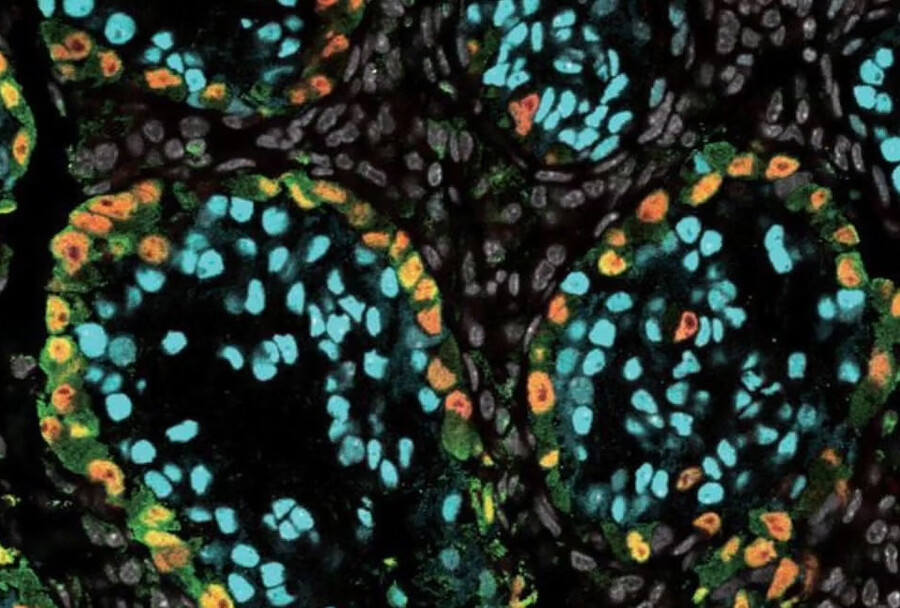
Spermatogonia generated from pluripotent stem cells.
(Image: Courtesy of Kotaro Sasaki)
The research, published in Cell Stem Cell, represents the most advanced stage yet achieved toward generating functional human sperm in the laboratory.
Even with today’s assisted reproductive technologies, many patients remain unable to conceive, particularly those with severely compromised sperm quality or only a very limited number of sperm. “If we could generate functional sperm from a patient’s own non-reproductive cells, it would fundamentally transform the treatment of male infertility,“ says Kotaro Sasaki, Richard King Mellon Associate Professor of Biomedical Sciences.
Recent advances have made it possible to reprogram virtually any cell from the body into cells resembling those of the early embryo, capable of giving rise to any cell type under the right conditions. These cells, known as induced pluripotent stem cells, have opened the door to regenerative medicine by enabling researchers to generate replacement cells and tissues in the laboratory.
Sasaki and his team mixed immature cells with nonreproductive cells from developing mice. The mice cells functioned as “nurse cells,” providing nutrients and support to the developing experimental cells.
The team transplanted cells into a host supportive of transplanted tissue. The cells began self-organizing into tubular structures similar to those in testicles where sperm are produced. Six months after the transplant, the cells had developed into spermatogonia—early-stage cells that can eventually develop into mature sperm. The Penn Vet team’s cells for the most part stopped at the spermatogonia stage, but their research continues.
This story is by Rita Giordano. Read more at Penn Vet.
On the move: Water quality and antimicrobial resistance testing goes mobile
Penn researchers have developed a mobile field laboratory allowing them to test water quality and track antimicrobial resistance in and around San Cristóbal in the Galápagos.
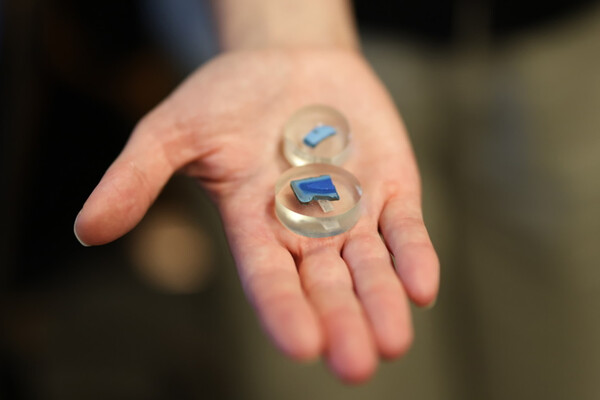
Penn researchers Vanessa and Alexis North are studying one of the largest collections of Egyptian blue objects ever found in the ancient Near East, shedding new light on how the world’s first synthetic pigment may have traveled far beyond Egypt.
A new role for dental providers? Rethinking where vaccines are given
Vaccinations have traditionally been administered in primary care settings or pharmacies. However, for about a decade, some states have authorized dentists to administer vaccines, and many others did so during the COVID-19 pandemic. The effectiveness of this approach has led some countries and states to expand or consider expanding the role of dental providers in delivering routine vaccines, including those against COVID-19 and the human papillomavirus (HPV), and in providing vaccine education.
Penn student develops a way for computer chips to run more efficiently
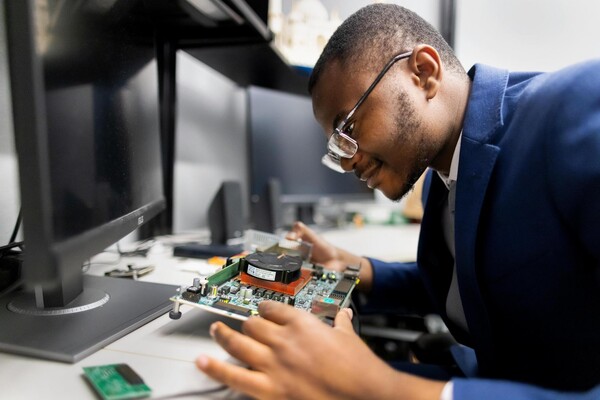
Fluid Silicon, a platform from President’s Sustainability Prize winner Nhlanhla Mavuso, allows computer chips to continuously monitor their health and self-tune as their characteristics change. The technology has the potential to reduce energy usage in data centers and improve reliability in mission-critical applications.