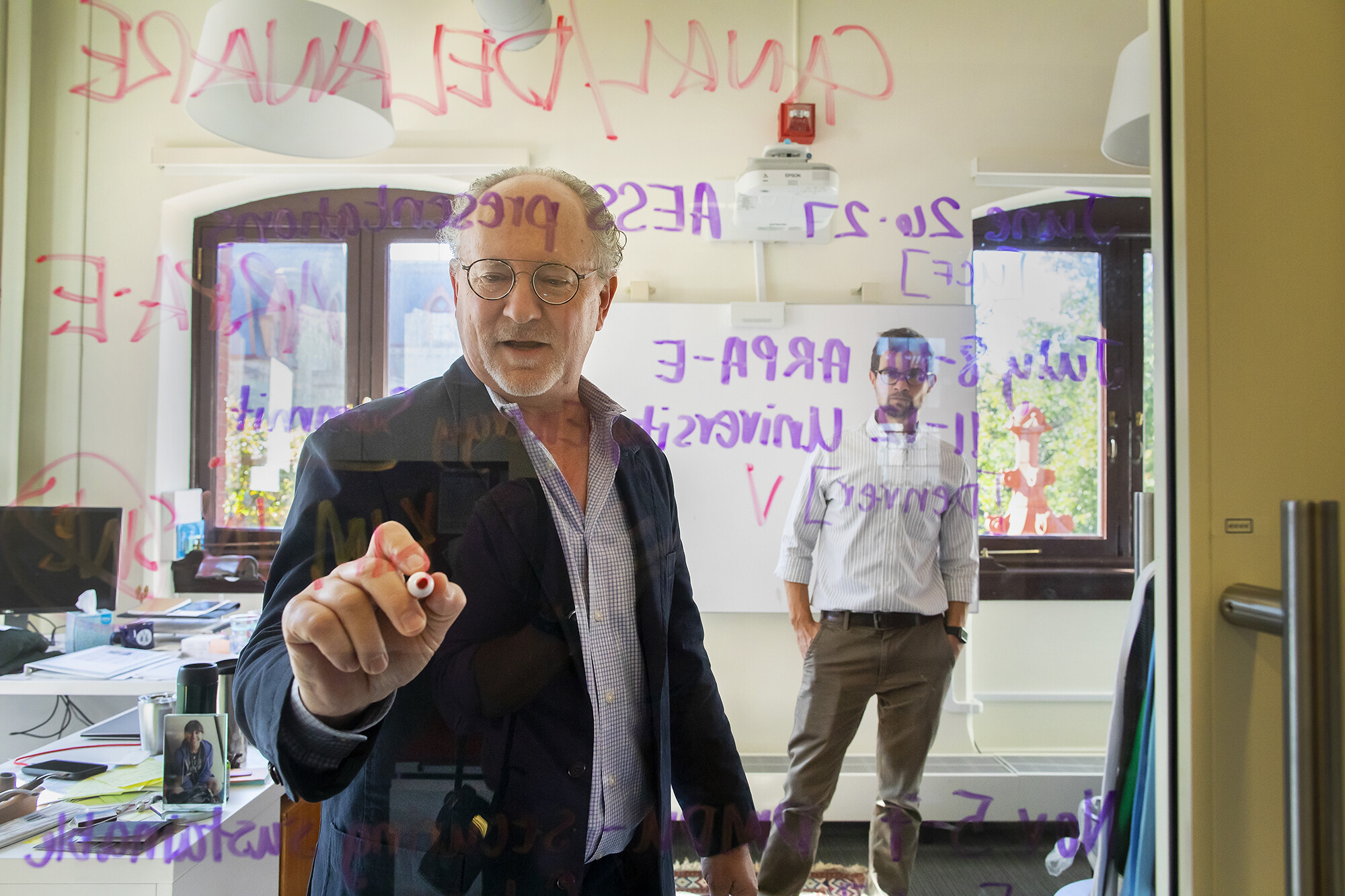
During two decades at Penn, Mark Alan Hughes has made the University a leader in the field of energy policy—and he’s showing no signs of slowing down.
Today Mark Alan Hughes (center) runs the Kleinman Center for Energy Policy. But during his tenure at Penn, he also helped found the Fels Policy Research Initiative. He was Penn’s lead investigator for the $150 million Energy Efficient Buildings Hub at the Philadelphia Navy Yard. He’s part of the Penn Institute for Urban Research, the Robert A. Fox Leadership Program, and Wharton’s Initiative for Global Environmental Leadership, and he’s a professor of practice in the Stuart Weitzman School of Design, where he teaches classes and mentors students.
After a late-June explosion and five-alarm fire in one of the operating units at the Philadelphia Energy Solutions (PES) refinery, Mayor Jim Kenney convened four committees to help the city figure out the future of PES and its effect on the economy, environment, public health, and safety. Penn’s Mark Alan Hughes was asked to lead the environment-focused group.
Nine months earlier, under Hughes’ leadership, the Kleinman Center for Energy Policy had published a report about the challenges PES was facing, including the likelihood of the refinery going bankrupt—again. The findings were prescient.
In June, the Philadelphia Energy Solutions (PES) refinery experienced an explosion and five-alarm fire. Hughes was asked by Mayor Kenney to lead the environment-focused committee, one of four aimed at helping the city figure out the future of PES after the incident. (Image: Library of Congress)
“A month after the fire, PES declared bankruptcy and began shutting down the refinery,” says Hughes, founding faculty director of the Kleinman Center. “Now the question is about the city’s power, its jurisdiction on this issue, and what its position should be about what happened.” To help crystallize some answers, Hughes organized a public meeting at a charter school near the refinery site.
Five Penn faculty gave public comments, including Cary Coglianese from the Law School, Nadine Gruhn from the Chemistry department in the School of Arts and Sciences, and Frederick Steiner, dean of the Stuart Weitzman School of Design. The Penn representatives spoke from personal experience, engaging in open conversation with the laid-off union workers and PES neighbors—the very people for whom the fire and shutdown would have the most direct consequences. Though the faculty had different areas of expertise and backgrounds, they united over a shared goal of helping inform how the city might proceed in the aftermath of the incident, no doubt spurred by Hughes’ quiet enthusiasm and fervor for all-things energy.
Such excitement has permeated all of Hughes’ endeavors during his tenure at Penn—and there have been quite a few.
For the past five years, he has run the Kleinman Center alongside Executive Director Cornelia Colijn. Hughes was the founding faculty director of the Fels Policy Research Initiative and was Penn’s lead investigator for the $150 million Energy Efficient Buildings Hub at the Philadelphia Navy Yard. He’s part of the Penn Institute for Urban Research (Penn IUR), the Robert A. Fox Leadership Program,and Wharton’s Initiative for Global Environmental Leadership, as well as a professor of practice in the Weitzman School, where he teaches classes and mentors students. For the past 20 years, he’s only stepped away from Penn for a brief time to begin architecture school and for a stint as the first-ever Director of Sustainability for the City of Philadelphia.
Mark Alan Hughes is founding faculty director of the Kleinman Center for Energy Policy and a professor of practice in the Stuart Weitzman School of Design.
“You might call him Mr. Energy,” says Eugenie Birch, Penn IUR co-director and a Weitzman School colleague, “not just for what he’s doing at the Kleinman Center, but because of his very high levels of energy.”
A piece of serendipity
Hughes hasn’t always been so laser-focused on energy policy. After graduating from Swarthmore in 1981, he started a graduate degree at Columbia. “I totally fell in love with my urban theory professor,” he says. “She was introducing me to all these ideas that made me want to pursue academia, to study urban studies, urban planning.” So, he applied to three programs in the field, one of which was at Penn.
At the time, the University had a department called Regional Science in the School of Arts and Sciences, and after an accidental mailroom mishap, his application ended up on the desk of that department’s then-chair, the late Ronald Miller. He called up Hughes and gave him the hard sell: “He said, ‘I know you didn’t apply to Regional Science, but can I tell you a little bit about it?’” Hughes explains. “One thing led to the next and out of nowhere, that’s where I went for my Ph.D. studies. Everything that happened after that happened because of that piece of serendipity.”
The Regional Studies department, which no longer exists today, turned out to be the perfect place for Hughes, with its combination of economics, geography, planning, and problem-solving. “It was a very empowering degree,” he says, leading him to his first teaching job at Princeton University at age 25. There, he connected with another young assistant professor named John DiIulio.
It is now an understatement to refer to climate change as the challenge of a generation. It’s the challenge of the species.
Mark Alan Hughes
“We met in 1986,” says DiIulio, the Frederic Fox Leadership Professor of Politics, Religion, and Civil Society in Penn’s Political Science department. “He was a brilliant young urban geographer and policy analyst. We both taught the core [master’s] public management course and several seminars together.” Since then, they’ve worked side by side many times, including at the Brookings Institution and of course, at Penn. “We’ve co-taught some classes here,” DiIulio says. “Our families have remained close for all these years.”
Around the time when the two reunited at Penn, Hughes began honing his writing chops as a columnist for the Daily News. Over several years, he penned hundreds of columns, meeting many politicians in the process, including a young man named Michael Nutter, a former councilman who was running for mayor of Philadelphia.
Time away from academia
Hughes had never intended to go into politics. He’d seen and learned a lot in his side gig as a columnist covering political issues. Plus, he harbored a deep-down desire to change course, to refocus his academic pursuits.
“I decided 30 years too late that I wished I’d gone to architecture school,” he says. “My wife”—he’s married to Medha Narvekar, the University’s vice president and secretary—“said you should stop talking about it and just do it. I was going to use my 40-something time-management skills to keep up with the energy of my 20-something schoolmates.”
Hughes and his wife, Medha Narvekar, the University’s vice president and secretary, circa 1989. Both attended Swarthmore College for undergrad and Penn for their graduate degrees.
He struggled through the first year. Then came the metaphorical knock on the door, a highly impressive way out. “One of those politicians I had played with and fought with in my Daily News column called me up. He was running for mayor, he was polling fourth or fifth [at that moment], and he asked me to be his policy director,” Hughes says.
The politician was Nutter, of course, and he won the race. In 2009, Hughes became the first Director of Sustainability for the City, a position he held for a year.
“I worked extremely hard—mostly because I really wanted to come back to my native habitat,” he says. “That year in city government was a bear. The only reason I could even be the Director of Sustainability was because I had learned so much in architecture school.” When he returned to Penn, his faculty appointment shifted from the School of Arts and Sciences to what was then called the School of Design.
An energy policy center emerges
It was from that position in what is now the Weitzman School that Hughes took another life-altering phone call, much like those he’d previously had from Nutter’s office and from the Regional Science chair, Ron Miller. This call came from alumnus Scott Kleinman and his wife Wendy Kleinman; they wanted to give a $10 million gift to Penn to start a center focused on energy policy.
That it should live in a design school made sense to Hughes. “The logic is so compelling. Much of what we know about sustainability comes out of design practices and disciplines,” he says. “Resource conservation and how you build a building have huge energy implications. Many of the fundamental ideas about energy efficiency come out of design and then get applied to areas like transportation. Design, both as a set of problems and as a way of thinking, is the perfect home for energy policy.”
The Kleinman Center for Energy Policy began in 2014 with an initial five-year gift. From the outset Colijn and several others joined the team, forming a core group dedicated to making the center the expert voice on energy policy. (Hughes takes pride in the fact that so far, there’s been zero turnover on the team.) The Kleinman Center is already making its mark.
To date, Kleinman staff and collaborators have produced around 85 policy digests and nearly 200 blog posts. The Center’s annual Carnot Prize has gone to such industry heavyweights as former Environmental Protection Agency head Gina McCarthy and International Energy Agency (IEA) Executive Director Fatih Birol, the latter of whom has since offered a competitive fellowship for Penn undergrads. And the report Kleinman put out on the PES refinery became the go-to resource after the June incident, getting cited over and over.
Taking an ‘expansive view’
Beyond that, Kleinman funds a whole host of research each year, for students and for faculty like Eugenie Birch, who this summer began a project about informal electricity distribution in Accra, Ghana.
“About 40% of the population [there] lives in informal settlements. They don’t have formal electricity,” Birch says. “The question I’m trying to answer is, how can you re-manage the electricity of that service to people who are low-income and who the city hasn’t extended services to?” It may not be typically what falls under the purview of “energy policy,” but Birch attributes such a broad perspective to Hughes. “Mark has an expansive view of what we need to be thinking about worldwide,” she says.
It’s something Coglianese also experienced when he was embarking on a major research project looking at regulatory excellence and energy in Canada. “Several Kleinman staff ventured out with us to Calgary to help facilitate a multi-stakeholder dialogue session,” recalls Coglianese, who teaches in the Law School and directs the Penn Program on Regulation. Thanks in part to the Kleinman Center boost, Coglianese’s team was selected to run the $1.2 million project.
Since that initial collaboration, he has stayed in close contact with the center, moderating panels and providing commentary on several episodes of its podcast, “Energy Policy Now.” Much like Birch, he attributes the forward momentum and impact of the center to Hughes’ creative thinking. “The best story that anyone can tell about Mark right now—and it’s one that’s still unfolding in wonderfully positive directions—is about the Kleinman Center,” Coglianese says. “He took it from a germ of an idea into one of the major research and policy programs on energy in the country.”
A twofold case in point: For the first time, Penn received observer status for the upcoming United Nations Climate Change Conference in Santiago, Chile, in December. Hughes and colleagues at Penn Global led the push for that position, which gives Penn a seat at the table at the biggest energy-related event in the world. Secondly, this past April, the Kleinman Center received an anonymous $30 million gift to continue its work well into the future.
“In the first five years, it was about becoming a place, developing programs, and proving concepts,” Hughes says, “motivated by a growing momentum around a larger set of ideas. We’ve always been great advocates for expanding Penn’s already strong presence in energy science and technology, because good work in energy policy research and energy policymaking builds on good science and technology. We can’t be influential without access to that very science.”
The path forward
Though Hughes doesn’t know what the energy future holds, he does have big plans for continuing to amplify Penn’s voice in this arena. As part of its renewal, the Kleinman Center will hire three senior faculty to work specifically on energy policy. Plus, Hughes’ team is creating new internships along the lines of the IEA program, one intended for someone with legal and regulatory interests, a second for someone more science- and engineering-oriented.
“It is now an understatement to refer to climate change as the challenge of a generation. It’s the challenge of the species,” Hughes says. “There are a lot of ways in, and energy is a big one. These issues are in demand as far as the eye can see.”
The Fisher Fine Arts Library (above) houses the Kleinman Center for Energy Policy, which, last April, received an anonymous $30 million gift to continue its work well into the future.
To that end, Hughes and Karen Goldberg from the Chemistry department are spearheading the first-ever Energy Week at Penn. (See the sidebar for upcoming events and more details.) It starts on Monday, Oct. 21, and will include the awarding of Kleinman’s annual Carnot Prize, the Wharton Energy Conference, and more, aimed at showcasing the depth and breadth of what Penn has to add to this conversation. To Elise Harrington, a former student of Hughes’ and a Penn alumna, such a conference fits with what she’s learned about her mentor over the past eight years.
“I owe a lot of my interest in energy issues to Mark. He is not afraid to embrace a little of the uncertainty about the energy future or to explore different options with smart, critical actors in the room,” says Harrington, a fifth-year doctoral student at MIT. “I’ve seen that continue in a lot of the Kleinman work, offering a space where people can have conversations that lead to critical action in Philadelphia and elsewhere.”
That’s what happened after the PES refinery explosion and fire. Though the conversations weren’t physically in the Kleinman space at Fisher Fine Arts Library, many were guided by Kleinman Center research and by Hughes himself. Given the level of public interest in what happens at the refinery site, as well as the ongoing investigations, it’s likely such conversations will continue for the foreseeable future.
And that’s OK with Hughes. “It’s really a model of engagement, a way of learning,” he says. “It is a way of having impact, of teaching at the broadest scale. For us to connect our work with real problems, not just around the corner but around the globe, it really is a natural for Ben Franklin’s university.”
Hughes (second from left) with the Kleinman Center team, including from left to right, Angela Pachon, Bill Cohen, Mollie Simon, Cornelia Colijn, and Kimberle Szczurowski.
Elise Harrington is a doctoral student in Urban Studies and Planning at Massachusetts Institute of Technology. She earned her undergraduate degree from the University of Pennsylvania.
On the move: Water quality and antimicrobial resistance testing goes mobile
Penn researchers have developed a mobile field laboratory allowing them to test water quality and track antimicrobial resistance in and around San Cristóbal in the Galápagos.
Penn researchers Vanessa and Alexis North are studying one of the largest collections of Egyptian blue objects ever found in the ancient Near East, shedding new light on how the world’s first synthetic pigment may have traveled far beyond Egypt.
A new role for dental providers? Rethinking where vaccines are given
Vaccinations have traditionally been administered in primary care settings or pharmacies. However, for about a decade, some states have authorized dentists to administer vaccines, and many others did so during the COVID-19 pandemic. The effectiveness of this approach has led some countries and states to expand or consider expanding the role of dental providers in delivering routine vaccines, including those against COVID-19 and the human papillomavirus (HPV), and in providing vaccine education.
Penn student develops a way for computer chips to run more efficiently
Fluid Silicon, a platform from President’s Sustainability Prize winner Nhlanhla Mavuso, allows computer chips to continuously monitor their health and self-tune as their characteristics change. The technology has the potential to reduce energy usage in data centers and improve reliability in mission-critical applications.