Geospatial data has long been an important tool for scientists and scholars, but now, as society grapples with both coronavirus and a history of systemic racism, can maps help chart a path toward a brighter future?
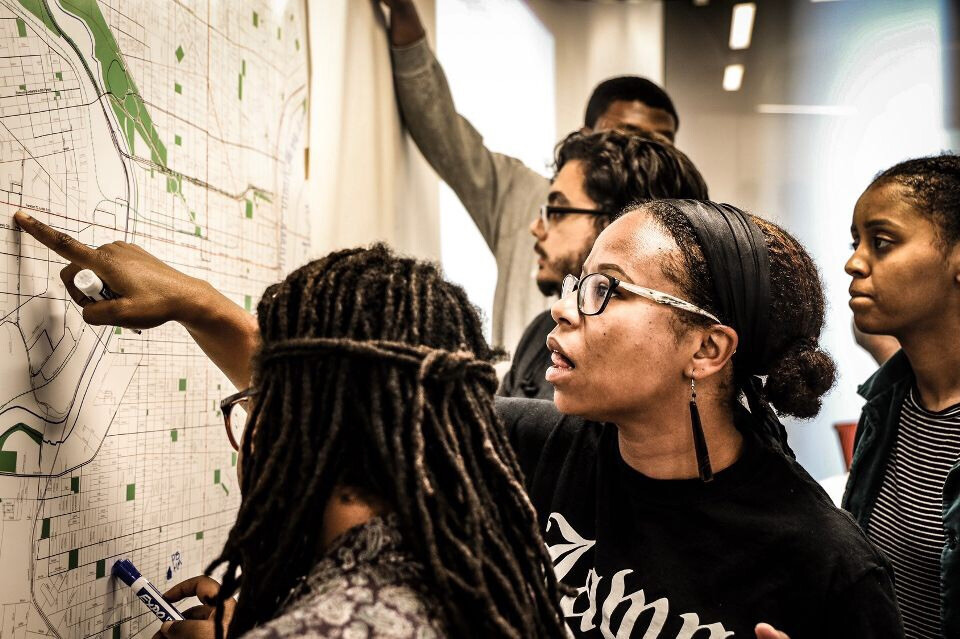
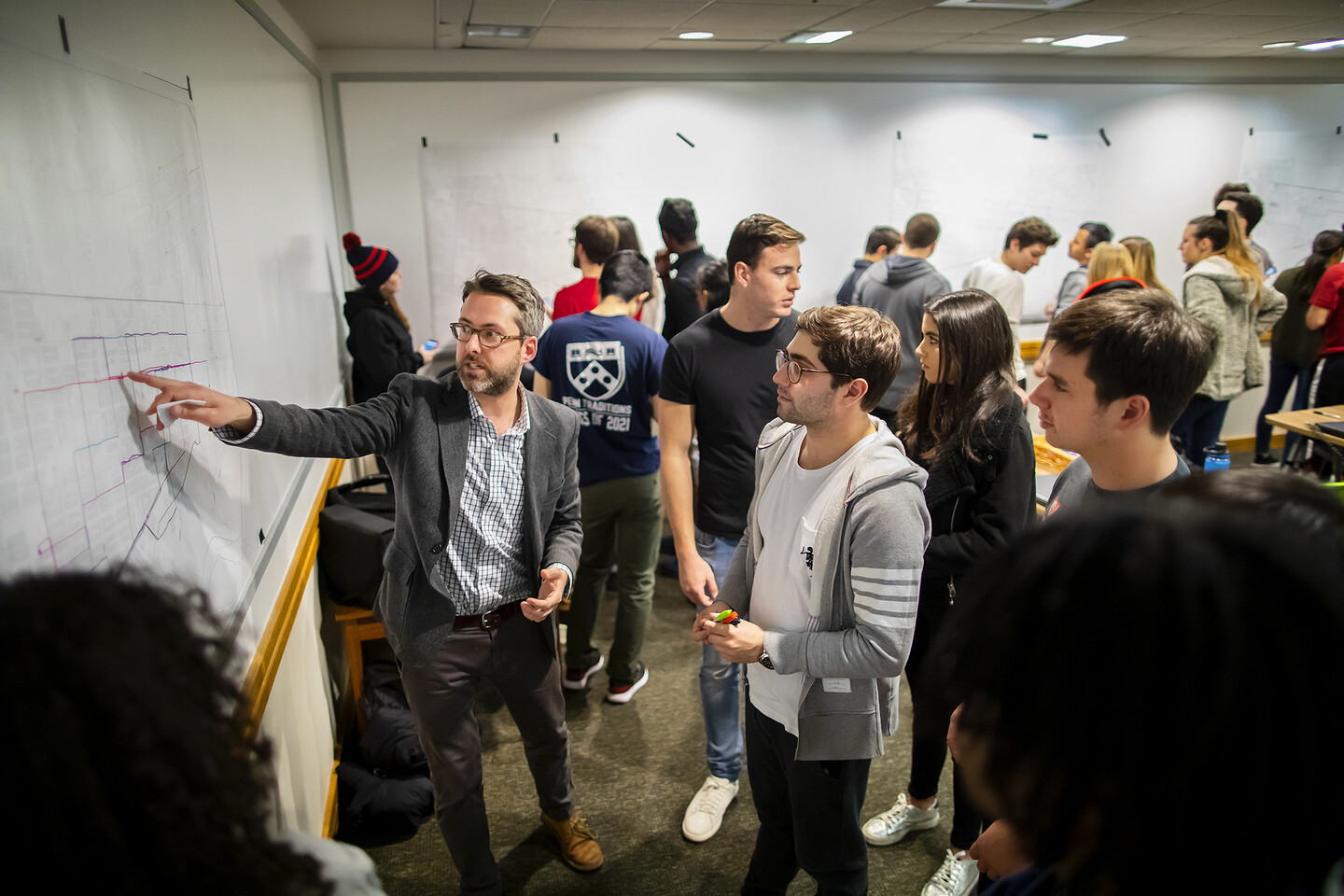
(Pre-pandemic image) Students participating in July 2019’s Map Room event for Krystal Strong’s Re/Member Black Philadelphia Project, which brought students from Penn and the School District of Philadelphia to talk about maps, resource disparity, and Philadelphia. The workshop was taught by Digital Scholarship Librarian Jennifer Garcon and Mapping & Geospatial Data Librarian Girmaye Misgna. (Image: Marc Holley)
With COVID-19 dashboards a regular feature of news reports and mitigation strategies, the coronavirus pandemic is a living example of the significance of maps and geospatial data. As the country grapples with coronavirus while also reckoning with its history of inequality and systemic racism, can maps be more than tools for tracking coronavirus cases? Could maps also help societies chart a path toward a better future?
Mapmaking fundamentals
More than 170 years after Snow’s famous cholera study, Mapping & Geospatial Data Librarian Girmaye Misgna says that maps have become even more powerful thanks to advances in data science and geographic information systems (GIS). “When it comes to COVID, the map has become a very important part of numerous activities: Capacity and resource management as well as tracking the movement of the virus and where it’s concentrated,” he says.
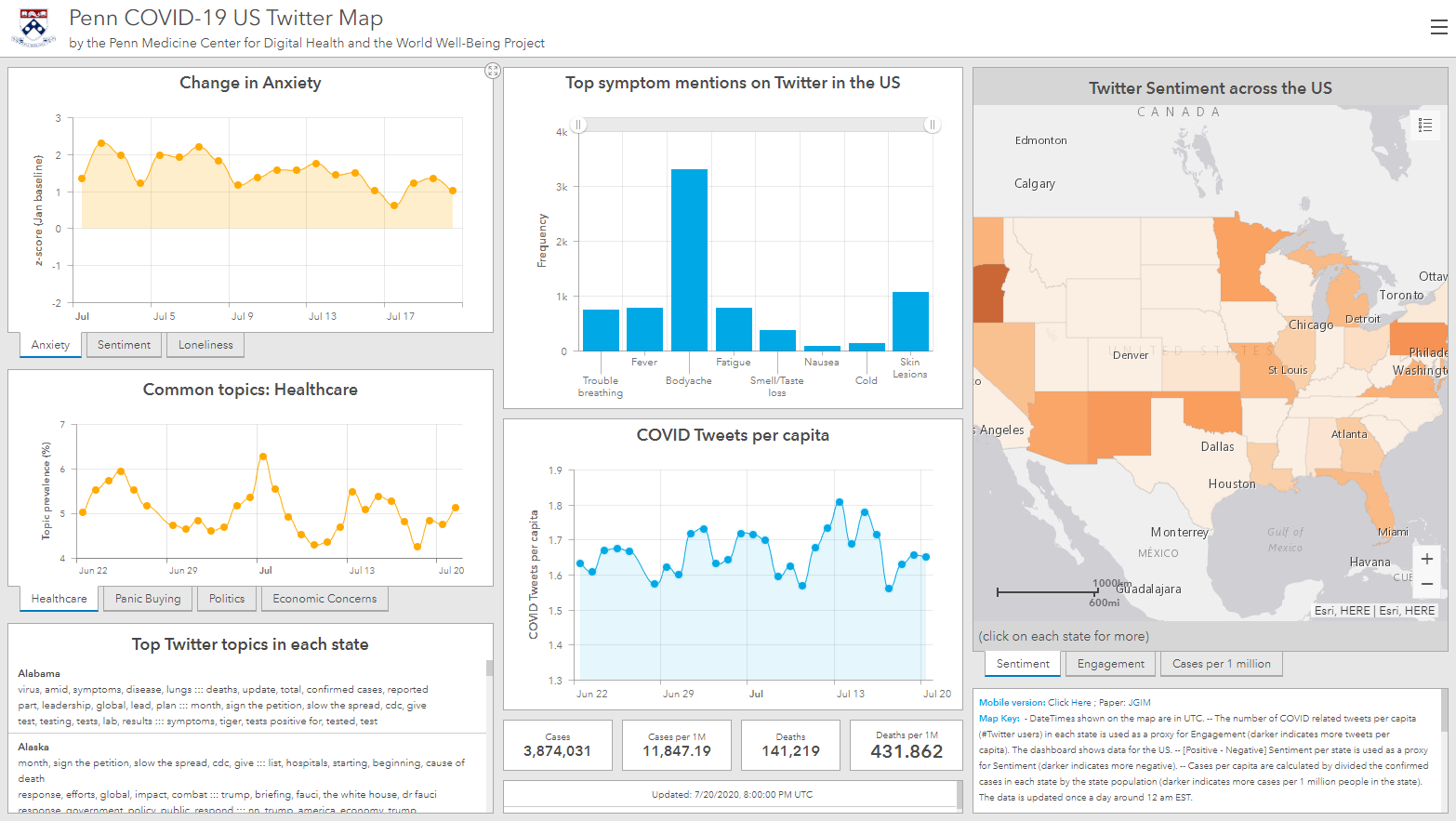
The Penn COVID-19 Twitter map looks for shifts in language that can indicate public perception of the ongoing pandemic. The tool is meant to help doctors and public health officials determine the both severity of an outbreak in a given location, as well as how people are reacting to increases in cases. (Image: Penn Center for Digital Health)
Misgna and his team support research and scholarly activities at Penn that incorporate maps and spatial data, and often his team’s first step is to help the students, faculty, and staff they work with to understand the process of creating a map, not just to focus on what the map will look like. “The main problem with GIS is, first, where to find the data, in what form, and how do you manage it in a way that would be available for your research,” explains Misgna.
“Making critical thinking and digital literacy a key part of any digital project collaboration is central to our work in the Center for Research Data and Digital Scholarship,” says Nicky Agate, Snyder-Granader Assistant University Librarian for Research Data and Digital Scholarship. “Decontextualized data can be dangerous, and Girmaye and the other members of the team help students learn to ask questions about data provenance (where it came from), as well as who gathered it and why so that they can not only approach digital storytelling in a more ethical way, but also learn to read maps, infographics, and other forms of data visualization with a more critical eye.”
RELATED
Ken Steif, program director of Master of Urban Spatial Analytics (MUSA), also emphasizes the importance of process over final product, especially in instances where maps are going to be used to make decisions or manage resources, such as PPE or food aid. “Fifteen years ago, if you could use a computer to put some points on a map, that was very employable. Now, it’s about converting data to a decision-making analytic, and that is really difficult,” says Steif. “There’s a tremendous amount of data, and it is my mission to help organizations, particularly governments, think about how to use maps to better align resource supply and demand.”
GIS and the fight against COVID-19
As the pandemic continues across the country, maps are an important tool for policymakers, not only to control the spread of the virus but also to better understand and alleviate its many wide-ranging impacts. Collating and visualizing this “small area data,” explains Dennis Culhane, is crucial for planners, public health organizations, and social welfare professionals who need to prioritize resources. “The first order of business is compiling data, especially geospatial data, that would enable you to target your efforts,” he explains.
In collaboration with Penn’s Center for High Impact Philanthropy, Culhane, an expert in homelessness and housing policy, and Steif combined geospatial data with indicators of need to create an online assessment tool that helps charitable foundations see what communities, organizations, or businesses are in most need of financial support. They also developed a web-based interface of maps to help communities allocate resources for homeless populations, which they projected back in March would be significantly impacted by coronavirus.
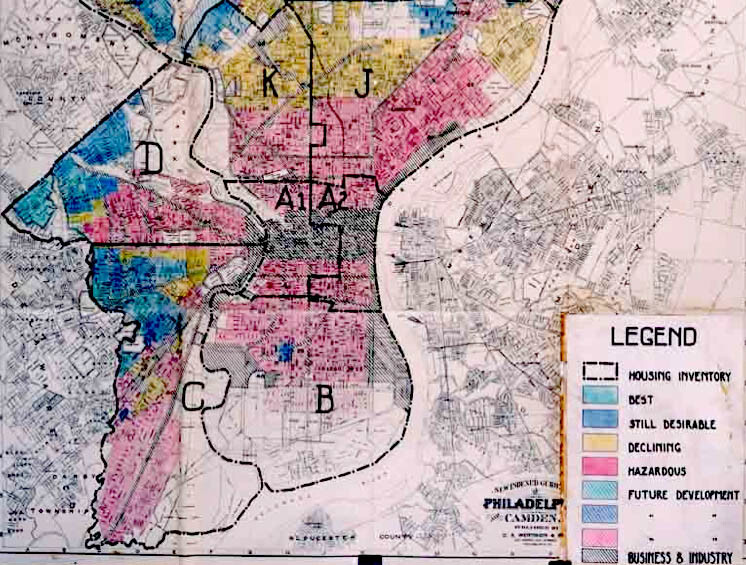
A 1936 HOLC “residential security” map of Philadelphia, classifying various neighborhoods by estimated riskiness of mortgage loans. Redlined neighborhoods included areas around downtown as well as sections of West and South Philadelphia, where the Black population was significantly higher.
Back at the Mapping and GIS library, Misgna’s team worked with computer scientist Lyle Ungar on the COVID-19 Twitter map, which provides health care workers with a region’s mental state. Now, Misgna is collaborating with Carmen Guerra to see if there is a relationship between COVID-19 infections and the history of redlining.
When COVID-19’s disparate impacts on African American and Latinx populations were first reported, Guerra wanted to understand why there were not only more fatalities but also higher case numbers in general. “I learned about how the social determinants of health were contributing: The type of employment, having to brave public transport, but the one that caught my eye was housing,” explains Guerra. “While we understand socioeconomic status and its impact on health, we don’t understand redlining and the legacy it left behind.”
The project is still in the early phases, but Guerra’s hope is that these maps can help inform public policies, such as having “COVID hotels” for people exposed to COVID-19 who live in shared housing to isolate if they test positive or providing free PPE on public transport. “If we can identify some of the reasons why people have greater exposure, there will be things that we can have a policy influence or medical intervention ready for,” says Guerra.
Maps appear to have a scientific reality, but maps are the product of political struggles, they have a history, and they serve certain functions.
Stewart Varner, managing director of the Price Lab for Digital Humanities
Combining coronavirus data with other demographic datasets is lecturer Mahir Yavuz, whose company Topos is making COVID-19 data accessible and interpretable with the COVID compiler. “We wanted to bring transparency, a tool that is easy to understand,” says Yavuz. “Most people see this as a daily dashboard, where they can check numbers in their area or where their family lives.” Interactive maps display COVID-19 cases alongside demographic data, such as age, race, income, and the presence of comorbidities, and the website also publishes detailed insights, such as correlations between COVID cases and income tax data, the locations of nursing homes, meat processing plans, and prisons, and graphs of case number changes after states reopened.
More than just a polygon
Beyond their use as tools for planners, health care professionals, and everyday citizens, maps themselves are also complex entities—far more than a simple chart with dots or numbers. “Every geography is just a polygon, but it also has culture, history, and people,” says Yavuz.
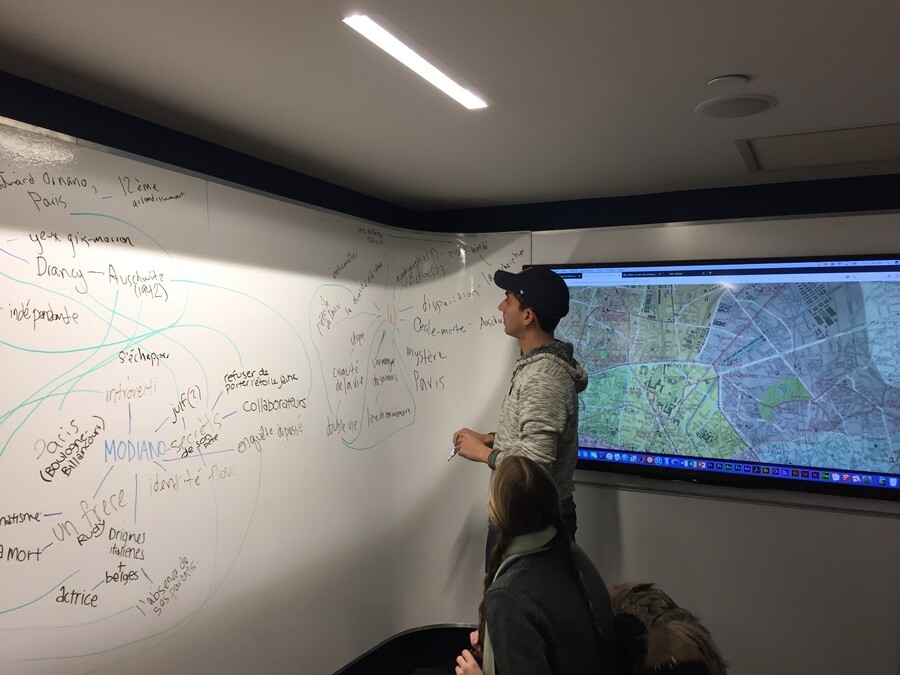
(Pre-pandemic image) A student in Mélanie Péron's "Mapping Paris during the German Occupation" course, a project which also includes 360° video. Other Price Lab projects focused on mapping and geospatial data include mapping urban renewal in Society Hill. (Image: Vickie Karasic)
“Maps appear to have a scientific reality, but maps are the product of political struggles, they have a history, and they serve certain functions,” says Stewart Varner, managing director of the Price Lab for Digital Humanities, a center that supports innovative uses of technology for history, art, and culture. “The humanities are particularly good at being thoughtful about those kinds of things, because it isn’t just about how the map functions, it’s also what histories you want to represent.”
Amy Hillier, a social work scholar who teaches introductory level GIS for social scientists and urban studies students, also emphasizes the importance of critical geography, with key questions that need to be asked, including how the existing narrative was constructed and who created the data. She says that while many students are interested in using and making maps, it’s important for them to understand all of the history that goes into one. “GIS privileges the visual, it pulls you in, but it can be deceptive because there can be a lot of complexity. The idea of what argument can you make with your map—that comes out of critical geography,” says Hillier.
(Pre-pandemic image) Brent Cebul’s “The Transformations of Urban America” course incorporates mapping exercises to help students trace the fall and rise of American cities through the lens of sociology and ethnography. (Image: Eric Sucar)
As an urban historian, Brent Cebul says that maps, while especially useful at providing a broader perspective of historical events that traditional archival research might not capture, are still socially constructed and biased. “Maps have a way of making human phenomenon seem too rationalized and, in that way, making it easy to forget the human element that comes into play,” he says. “In my teaching, I try to lend a bit of humility to what we think of as, ‘This will get me from point A to point B, this is simply the way the world is’—that’s really a proposition to be interrogated rather that presumed.”
Charting a path forward
Perhaps because of their inherent complexity, maps could also be uniquely positioned to shed light on other issues that are equally complicated, such as the ongoing struggles in the United States to both combat the spread of COVID-19 alongside renewed calls to action against structural racism and inequality. “Maps will put it in your face,” says Hillier. “I feel like now we have a window where people are willing to accept that there are inequalities. I don’t think it’s just because of COVID or just because of maps, but I do think people are willing to see systems in new ways.”
“There’s always an ability to see inequities, but there hasn’t been this level interest in equity. I think that veil has been removed by the George Floyd video,” says Guerra. By combining data visualizations, such as the COVID-19 and redlining project, with the many personal stories that are being shared and amplified at this time, she hopes to both quantify and address these inequities while also sharing them in a way that people can connect strongly with. “Human beings are motivated by and receptive to stories—I can show them a lot of data, but to actually hear the stories with that is very powerful,” adds Guerra.
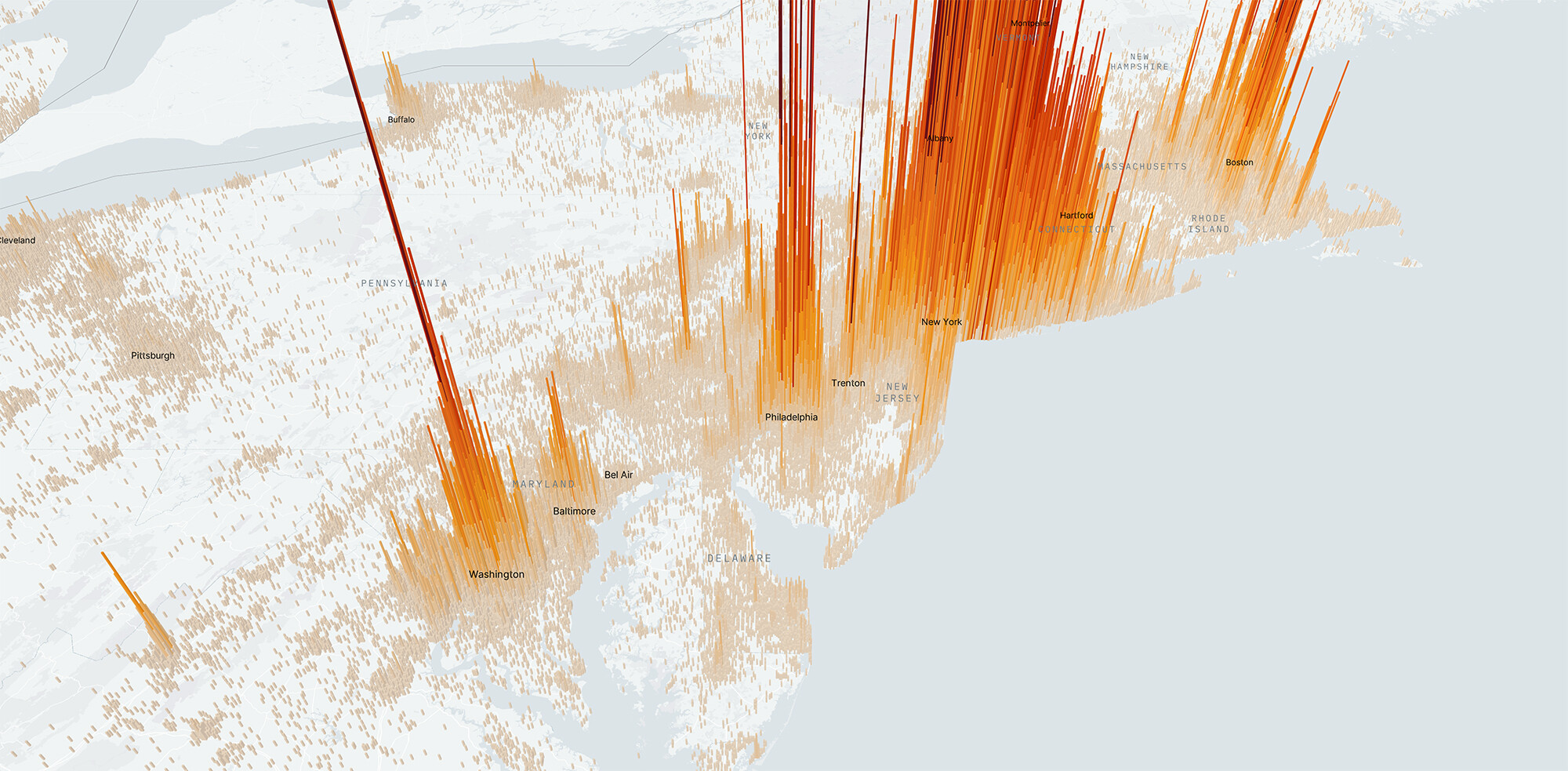
“Maps have a power on individuals to understand what’s happening around us, because maps are very intuitive. If we see on a map, we can see clearly what’s actually happening,” says Yavuz. Here, population weighted COVID-19 cases along the I-95 corridor provide a more accurate depiction of how concentrated cases are than a county-based map can achieve. (Imaget: COVID-19 compiler/Topos)
Cebul says that while maps aren’t enough on their own to gain a deep understanding of a situation, they are often a good starting point because of their accessibility to new audiences—something he’s seen firsthand while working as a postdoc on the “Mapping Inequality” project. “Maps do contain the power to change politics and outcomes, but it’s part of a longer process of consciousness raising and teaching,” he says.
Both Cebul and Varner emphasize the importance of qualitative understanding, looking beyond numbers and statistics to gain insights into an event or phenomenon. Varner adds that while many of the modern mapmaking tools used in the Price Lab were initially designed with the natural sciences in mind, he hopes that scientists in the future will take this time and this opportunity to incorporate learnings from scholars in other fields. “Just as the humanities can learn a lot from the sciences, science has a lot to learn from the humanities about ways of being thoughtful about data creation and data organization,” says Varner.
Additional progress that could be supported with the help of maps, whether it’s “reverse redlining” or reparations programs, is possible, says Culhane, but still requires a cultural shift. As the faculty co-director of the Center for Actionable Intelligence for Social Policy, Culhane says that while there has been progress in using maps and geospatial analyses for decision-making, there are still legal and organizational challenges that need to be addressed. “Creating that ethos is the most important part, because there’s so many fears about data. People need advice on how to do this securely and in an environment of mutual trust and collaboration,” says Culhane. “But once you put that framework in place, governments can collaborate at a speed that was heretofore not possible.”
I think the entire world became an expert of numbers and dashboards and maps during COVID, and I feel like that is there to stay.
Mahir Yavuz, lecturer in the Weitzman School of Design
Continued improvements in technology, increased access to large datasets, and continued open source data movements will also continue to shape the role that maps and GIS data play in the future, perhaps even allowing researchers to track the spread of COVID-19 using data in real time. “These tools have been very sophisticated and powerful, and web-based maps have allowed for wide distribution and awareness,” says Misgna.
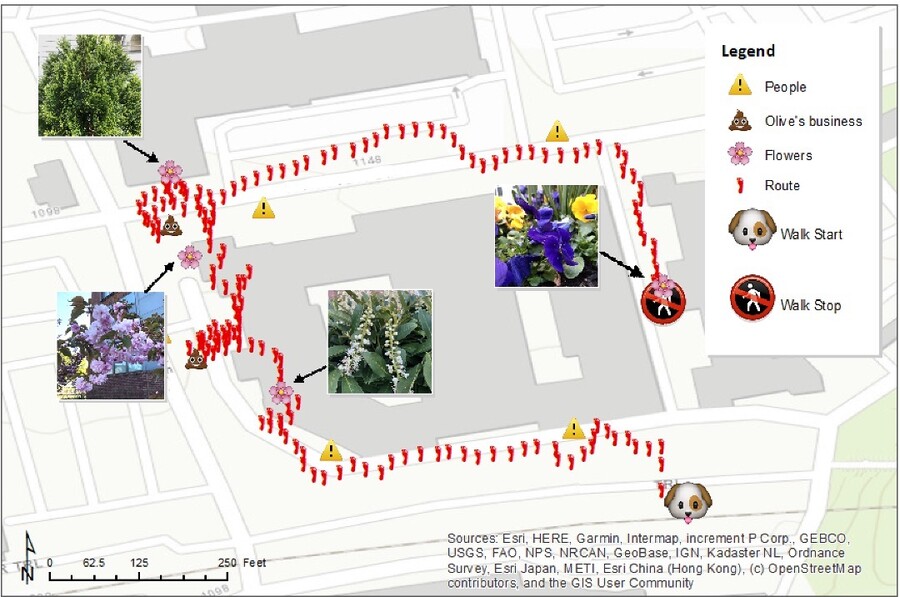
SP2 social policy student Juliana Zhou used GPS to document the daily walk with her dog during the early days of quarantining under COVID-19, making a point to avoid as many people as possible while still allowing her dog to stop and smell the flowers. (Image credit: Juliana Zhou)
But to take full advantage of technological improvements, especially with a tightening of government budgets in the future, Steif emphasizes that it will be crucial to have skilled people that are able to turn geospatial data into actionable intelligence. “In crisis modes, like delivering PPE or WiFi, that’s not a technology product, that’s a process—something that requires a tremendous amount of domain expertise. My hope is that there will continue to be some buy-in to growing these human capital resources in-house,” he says.
“I think the entire world became an expert of numbers and dashboards and maps during COVID, and I feel like that is there to stay,” says Yavuz. “I think there will be a lot of innovation and new ways of visualizing global or local-level data on maps, and open source code and techniques holds great potential for the future of data science and GIS technologies.”
Homepage image: (Pre-pandemic image) Students in Brent Cebul’s “Transformation of Urban America” class annotate maps of Philadelphia. The course is designed to help students trace the fall and rise of American cities using walking tours, historical records, and maps. (Image: Eric Sucar)
On the move: Water quality and antimicrobial resistance testing goes mobile
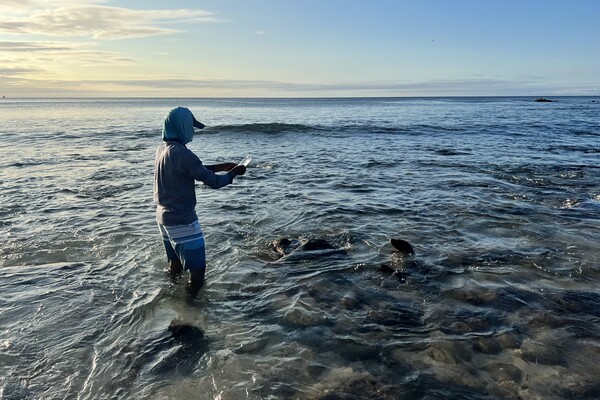
Penn researchers have developed a mobile field laboratory allowing them to test water quality and track antimicrobial resistance in and around San Cristóbal in the Galápagos.
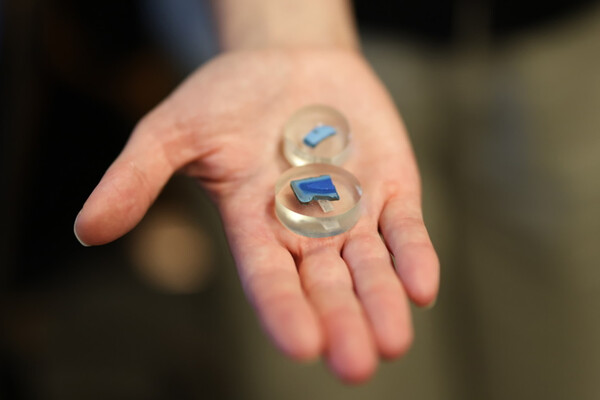
Penn researchers Vanessa and Alexis North are studying one of the largest collections of Egyptian blue objects ever found in the ancient Near East, shedding new light on how the world’s first synthetic pigment may have traveled far beyond Egypt.
A new role for dental providers? Rethinking where vaccines are given
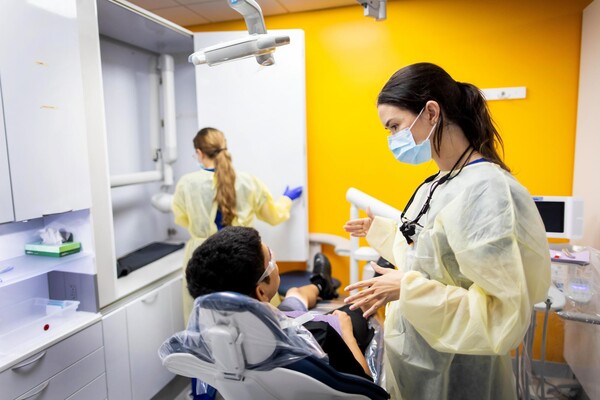
Vaccinations have traditionally been administered in primary care settings or pharmacies. However, for about a decade, some states have authorized dentists to administer vaccines, and many others did so during the COVID-19 pandemic. The effectiveness of this approach has led some countries and states to expand or consider expanding the role of dental providers in delivering routine vaccines, including those against COVID-19 and the human papillomavirus (HPV), and in providing vaccine education.
Penn student develops a way for computer chips to run more efficiently
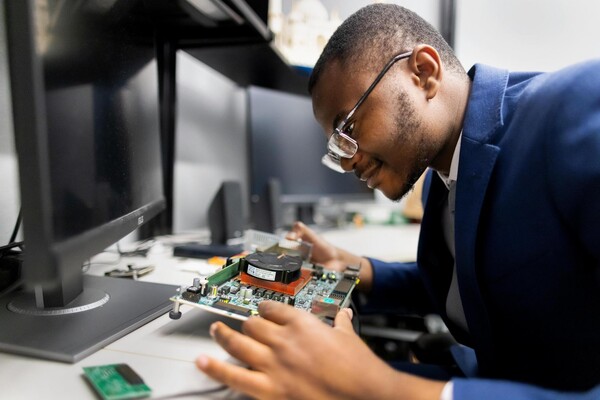
Fluid Silicon, a platform from President’s Sustainability Prize winner Nhlanhla Mavuso, allows computer chips to continuously monitor their health and self-tune as their characteristics change. The technology has the potential to reduce energy usage in data centers and improve reliability in mission-critical applications.