Identifying an elusive molecule key to combustion chemistry
Researchers made the most direct observation of a key intermediate formed during the breakdown of hydrocarbons during combustion and in the atmosphere, results that could help in the future design of fuels that burn more efficiently.
Researchers at Penn and Argonne National Laboratory have made the most direct observation of a key intermediate, a carbon-centered radical, formed during the breakdown of hydrocarbons during combustion and in the atmosphere. This benchmark study could help researchers design fuels that burn more efficiently in the future.
Researchers at the University of Pennsylvania and Argonne National Laboratory have made the most direct observation of a key intermediate formed during the breakdown of hydrocarbons in combustion and the atmosphere. Published in Science, this evidence of a carbon-centered radical could help in the future design of fuels that burn more efficiently.
Volatile organic compounds (VOCs), which are made out of carbon and hydrogen atoms and exist as gases at room temperature, include everyday fuels such as butane and gasoline, as well as natural emissions from plants and trees. When VOCs release into the atmosphere, they break down through a chemical process known as oxidation.
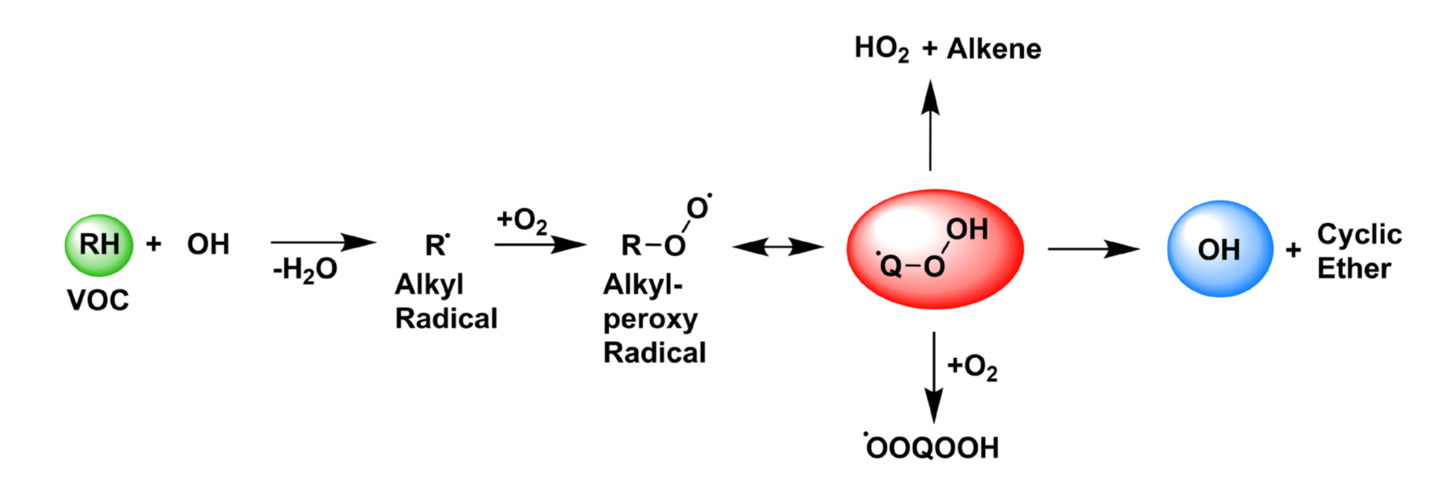
The oxidation reaction is consistent across many VOCs, but the specific chemical intermediates formed during a prototypical reaction had not been directly observed before. One such intermediate was thought to be a crucial driver in the reaction’s outcome: the formation of a carbon-centered radical called QOOH. Here, the “Q” indicates any chemical group that has a carbon atom with an highly reactive unpaired electron, and “OOH” indicates a hydroperoxide group.
While researchers had hypothesized this QOOH intermediate for many years, says Marsha I. Lester, corresponding author and Penn chemistry professor, it has been difficult to observe because it is short-lived and quickly degrades.
“This intermediate is a ‘switch yard’ controlling various subsequent steps that can happen, and those steps are really important for the propagation of this chemistry,” says Lester. “But prototypical QOOH intermediates have not been directly observed, so there were critical pieces missing about how this network of chemical reactions occurs.”
A diagram showing how the oxidation of volatile organic compounds (VOC) can consume and regenerate OH radicals. An alkyl radical (R•) reacts with oxygen to produce an alkylperoxy radical (ROO•), which undergoes an internal hydrogen shift to produce the carbon-centered hydroperoxyalkyl radical (•QOOH). This intermediate “switch yard” is a key intermediate step that controls how the reaction proceeds. (Image: Marsha Lester group)
Now, experimentalists in the Lester lab and theorists from the lab of Stephen J. Klippenstein at Argonne have published the most direct observation of QOOH to date. Using novel infrared spectroscopy lasers to collect QOOH’s “fingerprint,” advanced cooling equipment to study the reaction without condensation, and an innovative synthesis strategy, Penn postdoc Anne Hansen and graduate student Trisha Bhagde identified QOOH, tracked its degradation, and observed which chemical products formed during oxidation.
They had obtained their first signals shortly before the pandemic shutdowns began. Working through the fall, the Penn researchers realized they needed more advanced modelling techniques to explain their results. To do this, they collaborated with Argonne researchers to conduct the sophisticated calculations necessary to understand what they were seeing. Penn researchers were also able to validate these new predictions in the lab.
“We had been making predictions based on the hypothetical QOOH molecule for many years but had no idea how good they were,” says Klippenstein. “The experimental results showed they had some flaws we could fix.” The team modified its theoretical model so that prediction and experimental results now agree with great precision.
One unexpected result from the research involved discovering the role of quantum mechanical tunneling in driving this chemical reaction. “If you’re driving and you see a mountain, for example, you could create a tunnel rather than going over the mountain,” Lester says. “Typically, we anticipate tunneling for light particles, like an electron, a proton, or a hydrogen atom, but in this system it was heavy atoms, like oxygen atoms, that are tunneling. That is almost unheard of.”
These results provide important insights into understanding the chemistry around VOC oxidation more thoroughly. The Lester group will continue its work looking at QOOH’s fingerprint to help determine its presence in environmental samples. The team is also conducting experiments to see how the intermediate changes with different chemical substitutents on the carbon-centered radical.
Lester says that these findings have implications in both basic and applied sciences. Thoroughly understanding this chemistry could enable future researchers to design better fuels that burn more efficiently, a “radical” proposition as researchers across a number of fields try to address the ongoing climate crisis.
The complete author list: Anne S. Hansen, Trisha Bhagde, Michael F. Vansco, and Marsha I. Lester from the University of Pennsylvania, and Kevin B. Moore III, Daniel R. Moberg, Ahren W. Jasper, Yuri Georgievskii, and Stephen J. Klippenstein from the Argonne National Laboratory.
On the move: Water quality and antimicrobial resistance testing goes mobile
Penn researchers have developed a mobile field laboratory allowing them to test water quality and track antimicrobial resistance in and around San Cristóbal in the Galápagos.
Penn researchers Vanessa and Alexis North are studying one of the largest collections of Egyptian blue objects ever found in the ancient Near East, shedding new light on how the world’s first synthetic pigment may have traveled far beyond Egypt.
A new role for dental providers? Rethinking where vaccines are given
Vaccinations have traditionally been administered in primary care settings or pharmacies. However, for about a decade, some states have authorized dentists to administer vaccines, and many others did so during the COVID-19 pandemic. The effectiveness of this approach has led some countries and states to expand or consider expanding the role of dental providers in delivering routine vaccines, including those against COVID-19 and the human papillomavirus (HPV), and in providing vaccine education.
Penn student develops a way for computer chips to run more efficiently
Fluid Silicon, a platform from President’s Sustainability Prize winner Nhlanhla Mavuso, allows computer chips to continuously monitor their health and self-tune as their characteristics change. The technology has the potential to reduce energy usage in data centers and improve reliability in mission-critical applications.