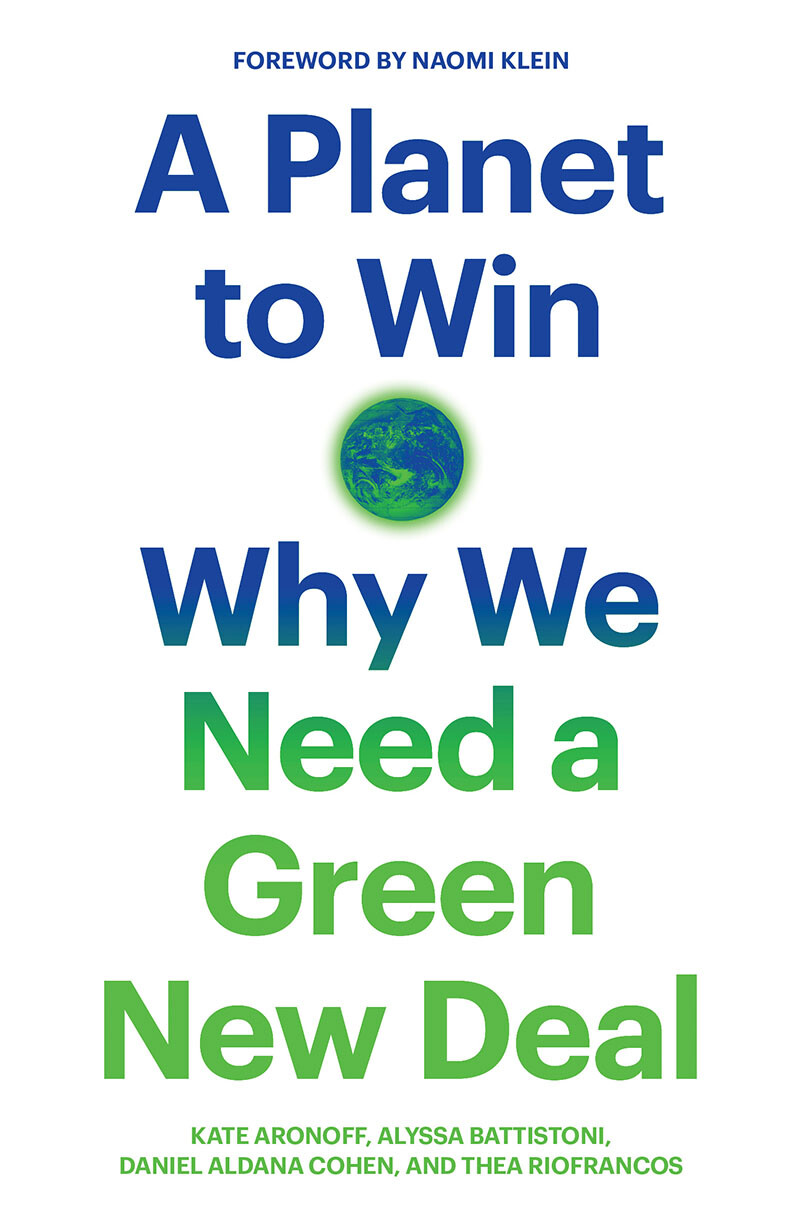
A new book from Penn sociologist Daniel Aldana Cohen and colleagues describes four key facets of the Green New Deal and why they could become a reality in the not-too-distant future.
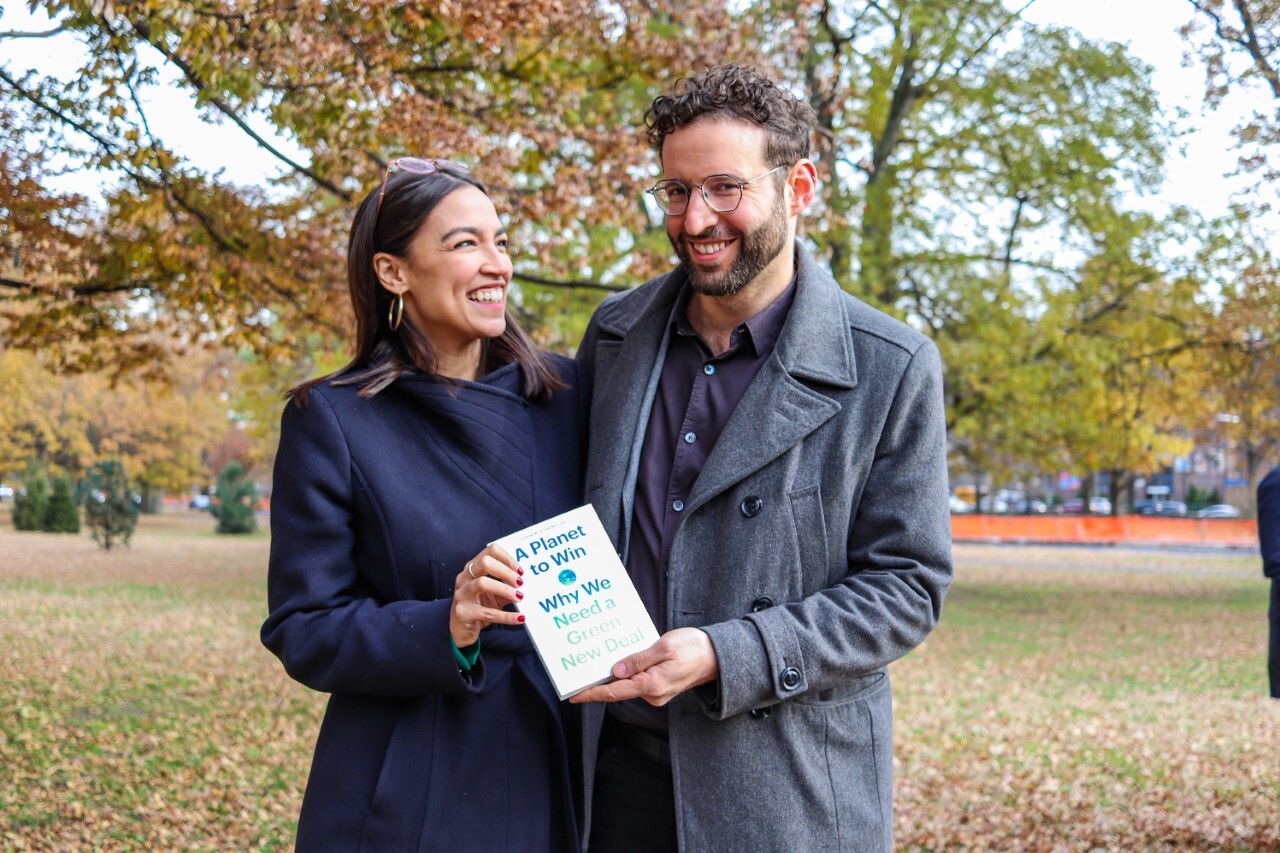
In November 2019, Cohen presented Representative Alexandria Ocasio-Cortez with a copy of the book outside the Pelham Parkway Houses in the Bronx, where they led a training on the Green New Deal for Public Housing Act. (Image: Gabriel Hernandez Solano)
Penn sociologist Daniel Aldana Cohen thinks the U.S. needs a radical Green New Deal, so much so that he and three colleagues wrote a book about it.
“The age of climate gradualism is over, and in the 21st century all politics will be climate politics,” Cohen says. “Going all-out means that no matter who wins the presidential election, there are going to be both victories and defeats. It’s just guaranteed. We’re not going to win every legislative compromise we want to win. That’s why, in a way, we need such aggressive targets because we know we’re not going to hit them all.”
“A Planet to Win” arose organically after a series of interactions made it clear that Cohen and his co-authors—Kate Aronoff from The New Republic, Alyssa Battistoni of Harvard University, and Thea Riofrancos of Providence College—all felt the same about pushing for this economic and environmental movement. Though a broad Green New Deal would hit on a vast realm of factors, the researchers opted to focus on four in their book.
The first two—nationalizing the fossil fuel industry and creating a powerful low-carbon labor movement—go hand in hand. “In contrast to a lot of market mechanisms, the only real way to stop burning fossil fuels is to reduce their extraction. Public ownership is the way to do it,” Cohen says. “Beyond that, we not only need to produce a just transition for workers in the fossil fuel industry, but we need to see green work as care work, caring for the planet and for humans.”
Cohen spearheaded the chapter on the third subject, about reducing the amount of energy used in the United States and creating an efficient, effective clean-energy system.
“What does a national renewable energy system look like? How does that link to housing? Inside of that are a bunch of arguments about social housing, public transit, and public recreation,” he says. He offers, as an example, shorter work weeks, which are part of a shift away from consuming and producing excessive material goods, toward more leisure time focused on play and social interactions.
The final recommendation chapter focuses on internationalism, starting with a discussion of a future with fully electrified affordable housing, a reduced energy demand, and use of “free no-carbon transit to travel for (less) work and (more) leisure, enjoying lovely parks, theaters, and landscapes,” the authors write. “We’ll need muscular social movements and insurgent policymakers to make this happen.”
These ideas aren’t pipe dreams, Cohen says, though to bring the Green New Deal to fruition, efforts already underway—such as low-carbon construction, retrofitting of homes, use of renewable energy, and cost-effective green housing—need to be scaled up and broadened. The time to act is now.
To that end, Cohen helped write and research the Green New Deal for Public Housing Act that U.S. Rep. Alexandria Ocasio-Cortez and Sen. Bernie Sanders (D-VT) introduced in November.
He’s seen the national movement to guarantee safe, accessible, sustainable, permanent housing put Green New Deal ideals into practice. He’s seen technical experts in areas like building materials take increasing interest in these social and political mobilizations. And most recently, he and Billy Fleming of the Stuart Weitzman School of Design co-authored a letter to Congress urging a Green Stimulus to put millions of Americans back to work after the COVID-19 pandemic subsides.
“The prospect of a recession caused by the coronavirus is terrifying,” Cohen says. “But it will also force us to debate the terms of an economic stimulus. What kind of economy do we want to develop?”
This will hit every level of society, he adds. “Right now we need get the organizing right, the immediate relief of health issues and economic hardship right, and a Green Stimulus to recover. Then green investments could truly become common sense, and we’d just be fighting to accelerate them,” he says. “I feel more optimistic about climate politics than I did five years ago. If we can get through this crisis, we could see massive changes that are greening the economy and making everyday life better. It’s not science fiction anymore.”
On the move: Water quality and antimicrobial resistance testing goes mobile
Penn researchers have developed a mobile field laboratory allowing them to test water quality and track antimicrobial resistance in and around San Cristóbal in the Galápagos.
Penn researchers Vanessa and Alexis North are studying one of the largest collections of Egyptian blue objects ever found in the ancient Near East, shedding new light on how the world’s first synthetic pigment may have traveled far beyond Egypt.
A new role for dental providers? Rethinking where vaccines are given
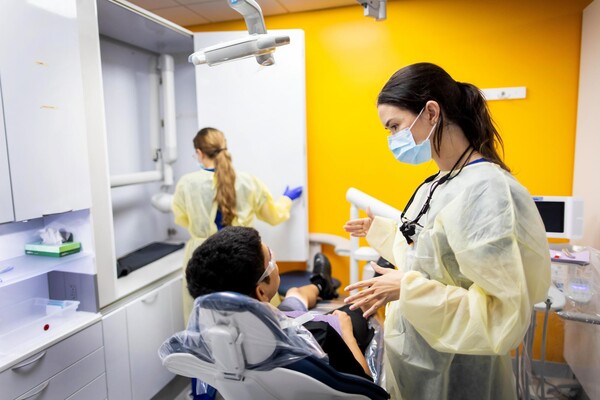
Vaccinations have traditionally been administered in primary care settings or pharmacies. However, for about a decade, some states have authorized dentists to administer vaccines, and many others did so during the COVID-19 pandemic. The effectiveness of this approach has led some countries and states to expand or consider expanding the role of dental providers in delivering routine vaccines, including those against COVID-19 and the human papillomavirus (HPV), and in providing vaccine education.
Penn student develops a way for computer chips to run more efficiently
Fluid Silicon, a platform from President’s Sustainability Prize winner Nhlanhla Mavuso, allows computer chips to continuously monitor their health and self-tune as their characteristics change. The technology has the potential to reduce energy usage in data centers and improve reliability in mission-critical applications.