With frank text and bold illustrations, graphic novel tackles puberty head on
The new book, for 9- to 14-year-olds and written by two Penn undergrads and an alum, details what physically happens in the body as girls experience puberty, plus the internal emotions and external social forces that accompany it.
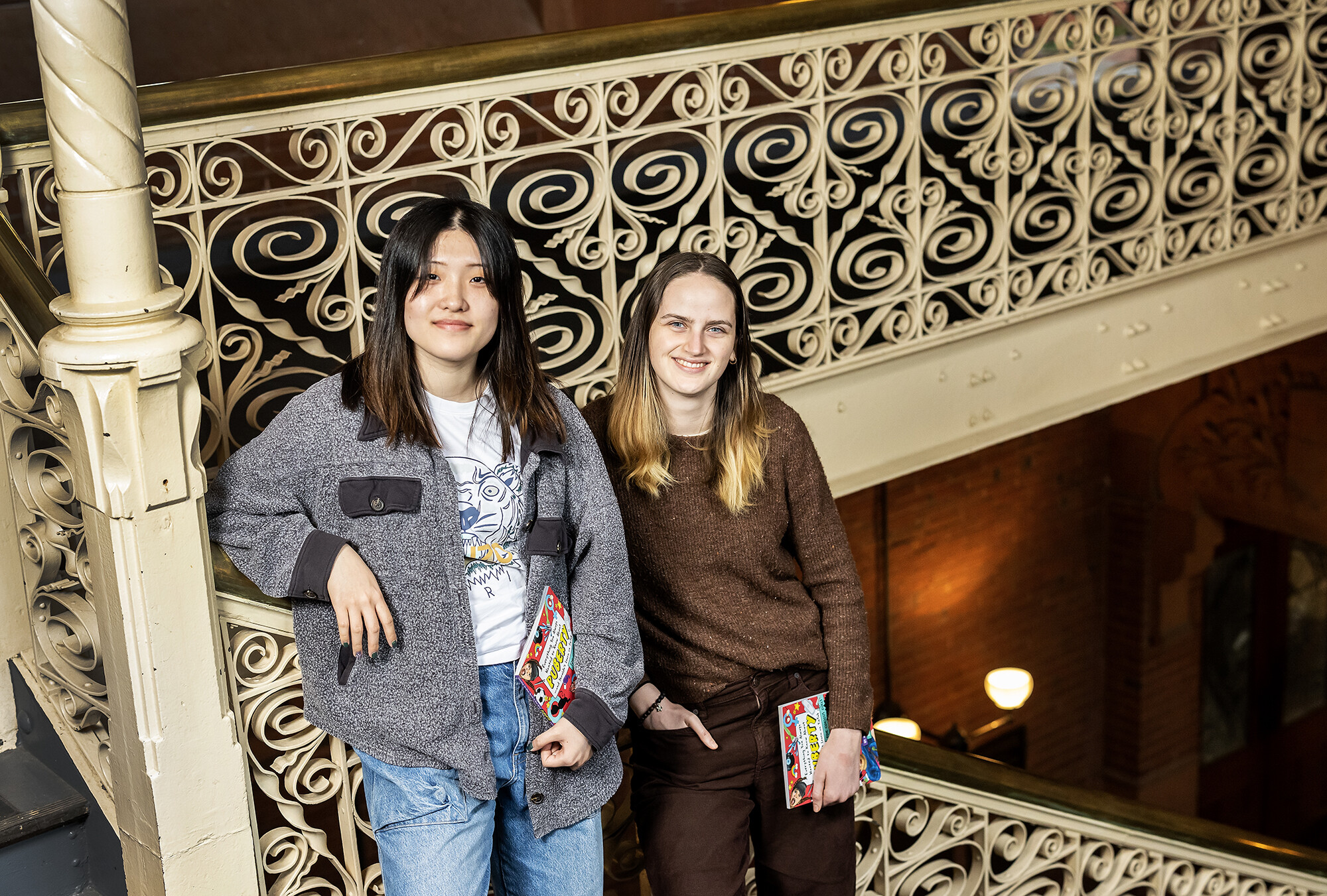
Penn undergraduates Gemma Hong (left) and Sophie Young (right) hold copies of the graphic novel they wrote and created with alum Julie Merberg and illustrator Amelia Pinney.
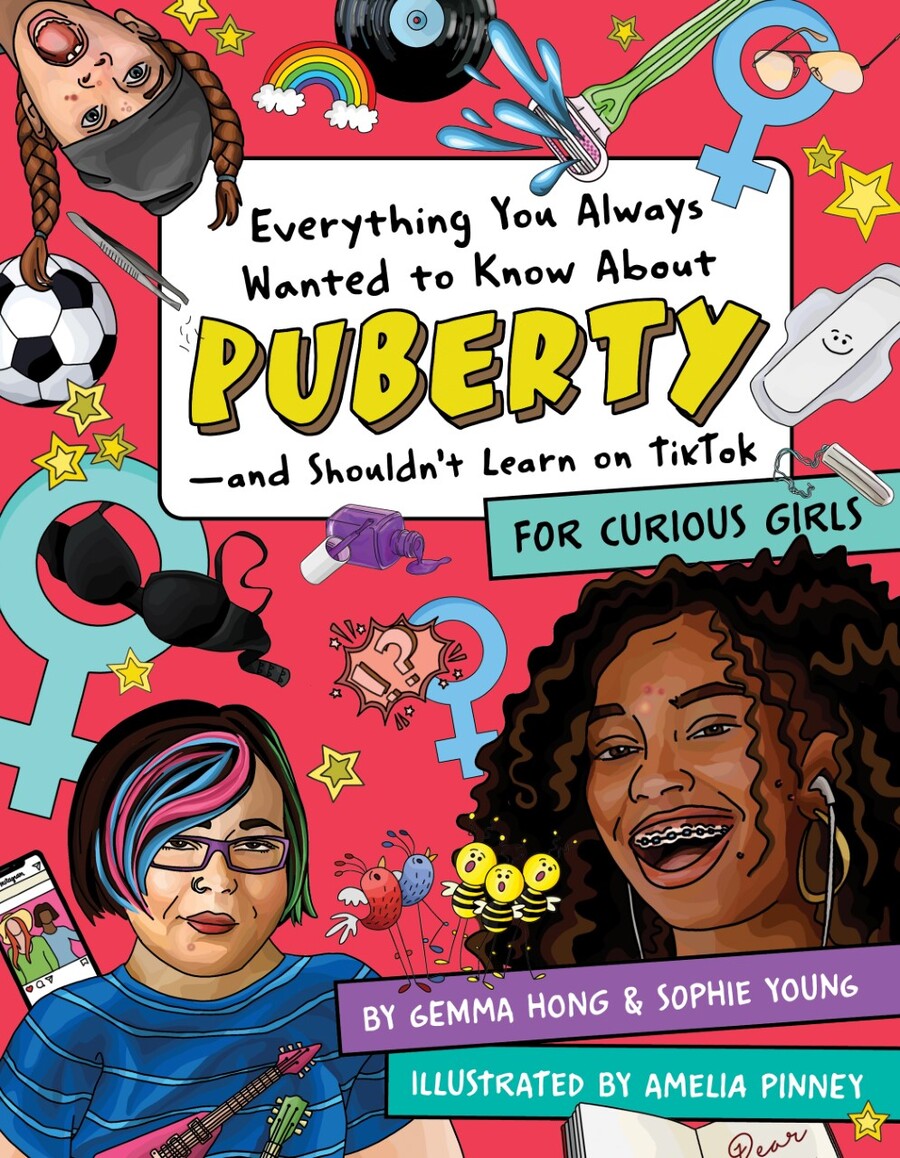
When Penn undergrads Gemma Hong and Sophie Young met in the University’s boxing club, they had no idea they would soon be teaming up to write a graphic novel for girls about puberty. But after a summer collaborating with alumnus Julie Merberg, who founded Downtown Bookworks more than a decade ago, they published “Everything You Always Wanted to Know About Puberty—and Shouldn’t Learn on TikTok: For Curious Girls.”
The book, for 9- to 14-year-old girls, aims to present information like a big sister would. Three sections take readers through the science of what’s happening in the body as puberty hits, plus how to cope with internal emotional changes and external social changes. New York City-based artist Amelia Pinney did illustrations that bring the topics to life in a relatable way but that also doesn’t downplay their importance.
Girls of all body types and backgrounds appear in the book’s pages, too. “It was really important for this book to capture as many experiences as possible,” says Hong, a third-year from Fort Lee, New Jersey. “We want all girls to feel seen.”
Filling an information void
The project emerged after Merberg, a mother of four boys, kept noticing she couldn’t find just the right books to explain tricky subjects to her children. At that point, she had been in the publishing industry for several decades. She decided to branch out on her own, creating a publishing house focused on filling the information hole she’d experienced as a parent.
One such subject was puberty for boys. “Everything out there already was tacky and embarrassing,” Merberg says. “Nothing was written or illustrated to address a diversity of kids. There was a void for something edgy and cool and inclusive, something that came from a young perspective.”
Yet as Merberg quickly learned, even a light bulb idea can be tricky to bring to fruition. Then one day, she heard two of her sons talking, an older brother giving his younger brother advice about puberty. “I thought, ‘That’s the voice I want,’” Merberg says. She soon enlisted her eldest son, then a junior at Skidmore College, to write a version of the book she had in her head. “Everything You Ever Wanted to Know About Puberty—and Shouldn’t Be Googling (For Curious Boys)” became their pandemic project.
“I always knew I wanted to do a girls’ version, too,” Merberg says. She put it into the schedule and set out to find the right authors, young females close enough in age to the audience that they could relate and anticipate concerns yet mature enough to reliably go through the process of writing a book. She reached out to Jamie-Lee Josselyn of Penn’s Kelly Writers House, who shared the opportunity with a group of undergraduates she thought might be interested in the opportunity.
A writing triad forms
The email from Josselyn piqued the interest of Young, a second-year from Greenville, South Carolina. “It was a topic I was really interested in, that was close to my heart,” says Young, a psychology major.
Though her parents talked with her about puberty, Young found sex ed in school lacking. “It included nothing about sexuality or those changing feelings.” she says. “I thought it would be great to have a resource to explain to young people, in an easily digestible manner, what they’re going through.”
Hong also recognized that sex ed often skims over or ignores some big topics altogether.
She says one example is Premenstrual Dysphoric Disorder (PMDD), a period-related chronic condition that’s similar to but more severe than PMS. “PMDD, which causes an extreme range of emotional and physical symptoms, was something my really good friend in high school went through. She didn’t have any explanation until years later because this was never talked about,” says Hong. “I wanted to make sure that other kids got a heads up before puberty about topics like that.”
Hong and Young each separately wrote back to Josselyn expressing their interest and submitting writing samples. Less than two weeks later, Merberg brought them on board, and in late May 2022 the trio started talking through the book process, divvying up who would write what and coming up with a game plan.
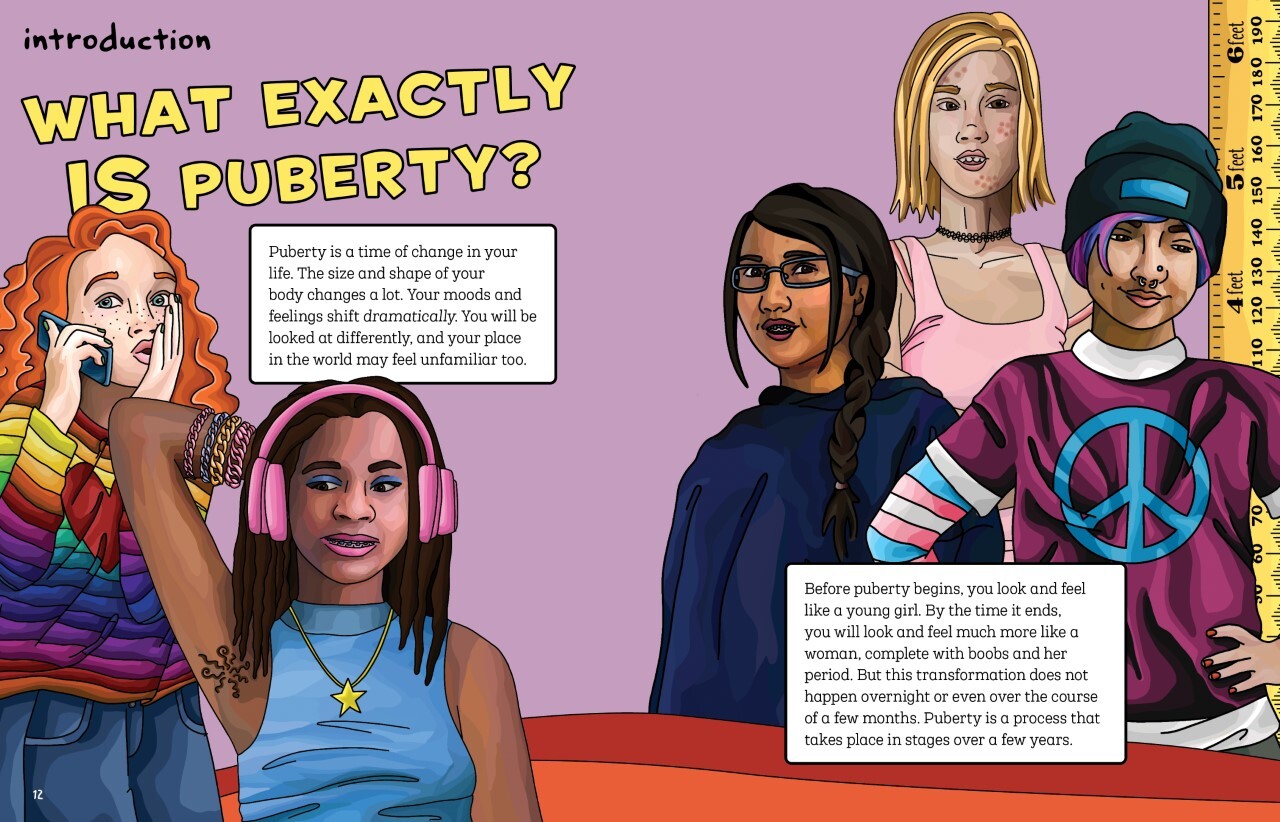
A page from the book “Everything You Always Wanted to Know about Puberty—and Shouldn’t Learn on TikTok: For Curious Girls.”
(Image: Courtesy Downtown Bookworks)
Representing all experiences
The writers worked from the same basic three-section structure Merberg had used in the already-published boys’ version of the book. The first section, which Merberg wrote, focuses on what happens physically in the body during puberty, from breasts and hips to hair and smells. Young worked on a part about emotional aspects of this time in a young person’s life, and Hong focused on changing social facets like friendships and social media. An additional chapter covered periods.
At the end of each section, the authors dedicate a few pages to answering the question, “Am I weird?” working from a list they’d been keeping during their research process. “It’s stuff that may seem silly, like, ‘My boobs are lopsided. Is something wrong with me?’” but it’s not silly, Young says. “We didn’t want to scare girls into thinking that this thing was going to happen to them,” says Merberg. “But at the same time, we wanted to reassure them that if it did, they’re not the only person who experiences it.”
Pinney’s accompanying illustrations make even the most serious of these topics less intimidating, Merberg says. The drawings are realistic and colorful, conveying girls of all body types, races, and abilities, yet each image gets its point across bluntly. It’s one aspect that makes the book unique in this space, according to Merberg, along with the anecdotes it includes told from the universal first-person perspective.
“To make the book as approachable as possible and an easy read, Julie urged us to reach out to our female peers, cousins, other family members” for anecdotes, Hong says. “It was group effort to showcase a wide range of experiences.”
That idea of offering a wide range of experiences so any young girl picking up the book feels seen gets at the crux of what Hong, Young, and Merberg intended with the project, they say. They acknowledge that parts are geared more toward a cisgender girl experience, but they also hope that they’ve successfully shown readers that many expressions of gender exist, something the resources they had growing up simply didn’t.
“The books we had weren’t representative of a lot of experiences, especially for young girls of color and young queer girls,” Young says. “There weren’t people acknowledging different gender identities. We wanted to provide a resource that did all of that that. It’s something I would’ve wanted and something I would want for my kids in the future.”
On the move: Water quality and antimicrobial resistance testing goes mobile
Penn researchers have developed a mobile field laboratory allowing them to test water quality and track antimicrobial resistance in and around San Cristóbal in the Galápagos.
Penn researchers Vanessa and Alexis North are studying one of the largest collections of Egyptian blue objects ever found in the ancient Near East, shedding new light on how the world’s first synthetic pigment may have traveled far beyond Egypt.
A new role for dental providers? Rethinking where vaccines are given
Vaccinations have traditionally been administered in primary care settings or pharmacies. However, for about a decade, some states have authorized dentists to administer vaccines, and many others did so during the COVID-19 pandemic. The effectiveness of this approach has led some countries and states to expand or consider expanding the role of dental providers in delivering routine vaccines, including those against COVID-19 and the human papillomavirus (HPV), and in providing vaccine education.
Penn student develops a way for computer chips to run more efficiently
Fluid Silicon, a platform from President’s Sustainability Prize winner Nhlanhla Mavuso, allows computer chips to continuously monitor their health and self-tune as their characteristics change. The technology has the potential to reduce energy usage in data centers and improve reliability in mission-critical applications.