How quickly nicotine clears the bloodstream determines which treatment will work best, a tool scientists at Penn Medicine are using to advance the field of tobacco research.
Using biomarkers to customize care, a new treatment model from researchers like Robert Schnoll and Rebecca Ashare at Penn Medicine’s Center for Interdisciplinary Research on Nicotine Addiction could significantly help people who want to quit smoking.
For many smokers, the story is a common one: To control the problem, they first try a nicotine-replacement therapy like the patch or gum, which, compared to other options, is inexpensive, simple, and often effective. But the reality is, for people who metabolize nicotine quickly, such treatments don’t work as well, or at least not as well as a prescription medication would.
That we can even make this distinction is thanks to a relatively new direction in tobacco research focused on biomarker-based treatments, one that scientists from Penn Medicine’s Center for Interdisciplinary Research on Nicotine Addiction (CIRNA) have been leading. The idea is to learn a person’s nicotine metabolite ratio—an indication of how rapidly the chemical leaves the bloodstream—then base a treatment plan around that number.
Pulmonologist Frank Leone’s work revolves around finding the most effective ways to take care of tobacco dependence, a challenge that is, in his view, “a lot more complicated than people give it credit for.”
“There are a couple clinical manifestations of tobacco dependence—the problem is not monolithic,” says Frank Leone, a pulmonologist who directs the Comprehensive Smoking Treatment Program at the Penn Lung Center. “Once we recognized that, we could start to identify subgroups more likely to respond to one type of therapy than to others.”
Within the past five years, clinical findings have started to back up that approach. A randomized trial Penn conducted from 2010 to 2014 showed that slow metabolizers respond well to the nicotine patch, but fast metabolizers do better with the prescription medication varenicline. And just-published work on smokers with HIV—who smoke at a rate double that of the general population—revealed that they metabolize nicotine faster than those without HIV.
“The main principle behind all this work is to improve the effectiveness of existing FDA-approved medications,” says Robert Schnoll, CIRNA director and associate director for population science, and co-leader of the Tobacco and Environmental Carcinogenesis Program at the Abramson Cancer Center. “At best, [right now] they only help about one-third of smokers quit. So that’s our overarching mission.”
Schnoll runs Penn Medicine’s Center for Interdisciplinary Research on Nicotine Addition, where much of the work on biomarker-based smoking cessation treatments is taking place.
How biomarkers work
Biomarkers are measurable biological characteristics that indicate normal processes happening in the body; blood glucose levels or blood pressure are common examples. They can help clinicians get to the root of a problem faster.
Leone uses a bum knee to explain. “Let’s say you and I both suffer knee pain. We’re both limping and have trouble getting up and down the steps, but yours might be because of a meniscus tear and mine might be arthritis,” he says. “They’re different problems that look the same. Biomarkers help us at the early stage drill down.”
In the case of smoking, an important biomarker related to dependence is the rate of nicotine metabolism, or how long it takes for the chemical to leave the body. Although the field had long known that individuals process nicotine differently, and that genetic variants like gender and race influence this, it wasn’t until the nicotine metabolite ratio (NMR) emerged that the work took a significant step forward.
Part of this research includes work on smokers who have HIV. Ashare and colleagues recently published findings showing that this group metabolizes nicotine faster than expected, which could affect their ability to quit and smoking rates in general.
Nicotine is primarily metabolized by six enzymes in the liver, which break down nicotine into a number of smaller molecules. The relative proportions of two of these molecules, cotinine and 3-hydroxycotinine, determines a person’s NMR, and because this ratio rarely changes, it offers a stable, long-term index of the nicotine clearance rate. In addition, NMR can be measured via the blood, saliva, or urine, so it’s not difficult to obtain.
Focusing on the NMR quickly revealed that this rate matters a great deal in smoking cessation. “Folks characterized as faster metabolizers clear out nicotine more quickly, so they tend to smoke more cigarettes, be more nicotine-dependent, and have a more difficult time quitting overall,” says Rebecca Ashare, an assistant professor in Penn Medicine’s Department of Psychiatry and a member of the CIRNA team. “For slower metabolizers, the nicotine hangs around in your system a little bit longer.”
Clinical trial findings
Armed with this information, Schnoll and a team lead by Caryn Lerman, Penn Medicine’s dean of strategic initiatives, conducted a double-blind clinical trial in which they randomly assigned 1,246 patients—about half of whom were known to be slow metabolizers—into a placebo, nicotine patch, or varenicline group. The first-of-its-kind research, which they published in The Lancet Respiratory Medicine in 2015, concluded that fast metabolizers had significantly higher quit rates with varenicline versus the patch; slow metabolizers had the same quit rates when treated with varenicline or the nicotine patch, but higher side effects on the medication, which can lead to discontinuing treatment.
“That trial demonstrated the validity of the approach,” Schnoll says.
Since then, he and colleagues have begun looking at how NMR affects specific populations, such as work done in collaboration with Ashare’s lab on smokers who have HIV. The team recently published two papers on the subject, one in the journal AIDS, the other in the Journal of Acquired Immune Deficiency Syndromes.
For the AIDS study, “we did a matched, case-control study of smokers with HIV versus those without,” Ashare says. “Smokers with HIV had a significantly higher NMR compared to their matched controls, and they’re metabolizing nicotine faster than we would expect. We hypothesize that this is related to difficulty in quitting, higher smoking rates, and treatments being less effective. However, we don’t know why.”
The second study looked at how an anti-retroviral drug called efavirenz affects NMR and smoking cessation. “The people in our study who were taking efavirenz had significantly faster nicotine metabolism than those who were not,” she says. “We’re not showing causality; we’re just showing an association between this medication and NMR, but we want to follow it up with more well-controlled studies.”
The main principle behind all this work is to improve the effectiveness of existing FDA-approved medications.
Robert Schnoll, CIRNA director and associate director for population science, and co-leader of the Tobacco and Environmental Carcinogenesis Program at the Abramson Cancer Center
This work, Schnoll adds, “is designed to be practice-changing, so that we have enhanced tools to address tobacco dependence clinically in a new and impactful way.”
Then there’s the policy-related work being conducted by Andrew Strasser, director of CIRNA’s Biobehavioral Smoking Laboratory, who studies, in part, whether the amount of nicotine allowed in a single cigarette should be capped. On the one hand, lowering nicotine levels could create less satisfying cigarettes, potentially leading to less severe addiction. On the other, people might simply increase the number of cigarettes they smoke in a day or puff more vigorously to get the same effect.
The Tobacco Control Act gives the Food and Drug Administration power to regulate products if doing so would benefit the public as a whole, but could controlling nicotine amounts put certain sub-groups—say metabolizers whose bodies clear the nicotine faster—at increased risk? Strasser wanted to know, and he believed the NMR could tell him.
In a nonrandomized clinical trial, 100 adult smokers used reduced-nicotine cigarettes for two 15-day periods. Strasser found overall that participants puffed less frequently, and their urine showed decreased tobacco biomarkers, though carbon monoxide levels stayed the same. What most struck him, however, was that slow and fast nicotine metabolizers behaved the same. “In other words,” he explains, “there wasn’t an increased risk for fast metabolizers. There’s no way to puff vigorously enough to overcome the low-nicotine content.” The findings, which he published in JAMA Network Open in 2018, could be vital for helping the FDA develop a new tobacco-control policy.
Andrew Strasser (right, standing) is trying to determine whether the amount of nicotine per cigarette should be capped. He conducted an experiment to see if doing so could put people whose bodies quickly clear nicotine at risk.
Future of the work
Though the advancements in the field are exciting, they’ve happened at such at clip that clinical practice hasn’t kept pace. They are still novel, and require a new way of thinking about smoking cessation, especially compared with early tactics that focused solely on educating smokers about the ill-effects of the practice.
“We imagined that there was a single problem that affected everyone equally. Even if the degree of the problem might have been different, it was still the same problem,” Leone says. “What we’re recognizing now is that smoking might be a similar behavior manifestation, but the brain gets to that point through a couple different pathways. Unfortunately, the system around us hasn’t caught up to this idea yet.”
That’s partially due to cost. To be able to use the NMR to determine the most effective treatment, clinicians need to know that value for each patient they see. It seems simple, but many insurance companies won’t pay the $75 for this analysis. On top of that, if the insurance company only covers the patch, for example, but not a prescription medication, patients often don’t want to pay out of pocket for the other option, which can get as high as $1,200 for varenicline.
There are a couple clinical manifestations of tobacco dependence; the problem is not monolithic.
Frank Leone, director of the Comprehensive Smoking Treatment Program at the Paul F. Harron Jr. Lung Center
Part of making this change requires tapping into how physicians think, a future research question Leone and Schnoll plan to pursue. “What pre-existing issues influence their treatment decision-making?” Leone asks. “And what are some simple, pragmatic ways that we can help guide clinicians toward more population-based decisions?”
Regardless, we’re still a decade away from biomarker-based treatments being commonplace, Leone adds. And though Schnoll doesn’t offer a timeline, he does describe CIRNA’s most immediate next step, which will launch within a few weeks. In collaboration with Penn Primary Care, Schnoll and Leone will integrate NMR testing into the physician clinical decision-making process to determine whether it improves how physicians treat nicotine dependence and how patients utilize tobacco-dependence treatments. That project, funded by the National Institute on Drug Abuse, goes through 2020. So, no final answers yet. But it’s a long game, one at which the Penn researchers will keep plugging away, for the health of current and future smokers.
“In theory, we’ll be able to demonstrate that we could integrate a personalized approach to improve the quality of care,” Schnoll says. “It would mean that patients who smoke get more-effective care, and if we do a better job of getting smokers more-effective care, that will translate into reducing the total number of smokers.”
Funding for the research described in this piece came from the National Institutes of Health, the Food and Drug Administration Center for Tobacco Products, the Canadian Institutes of Health Research, the Abramson Cancer Center, the Penn Center for AIDS Research, the Penn Mental Health AIDS Research Center, the Centre for Addiction and Mental Health Foundation, and Pennsylvania Department of Health.
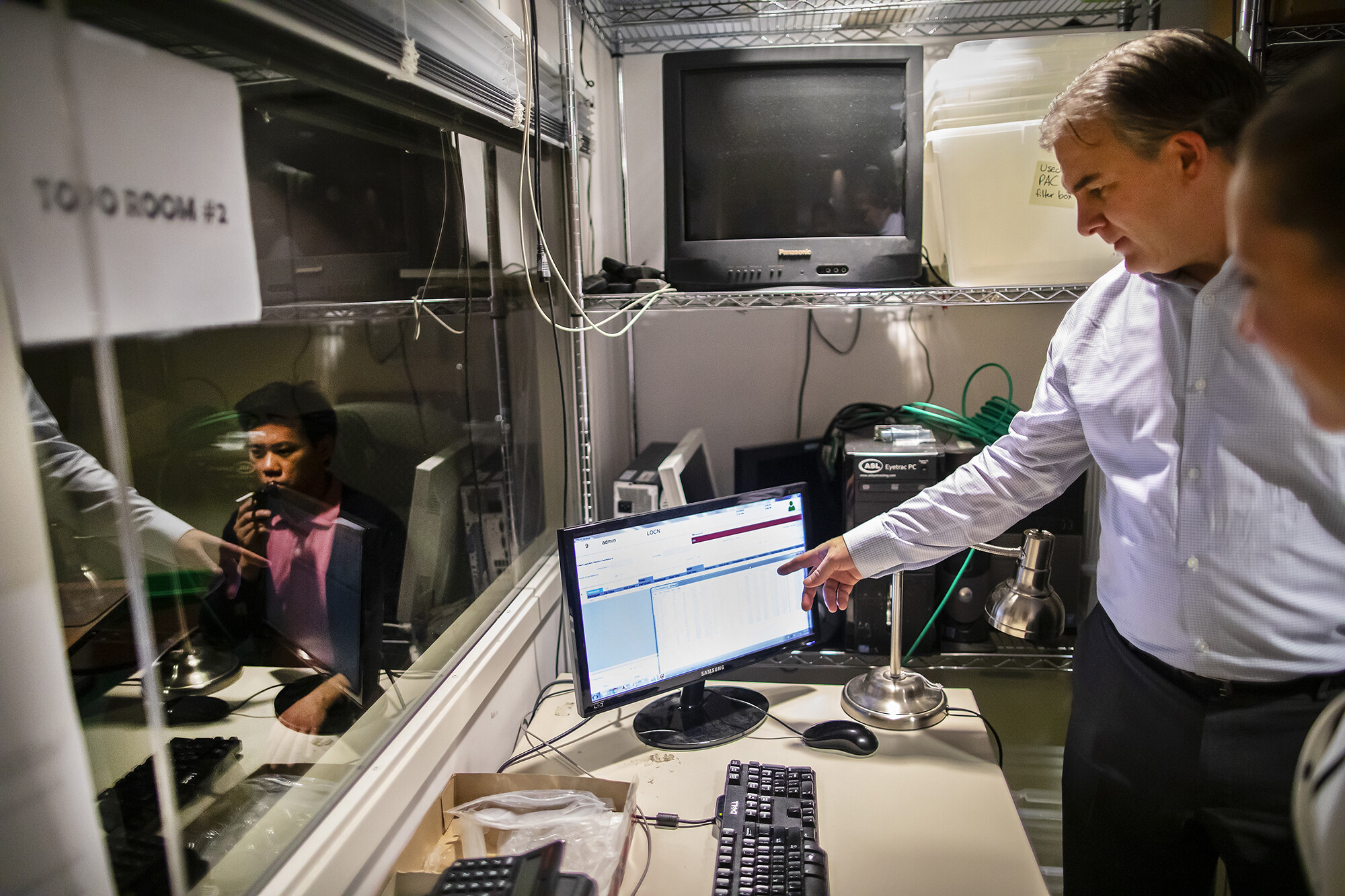
Homepage photo: How vigorously someone puffs determines how much nicotine gets into the bloodstream. Here, in the Strasser lab, they test a subject’s puffing vigor.
On the move: Water quality and antimicrobial resistance testing goes mobile
Penn researchers have developed a mobile field laboratory allowing them to test water quality and track antimicrobial resistance in and around San Cristóbal in the Galápagos.
Penn researchers Vanessa and Alexis North are studying one of the largest collections of Egyptian blue objects ever found in the ancient Near East, shedding new light on how the world’s first synthetic pigment may have traveled far beyond Egypt.
A new role for dental providers? Rethinking where vaccines are given
Vaccinations have traditionally been administered in primary care settings or pharmacies. However, for about a decade, some states have authorized dentists to administer vaccines, and many others did so during the COVID-19 pandemic. The effectiveness of this approach has led some countries and states to expand or consider expanding the role of dental providers in delivering routine vaccines, including those against COVID-19 and the human papillomavirus (HPV), and in providing vaccine education.
Penn student develops a way for computer chips to run more efficiently
Fluid Silicon, a platform from President’s Sustainability Prize winner Nhlanhla Mavuso, allows computer chips to continuously monitor their health and self-tune as their characteristics change. The technology has the potential to reduce energy usage in data centers and improve reliability in mission-critical applications.