On the Galápagos, an underwater exploration of marine life
In collaboration with a local dive instructor and the students he trained, researchers from Penn and Villanova are learning how human presence affects life on the seafloor around these islands.
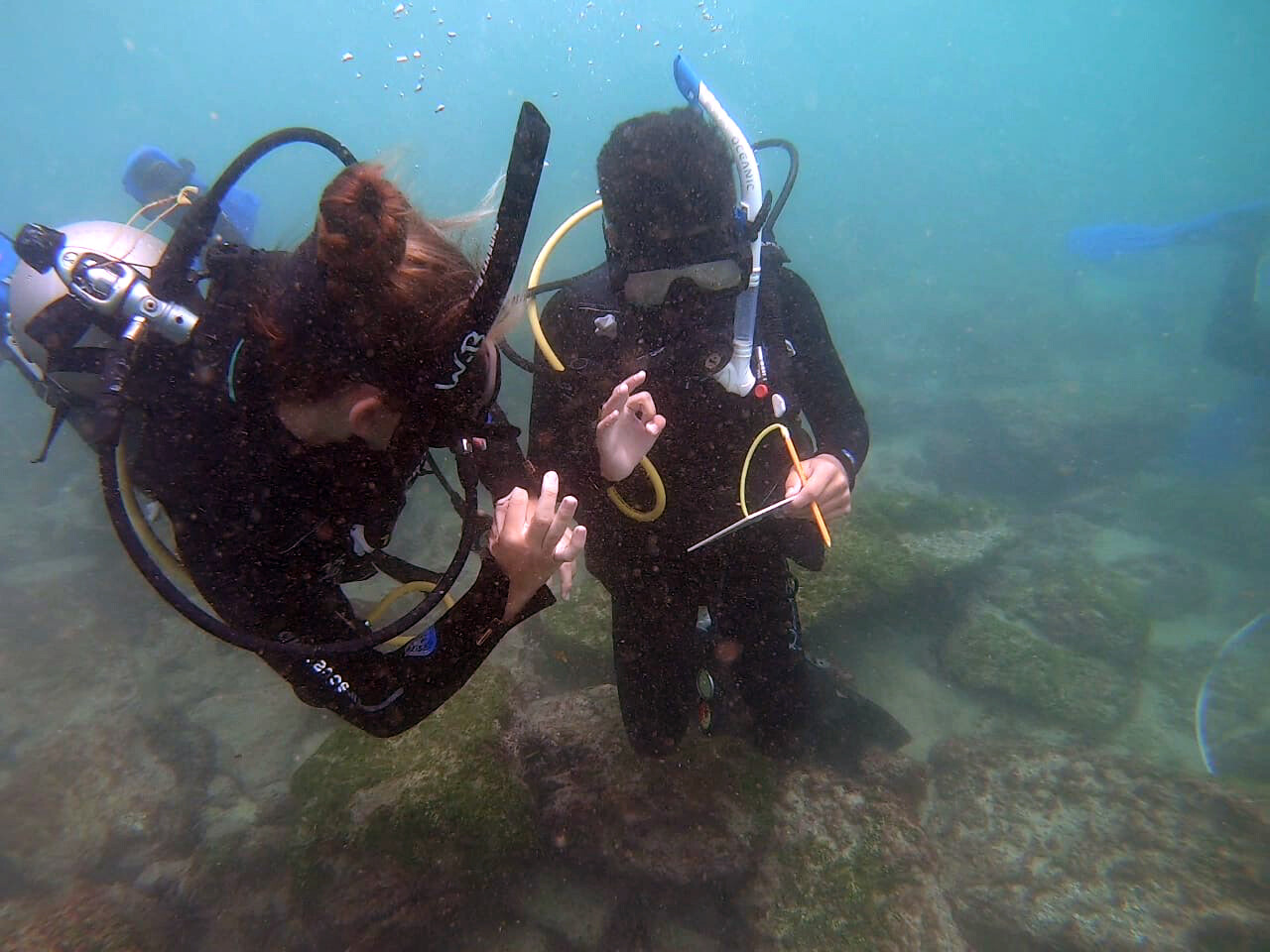
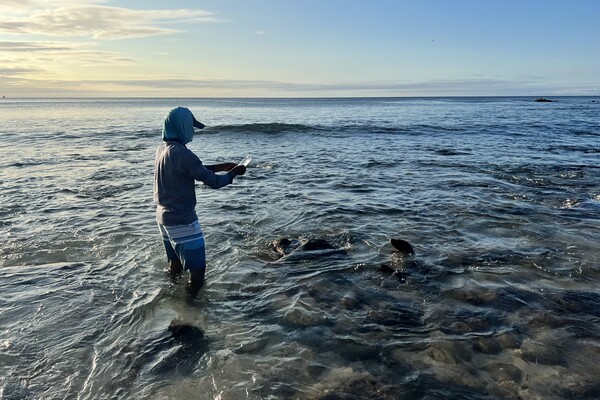
Since 2019, students have been going on dives in pairs, tallying every benthic species they see along a 30-meter transect line. Mostly they’ve encountered sea urchin and sea cucumbers, plus a few starfish and turtles.
The waters around the Galápagos Islands are some of the world’s most unique, known for their exceptional marine life. Yet, for a variety of reasons—the cost to learn SCUBA diving, for example, or rules about the protections on the marine reserve—many locals rarely get the chance to experience those waters and the life they hold within.
“Local people have to comply with all these regulations, but often never actually get to see the incredible flora and fauna that’s right at their doorstep,” says Maddie Tilyou, lab manager for the Galápagos Education and Research Alliance (GERA), an initiative co-directed by Penn researcher Michael Weisberg.
Ivan Lopez, a local dive instructor and naturalist guide, had been trying to shift that dynamic by offering free SCUBA diving lessons to local middle schoolers. In 2019, he teamed up with Weisberg, Tilyou, and others to combine his training program with the underwater exploration branch of GERA’s community science initiative, called Projecto Laboratorio para Apreciar la Vida y el Ambiente or Project LAVA.
Through LAVA-Mar, Lopez’s divers are helping the research team understand how humans are affecting the marine creatures in protected waters compared to those in the municipal waters of San Cristóbal, the easternmost island of the Galápagos. On more than a dozen trips, student diving pairs—led by Lopez, Tilyou, and LAVA-Mar project leader Olivia Fielding—have recorded every individual animal spotted along a 30-meter transect line.
So far, in bay waters closest to shore, the team has tallied mostly sea urchin and sea cucumbers, plus a few starfish and turtles. When they traveled farther out to renowned dive site Kicker Rock, the marine life changed dramatically. “There’s a lot less pollution and human traffic and way more benthic cover,” says Fielding, a Perry World House climate change research fellow and recent Penn graduate. “The benthic cover signifies how healthy an area is.”
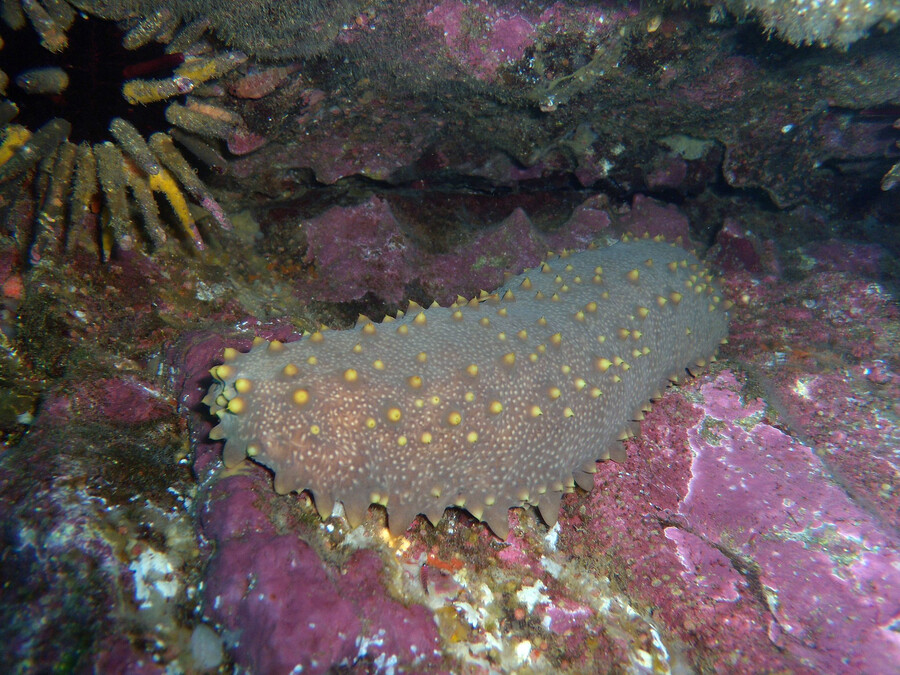
Sea cucumbers like the species here, Isostichopus fuscus, make up the bulk of creatures the LAVA-Mar divers see. As they travel farther from shore, the marine life changes, becoming much more colorful and varied.
Though the pandemic took the training out of the water and moved it online, in recent months Weisberg and colleagues have picked up the in-person work again in earnest. They traveled to the Galápagos this past summer and completed one dive with the students. They’re also working with Penn marine biologist Katie Barott and locals to create a water health index, to better facilitate comparison across sites. And they plan to return to the islands throughout 2022, if it’s safe for all parties involved.
“The science is important,” says Weisberg, the Bess W. Heyman President’s Distinguished Professor and chair of the Department of Philosophy. “But even more important is working with the community on conservation research and practices. Science is not just a tool that outsiders use to come in and extract knowledge.”
‘Social ecology’
The Galápagos Education and Research Alliance, co-led by Weisberg, Deena Weisberg of Villanova, and Galápagos naturalist guide Ernesto Vaca, has been working in and around the town of Puerto Baquerizo Moreno on San Cristóbal for the past seven years. Project LAVA is one of a handful of GERA’s initiatives.
RELATED
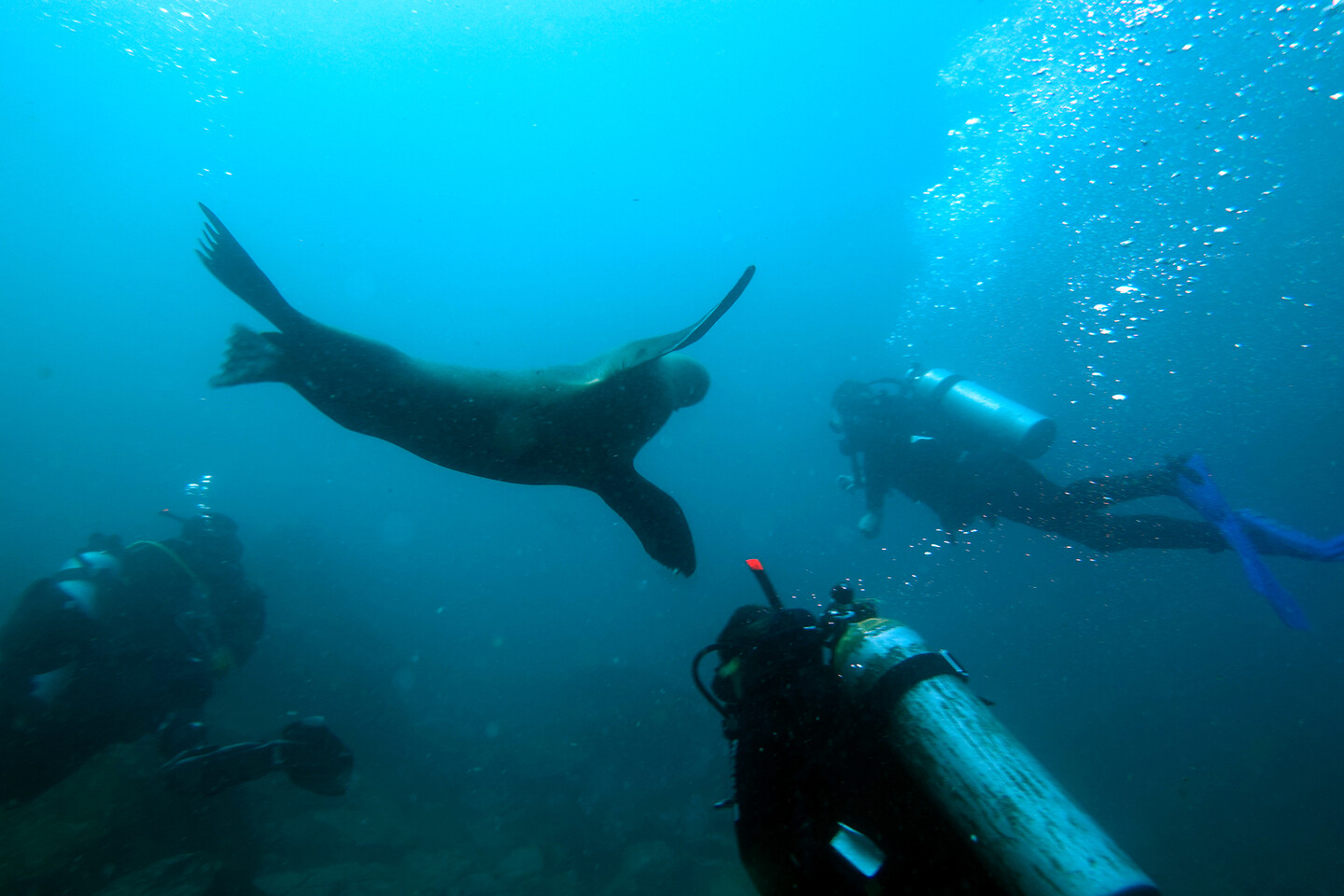
Earlier work in this area included LAVA-Lobos, which studies the impact of human presence on endangered sea lions. In the future, LAVA-Agua will focus on San Cristóbal’s domestic water supply; LAVA-Agro, on the effect of invasive plants and animals; and LAVA-Astro, on the night sky, in conjunction with the International Dark-Sky Association.
All of this work happens in collaboration with locals. “The overall approach that we take is called social ecology. When we do conservation research or practice, we center local people’s involvement,” Weisberg says. “Just as the sea lion project was working with students, here we’re working with a different set of students.”
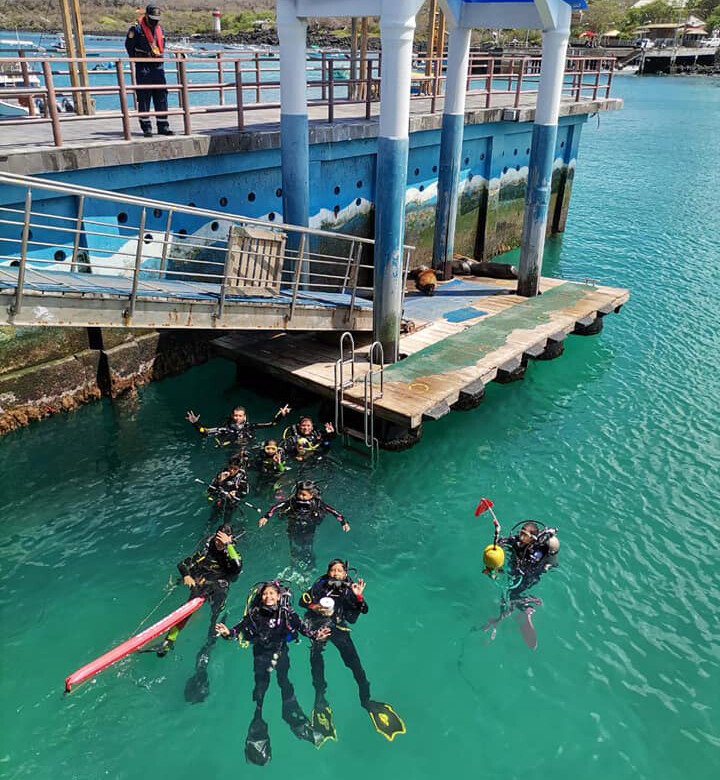
Currently, 10 Galapagueños ranging from 11- to 16-years-old are involved in LAVA-Mar. Fielding and Tilyou, who helped get the project up and running in 2019, worked with Weisberg and Lopez to create the scientific protocol the students now use on each dive. It’s been an evolution, Tilyou says. “It’s been really cool to watch these students advance through their training. More than half are rescue divers now.”
Conducting the science
The aim of this project is to investigate how people affect marine life. Given that at the start, most participants didn’t even know how to SCUBA dive, Tilyou and Fielding understood the protocol had to be simple and straightforward.
So, they came up with this: Students pair up, one with a GoPro camera, the other a slate and pencil usable underwater. Swimming above a 30-meter transect line being held by two adults—typically Lopez and one of his helpers—they record and tally any species they see within a meter of the line. Before the first dive, the students received training in the most common animals they’d likely encounter.
Currently, 10 Galapagueños ranging from 11- to 16-years-old are involved in LAVA-Mar, all trained by Ivan Lopez, a local dive instructor and naturalist guide that teamed up with the Penn group several years ago.
“That’s the scientific part,” which typically takes about 10 to 15 minutes each time, Tilyou says. “Because they usually have air left in their tanks, they then go on a little treasure hunt and take photos.” At the end, they pick their favorite image to share. “Elements like that will become more important as we go,” Fielding says, “to make sure they’re not just coming out and counting sea urchins.”
She and Tilyou are also working with Weisberg to make the data that’s collected more scientifically viable. That’s where the expertise of Barott, who studies the biology and ecology of coral reef systems, comes into play. “We’re working with Katie to create a health index,” Weisberg says. “We want to be able to turn what the students are seeing into something we can compare across sites.”
That will lead to a much-needed baseline measurement, Tilyou adds. “Getting that data is really important, especially in the face of factors like climate change. If we don’t have a baseline, it’s going to be really hard to assess down the road what we’ve lost.”
Marine stewardship
The LAVA-Mar team has collected data since 2019. Now they need to figure out how to analyze it and what comes next. The local group will undoubtedly complete more dives, even if the Penn and Villanova teams cannot physically get to the Galápagos.
The researchers are also working to get backing for dives that will take the participants farther from shore. “Getting beyond the bay has been the goal the whole time, but it requires more funding and logistics,” Fielding says. “We need comparative data from the less disturbed areas to really understand the data we have.”
And yet, even in the bay, even in frigid waters and knowing that they’ll most likely observe sea urchins and possibly nothing else, the participants are always enthusiastic. Tilyou says she sees this as a sign that they’re starting to take ownership of the process, becoming guardians of the marine environment in their backyard.
“Because it’s such an incredible space scientifically, scientists have always gone there, but traditionally in a pretty exploitative way,” Tilyou says. “We’re asking this population to be stewards of a really fragile marine ecosystem and yet they don’t know what they’re protecting. The root of this project is to make science more democratic in how it’s carried out.”
One dive at a time, one sea urchin at a time, this underwater exploration broadens the understanding of precisely how humans are changing the waters around the Galápagos Islands and the benthic creatures below.
Homepage image: The diving project is part of a larger initiative called Projecto Laboratorio para Apreciar la Vida y el Ambiente or Project LAVA, which also includes research about the effect humans are having on sea lions in the Galápagos.
On the move: Water quality and antimicrobial resistance testing goes mobile
Penn researchers have developed a mobile field laboratory allowing them to test water quality and track antimicrobial resistance in and around San Cristóbal in the Galápagos.
Penn researchers Vanessa and Alexis North are studying one of the largest collections of Egyptian blue objects ever found in the ancient Near East, shedding new light on how the world’s first synthetic pigment may have traveled far beyond Egypt.
A new role for dental providers? Rethinking where vaccines are given
Vaccinations have traditionally been administered in primary care settings or pharmacies. However, for about a decade, some states have authorized dentists to administer vaccines, and many others did so during the COVID-19 pandemic. The effectiveness of this approach has led some countries and states to expand or consider expanding the role of dental providers in delivering routine vaccines, including those against COVID-19 and the human papillomavirus (HPV), and in providing vaccine education.
Penn student develops a way for computer chips to run more efficiently
Fluid Silicon, a platform from President’s Sustainability Prize winner Nhlanhla Mavuso, allows computer chips to continuously monitor their health and self-tune as their characteristics change. The technology has the potential to reduce energy usage in data centers and improve reliability in mission-critical applications.