Evidence of broadside collision with a dwarf galaxy discovered in the Milky Way
‘Shell structures,’ the result of a collision with another galaxy nearly 3 billion years, have been confirmed in the Milky Way galaxy for the first time.
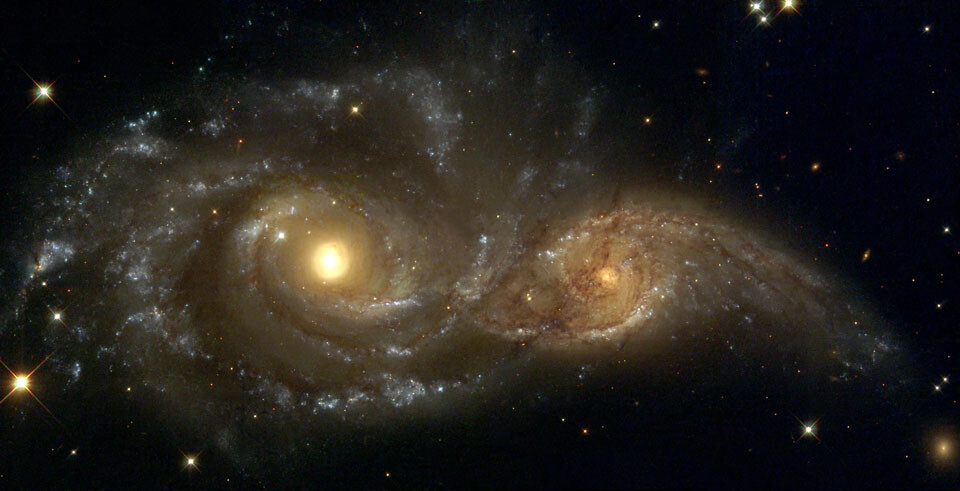
Two spiral galaxies (from left) NGC 2207 and IC 2163 colliding with one another. As the two galaxies slowly tear each other apart, their stars are pulled by “tidal forces,” eventually forming a long cord of stars that will form a smooth, sharp curve around the galaxy. Evidence of this type of collision, known as a "shell structure," was recently found in the Milky Way, remnants of a collision that happened nearly 3 billion years ago. (Image credit: Debra Meloy Elmegreen (Vassar College) et al., & the Hubble Heritage Team (AURA/STScI/NASA))
Nearly 3 billion years ago, a dwarf galaxy collided with the center of the Milky Way. This new discovery—a collaboration between researchers at Penn, Rensselaer Polytechnic Institute, and Queen’s University—is the first evidence of a “shell structure” in the Milky Way galaxy. The finding, published in The Astrophysical Journal, paves the way for a better understanding of how the universe has evolved.
Shell structures are formed when one galaxy collides head-on with another that’s much smaller. As the smaller galaxy coalesces with the larger, their stars are pulled by “tidal forces,” eventually forming a long cord of stars that move in unison within the galaxy’s halo and form a smooth, sharp curve around the galaxy. These shell structures are easy to spot in other galaxies and were hypothesized to exist in the Milky Way, but are harder to pinpoint when looking from Earth’s vantage point inside the Milky Way.
Robyn Sanderson was originally interested in using shells to detect dark matter, and studied these structures during her Ph.D. thesis process. She theorized that these edge regions are far enough away from the center of the galaxy to avoid the high background signals that would make spotting dark matter challenging but would still have a detectable amount of dark matter.
While the method didn’t end up working for dark matter, it ended up being useful for determining a galaxy’s mass, she says. “I derived some expressions to describe the density distribution you expect near the edges, as well as the distribution of velocities. From that, if you can measure positions in one of these edges, it will tell you the mass of a galaxy you find a specific feature in,” Sanderson says.
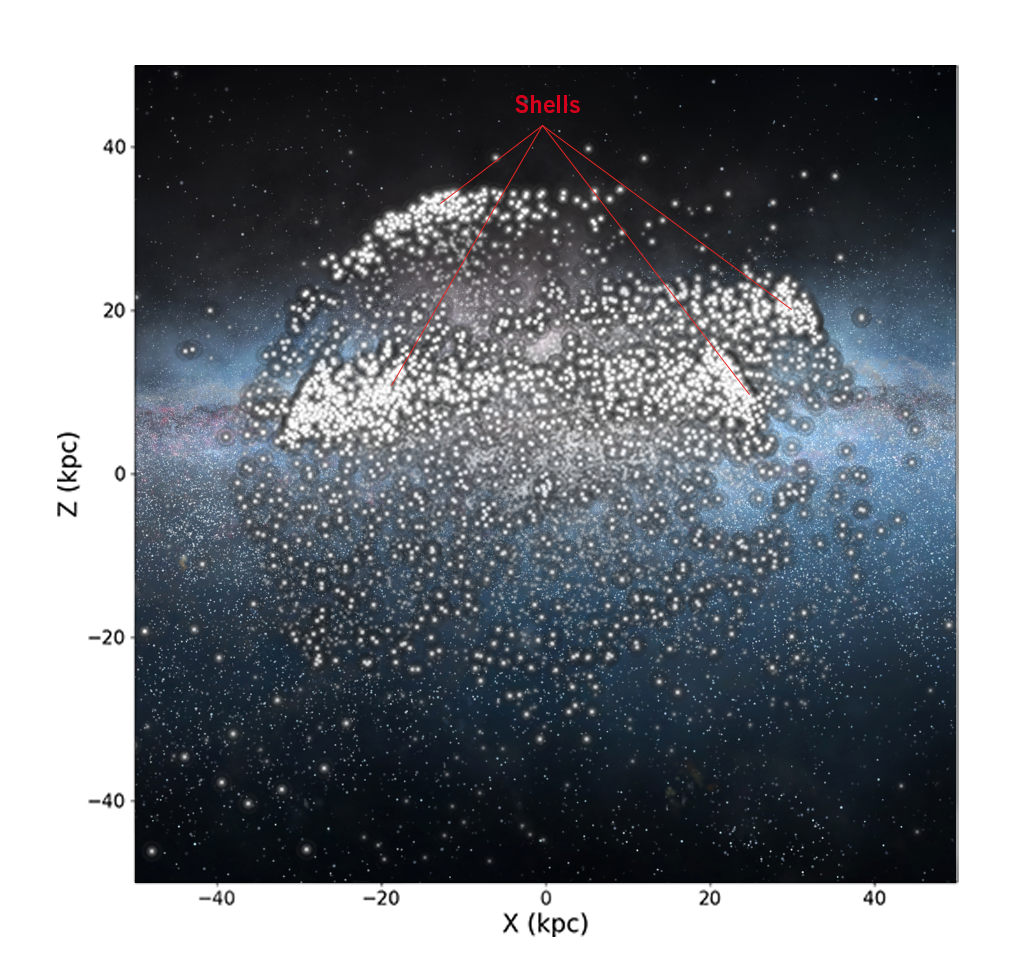
Stars identified in this paper formed “shell structures” in the Milky Way during the aftermath of a radial merger that took place nearly 3 billion years ago. (Image credit: Rensselaer Polytechnic Institute)
Now, thanks to the high-resolution data on all of the Milky Way’s stars provided by Gaia, as well as Sanderson’s previous work, the researchers were able to find and confirm the existence of four shell structures within the galaxy: two in the Virgo Overdensity and two in the Hercules Aquila Cloud region. Additional modeling of the shells and the motion of the stars was also used to figure out how long ago this collision took place, showing that a dwarf galaxy first passed through the galactic center of the Milky Way 2.7 billion years ago.
“There are other galaxies, typically more spherical galaxies, that have a very pronounced shell structure, so you know that these things happen, but we’ve looked in the Milky Way and hadn’t seen really obvious, gigantic shells,” says Thomas Donlon II, a Rensselaer graduate student and first author of the paper. “And then we realized that it’s the same type of merger that causes these big shells. It just looks different because, for one thing, we’re inside the Milky Way, so we have a different perspective, and also this is a disk galaxy and we don’t have as many examples of shell structures in disk galaxies.”
This finding also has implications for studying other stellar phenomena to figure out how the evolution of this galaxy compares to the evolution of the Universe as a whole, for example, to see what is unique about the Milky Way and what is similar to other galaxies. “We are working on making predictions for what kinds of ‘leftovers’ from collisions you expect,” says Sanderson. “If we have the physics right, we should be able to match up the debris, compare it to what we see in the simulations, and verify that our theory of how structures grow in the universe is right.”
For Sanderson, it’s also satisfying to see her thesis work support this new discovery. “This is something that people had been wondering about for a long time, and now there’s good enough data to say something conclusively,” she says. “The goal of our work, and the work of others, is to pick through the pieces of the Milky Way and to sort out what came from where, like archaeologists. This was a piece of the puzzle that no one knew how it fit before, so it’s something that we’re able to place into the puzzle of our history as a galaxy.”
This research was supported by National Science Foundation (Grant AST 19-08653) and by contributions made by Marvin Clan, Babette Josephs, and Manit Limlamai and the 2015 Crowd Funding Campaign to Support Milky Way Research.
To learn more about this research, watchan online presentation by first author Tom Donlon on YouTube.
On the move: Water quality and antimicrobial resistance testing goes mobile
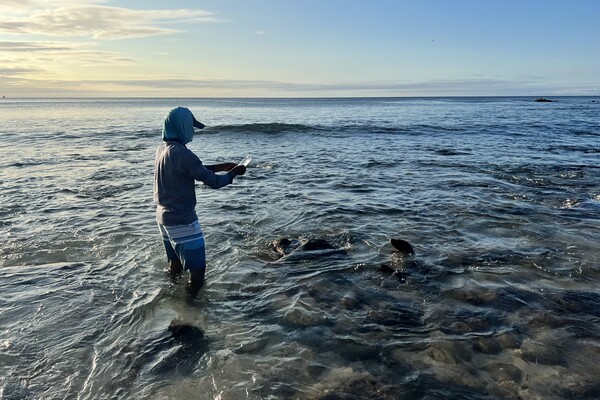
Penn researchers have developed a mobile field laboratory allowing them to test water quality and track antimicrobial resistance in and around San Cristóbal in the Galápagos.
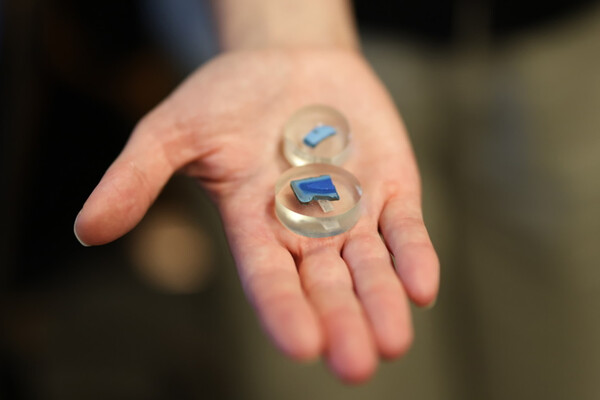
Penn researchers Vanessa and Alexis North are studying one of the largest collections of Egyptian blue objects ever found in the ancient Near East, shedding new light on how the world’s first synthetic pigment may have traveled far beyond Egypt.
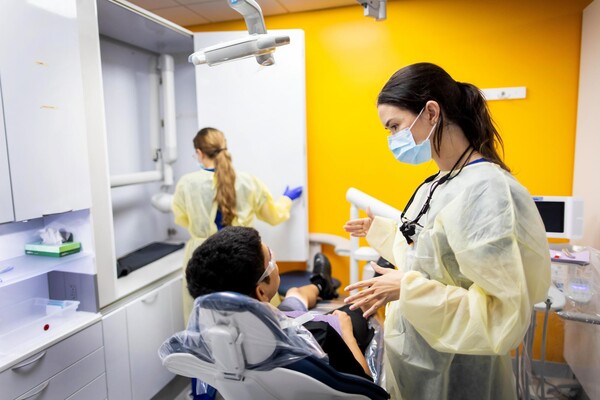
A new role for dental providers? Rethinking where vaccines are given
Vaccinations have traditionally been administered in primary care settings or pharmacies. However, for about a decade, some states have authorized dentists to administer vaccines, and many others did so during the COVID-19 pandemic. The effectiveness of this approach has led some countries and states to expand or consider expanding the role of dental providers in delivering routine vaccines, including those against COVID-19 and the human papillomavirus (HPV), and in providing vaccine education.
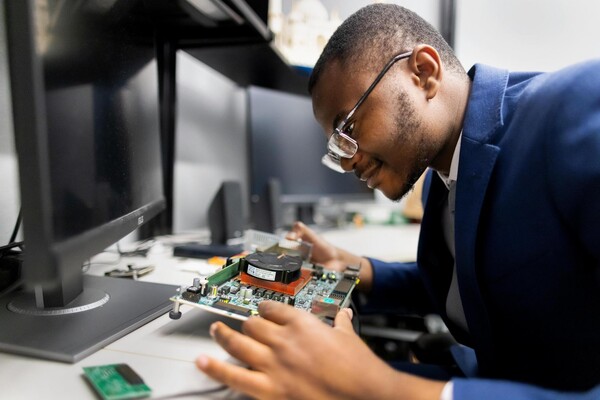
Penn student develops a way for computer chips to run more efficiently
Fluid Silicon, a platform from President’s Sustainability Prize winner Nhlanhla Mavuso, allows computer chips to continuously monitor their health and self-tune as their characteristics change. The technology has the potential to reduce energy usage in data centers and improve reliability in mission-critical applications.