In a Q&A, political scientist Jane Esberg discusses democracy and organized crime in Latin America.
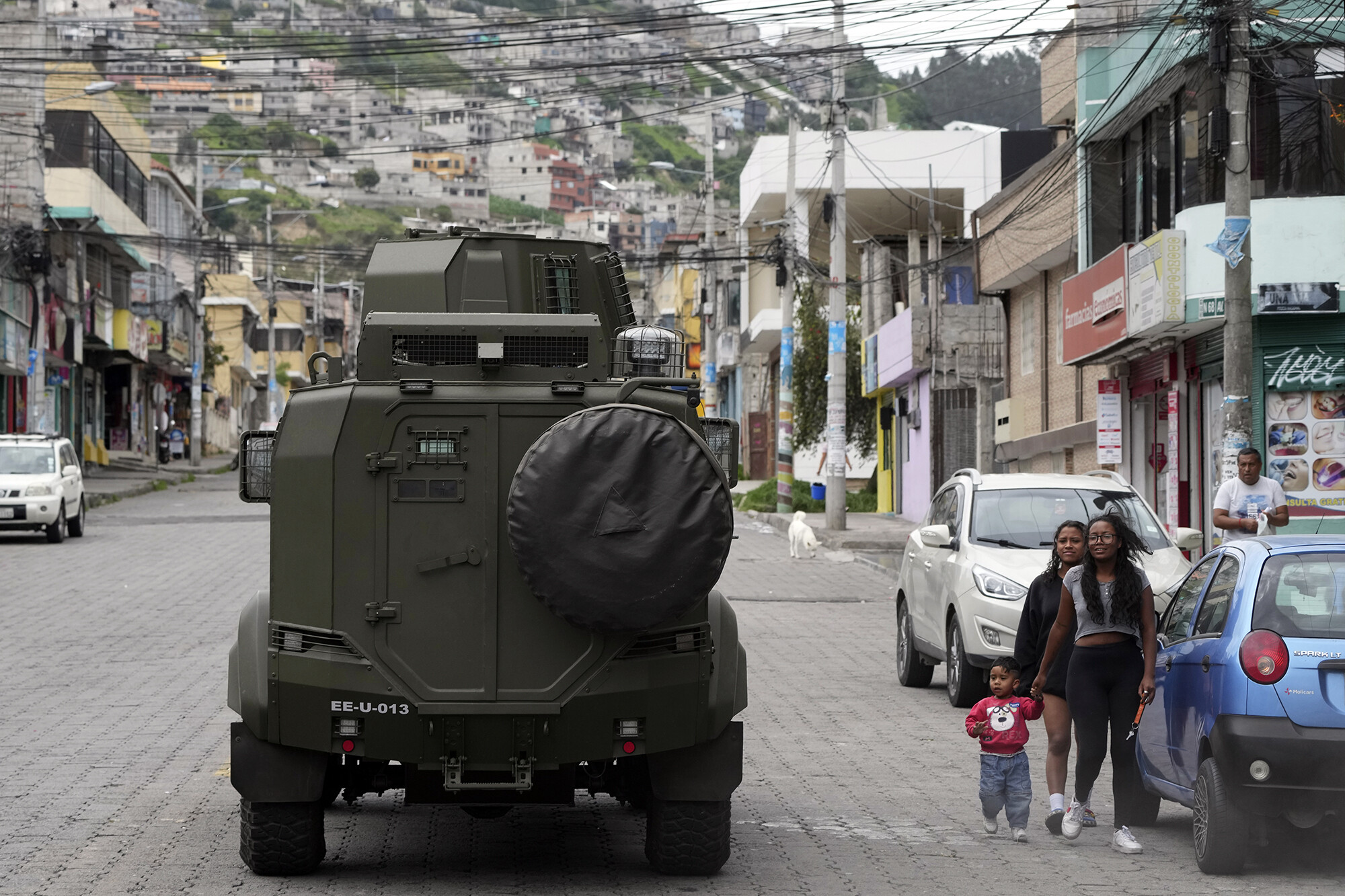
Soldiers patrol a residential area of northern Quito, Ecuador, on Jan. 11, 2024. President Daniel Noboa decreed Monday a national state of emergency due to a wave in crime, a measure that lets authorities suspend people's rights and mobilize the military. The government also imposed a curfew.
(Image: AP Photo/Dolores Ochoa)
On Jan. 8, Ecuadorian President Daniel Noboa declared a national state of emergency as the country’s most notorious cartel boss, Adolfo Macías, escaped from prison. Within the country, criminal record checks increased and a curfew was imposed, as the gang leader’s escape triggered a surge of violence, including the escape of other inmates, the death of two police officers, and over 200 prison guards taken hostage.
On Jan. 20, Macías’ wife, three children, a nephew, a family friend, and a nanny were all deported back to Ecuador from Argentina, where they had arrived two weeks ago, purchasing a home in cash within a gated community outside of Córdoba. Macías himself is still at large.
Jane Esberg, assistant professor of political science, studies repression, censorship and conflict in Latin America. In a Q&A with Penn Today, she addressed the state of emergency, democracy, and organized crime in Ecuador.
Who is Adolfo Macías and why did his prison escape trigger a national state of emergency?
Adolfo ‘Fito’ Macías is the leader of the Los Choneros criminal group, one of the two largest gangs active in Ecuador. He took power after the murder of Jorge Luis Zambrano; that murder led to a power struggle between Los Choneros and other, rival gangs (most notably Los Lobos). These conflicts are a big reason why criminal violence increased. The escape triggered a state of emergency in part because Noboa wanted to send the military into the prisons. Macías’ prison break likely occurred due to corruption among prison guards. In general, the prisons are a hotbed of criminal activity and, most importantly, criminal recruitment.
The gangs responded to the military offensive with a wave of further violence, including kidnappings and the now-infamous takeover of a live television news program. Noboa has declared a state of internal conflict and named 20 gangs as terrorist organizations.
Why has Ecuador, which has enjoyed relative stability and a temperate climate largely unsuitable for growing coca, become a site for cocaine trafficking?
While Ecuador is not a large coca grower, it is sandwiched between the two largest producers: Colombia and Peru. This has always been true, of course, but a number of shifts have intensified the use of Ecuador’s ports—especially the city of Guayaquil—for drug trafficking. Macroeconomic conditions are a big part of the story. Poverty and unemployment were exacerbated by COVID-19, which hit Ecuador—and especially Guayaquil—hard. Ecuador’s prison population has grown, which has had the perverse effect of solidifying criminal rule, since the prisons are effectively controlled by gangs. Then there is the breakdown of the uneasy truce that existed at one point between Los Choneros and Los Lobos, the other major gang, which has led to a cycle of retributive violence.
But a confluence of other regional factors has left Ecuador in the crosshairs. The demobilization of the Revolutionary Armed Forces of Colombia (Fuerzas Armadas Revolucionarias de Colombia, or FARC) demobilization in Colombia created something of a power vacuum for drug trafficking in the region. Mexico’s failure to reign in its own criminal groups may also be contributing. Ecuador’s most powerful gangs are allegedly linked to the most important cartels in Mexico: Los Choneros to the Sinaloa Cartel (formerly headed by El Chapo, himself famous for frequently breaking out of prison) and Los Lobos to the Cartel Jalisco Nueva Generación (CJNG). Finally, Peru has been facing political upheaval. Demand for cocaine has also shifted somewhat, decreasing in the US and increasing in Europe, which makes sea routes—and thus port cities like Guayaquil—especially attractive.
Ecuador has had democratic rule since 1979. What are the challenges currently facing the democratic government and is the country at risk of a military coup d’état?
I am less worried about the risk of a coup d’état than I am about democratic backsliding of a subtler form. In particular, Nayib Bukele in El Salvador is lionized by many in Latin America as a sort of anti-gang miracle worker. And Bukele has, without a doubt, overseen an incredible drop in violence in El Salvador. In part, this was through a truce with the gangs, though that gets hidden in the official narrative. But he has also used some very classic mano dura (or firm hand) policies, including significant increases in arrests and a tightening of prison restrictions. It has come at considerable cost: Bukele has cracked down on freedom of the press and freedom of association, violated human rights, and in general pursued a number of anti-democratic measures that will guarantee his continued power.
Ecuador rejected the most Bukele-aligned candidate in the recent elections, instead electing Daniel Noboa. This was in part a reaction to concerns about things other than crime, including the economy. That shows there is still some skepticism about this ‘tough on crime’ approach. Noboa, however, has turned to the sort of militarized crackdowns associated with mano dura. And while such crackdowns can form a part of a coherent security policy, we’ve seen time and time again that they just don’t work in isolation. Kill and detain criminals, and more will come to take their place, so long as the incentives that breed crime remain.
The murder rate in South America has risen sharply in the last five years. What’s behind this, and where might Noboa look for guidance?
In general, the main driver of violence in Latin America and the Caribbean is organized crime. The specifics vary, though. Some countries, like Ecuador and Costa Rica, have transnational shipment points. In part, this is due to policies of interdiction that forced gangs out of some areas and into others. Haiti’s gangs, meanwhile, look more similar to El Salvador’s—less involved in international drug trafficking and more focused on territorial control and extortion. The most important commonality is that these groups need state weakness to thrive, which means—at minimum—poor resourcing or coordination and—more commonly—complicity between the state and criminal groups.
Unfortunately, we mostly have models of what not to do. Take Mexico. Militarization of the war on drugs, interdiction, and a focus on high-profile targets (akin to Macías in Ecuador) led to a fragmentation of criminal control and a diversification of their revenue sources. This, in turn, made civilians the targets of violence, as criminal groups began using tools like extortion and kidnapping. Corruption runs rampant, and more than 80% impunity for violent crimes mean that criminal groups face few consequences. As more young men are arrested or killed, more young men are recruited; it is a vicious cycle.
In that context, the tendency is to turn to Bukele as a model. But even setting aside the costs of Bukele’s policies, it’s not at all clear that the mano dura approach would work in Ecuador. El Salvador’s gangs are mostly domestic and draw revenue from extortion. International drug-trafficking means that Ecuador may be in danger of looking more like Mexico. Not only that, but a truce with gangs was key to lowering violence—the mano dura policies were not the only reason for the drop in violence.
Noboa would be better served by focusing on strengthening state institutions and reducing violence against civilians. To some extent, Gustavo Petro’s policies in Colombia can offer a roadmap. But Ecuador should look to chart its own path to stopping violence. Economic growth and development; funding for prosecution and investigation of violent crime; and anti-corruption and anti-bribery efforts should take center stage.
On the move: Water quality and antimicrobial resistance testing goes mobile
Penn researchers have developed a mobile field laboratory allowing them to test water quality and track antimicrobial resistance in and around San Cristóbal in the Galápagos.
Penn researchers Vanessa and Alexis North are studying one of the largest collections of Egyptian blue objects ever found in the ancient Near East, shedding new light on how the world’s first synthetic pigment may have traveled far beyond Egypt.
A new role for dental providers? Rethinking where vaccines are given
Vaccinations have traditionally been administered in primary care settings or pharmacies. However, for about a decade, some states have authorized dentists to administer vaccines, and many others did so during the COVID-19 pandemic. The effectiveness of this approach has led some countries and states to expand or consider expanding the role of dental providers in delivering routine vaccines, including those against COVID-19 and the human papillomavirus (HPV), and in providing vaccine education.
Penn student develops a way for computer chips to run more efficiently
Fluid Silicon, a platform from President’s Sustainability Prize winner Nhlanhla Mavuso, allows computer chips to continuously monitor their health and self-tune as their characteristics change. The technology has the potential to reduce energy usage in data centers and improve reliability in mission-critical applications.