Dark Energy Survey makes public catalog of nearly 700 million astronomical objects
With the goal of understanding dark energy and the accelerating expansion of the universe, DES released six years of data, representing one of the largest galaxy surveys published to date.
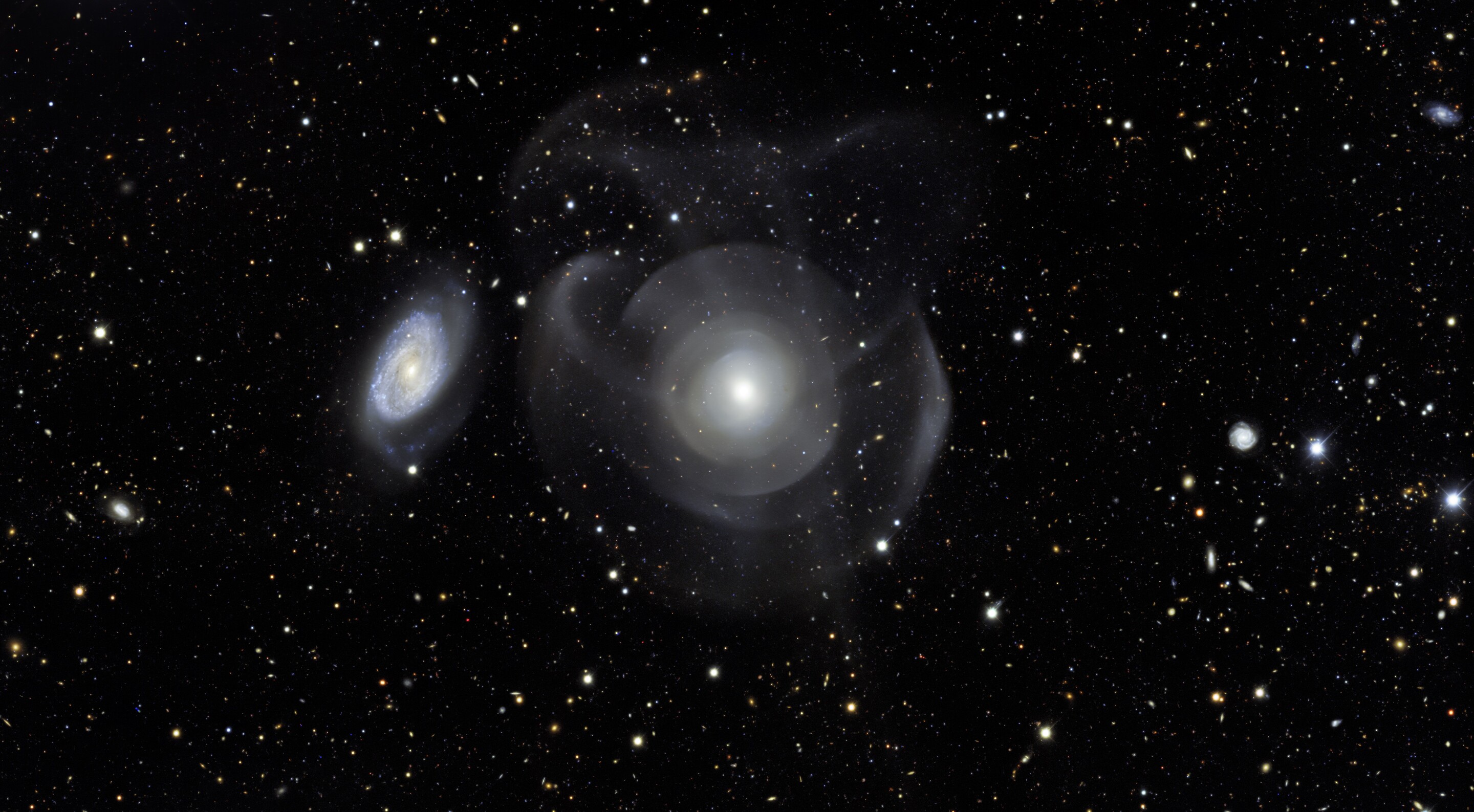
The elliptical galaxy NGC 474 center and spiral galaxy NGC 470 (left). The region shows unusual structures known as “shells of stars” that are likely due to mergers of smaller galaxies into the main body of NGC 474 within the last billion years or close passages of nearby galaxies. (Image: DES/NOIRLab/NSF/AURA)
The ultimate goal of DES, a global collaboration of more than 400 scientists from 26 institutions, is to understand dark energy and its role in the accelerating expansion of the universe. To do this, DES has collected images of hundreds of millions of galaxies and thousands of supernovae. During its six-year mission, DES surveyed one-eighth of the sky and finished collecting data in January 2019.
“DES has imaged millions of galaxies at different stages of cosmic evolution,” says Bhuvnesh Jain. “The release of the full DES data is a big deal for the astronomy community since it is one of the largest and best calibrated datasets of stars and galaxies.” Here at Penn, DES research efforts are led by Jain, Gary Bernstein, Mike Jarvis, and Masao Sako with the help of graduate students and postdocs.
DR2 contains all six years of data collected by DES and represents one of the largest astronomical catalogs published to date. It includes nearly 700 million astronomical objects and, because it is accessible to the public, can now be used for verifying previously published studies as well as enabling new avenues of research.
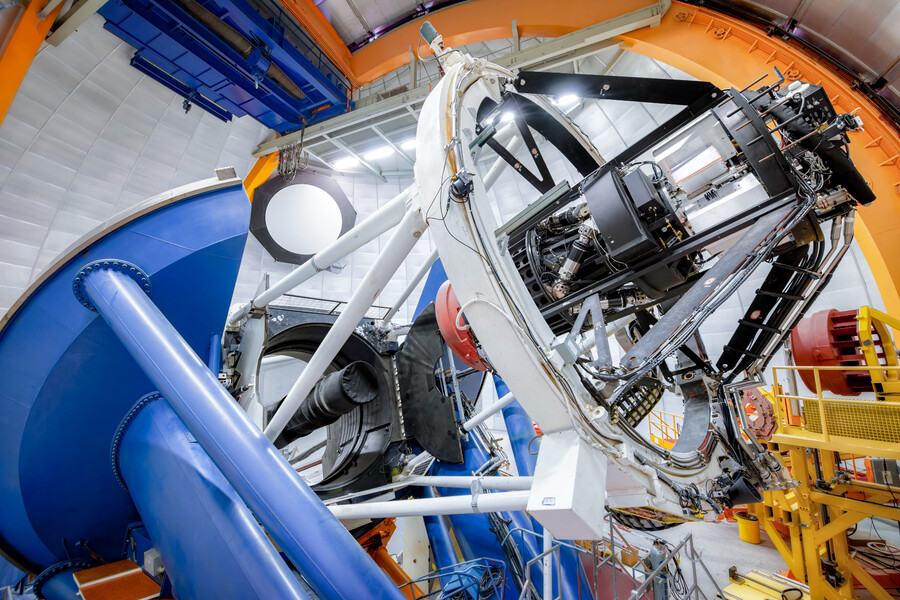
DES relied on a 570-megapixel camera, known as DECa, mounted on the Victor M. Blanco Telescope 4-meter telescope at the Cerro Tololo Inter-American Observatory in Chile. (Image: Reidar Hahn/Fermilab)
One technical contribution made by Penn researchers for DR2 was refined-calibration techniques and improved algorithms for processing images. Bernstein helped develop automated processes for precisely mapping the locations of images collected, and Jarvis worked on algorithmic improvements for image-blur correction. “The DES DR2 represents not just a step forward in the quantity of sky measurements but also in their quality. This is the most accurate and reliable catalog of any sky survey,” says Bernstein.
Data from DR2 are now being used to create an updated map that will improve estimates of the amount and distribution of dark matter in the universe. Previously, DES researchers produced the largest and most accurate dark matter map to date using galaxy weak lensing. A new map, one that will be three times larger, will be released in the near future and will be used to address key questions about the expansion rate of the universe.
Additional studies made possible with the full dataset, to which DES collaborators have had access in advance of its public release, include the ability to study how galaxies have changed since earlier periods of cosmological history by connecting new results with measurements of cosmic-microwave-background data, signals from the earliest moments of the universe’s formation. “Having more galaxies means better statistics,” says Jarvis. “We think this data should be some of the most precise measurements of cosmology over the last half of the universe.”
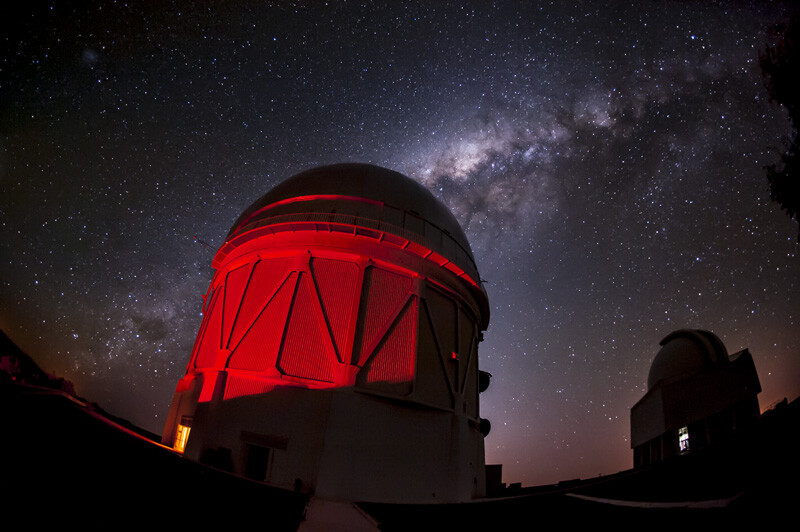
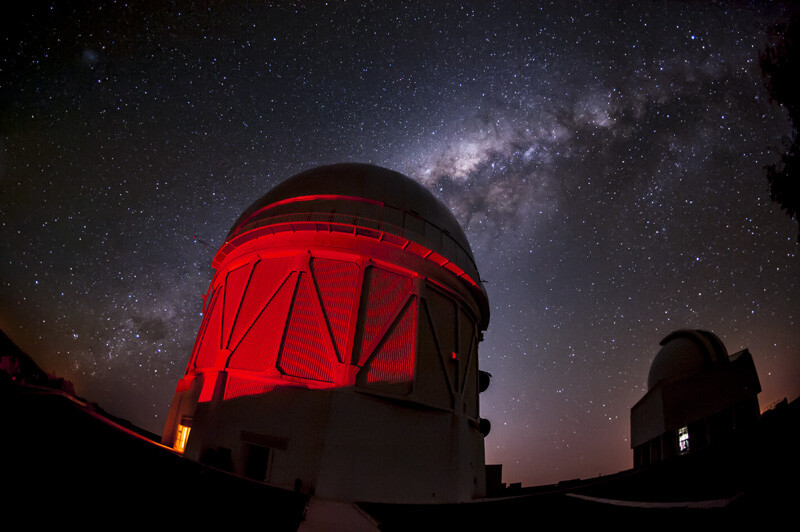
The Blanco Telescope dome at the Cerro Tololo Inter-American Observatory in Chile, where the Dark Energy Camera used for the recently completed Dark Energy Survey was housed. (Image: Reidar Hahn, Fermilab)
“In the next two years, DES will produce the most precise measurements of how cosmic structures have grown via gravity,” says Bernstein. “These will in turn provide stringent tests of the standard model of cosmology—that the universe is composed primarily of dark matter and dark energy, acting as a ‘cosmological constant’ that accelerates the expansion of the universe.”
Graduate students and post-docs from Penn who are working on DES are Pedro Bernardinelli, Cyrille Doux, Dillon Brout, Marco Gatti, Rebekah Hounsell, Shivam Pandey, Helen Qu, Marco Raveri, Carles Sanchez, Helena Sanchez, Lucas Secco, and Tae-hyeon Shin.
On the move: Water quality and antimicrobial resistance testing goes mobile
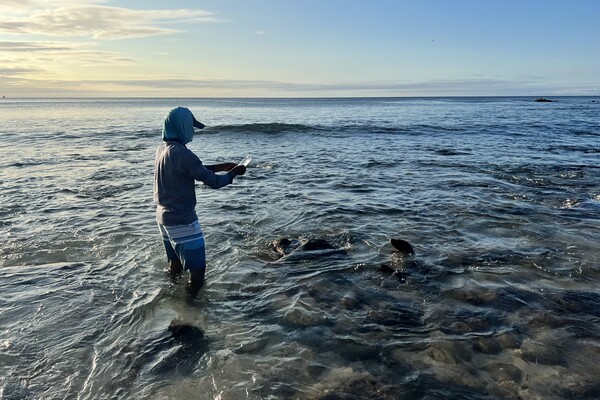
Penn researchers have developed a mobile field laboratory allowing them to test water quality and track antimicrobial resistance in and around San Cristóbal in the Galápagos.
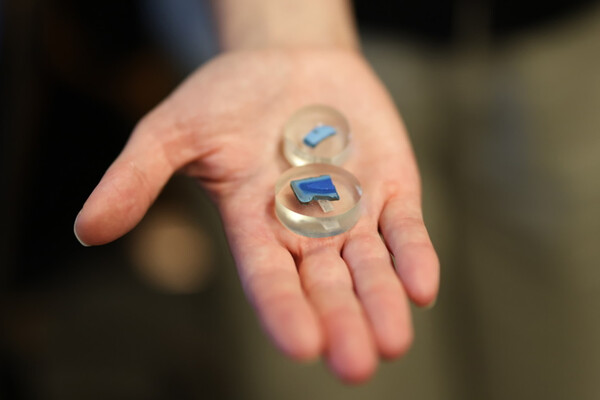
Penn researchers Vanessa and Alexis North are studying one of the largest collections of Egyptian blue objects ever found in the ancient Near East, shedding new light on how the world’s first synthetic pigment may have traveled far beyond Egypt.
A new role for dental providers? Rethinking where vaccines are given
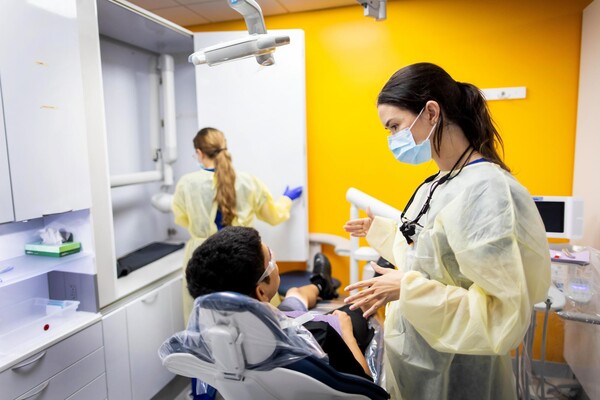
Vaccinations have traditionally been administered in primary care settings or pharmacies. However, for about a decade, some states have authorized dentists to administer vaccines, and many others did so during the COVID-19 pandemic. The effectiveness of this approach has led some countries and states to expand or consider expanding the role of dental providers in delivering routine vaccines, including those against COVID-19 and the human papillomavirus (HPV), and in providing vaccine education.
Penn student develops a way for computer chips to run more efficiently
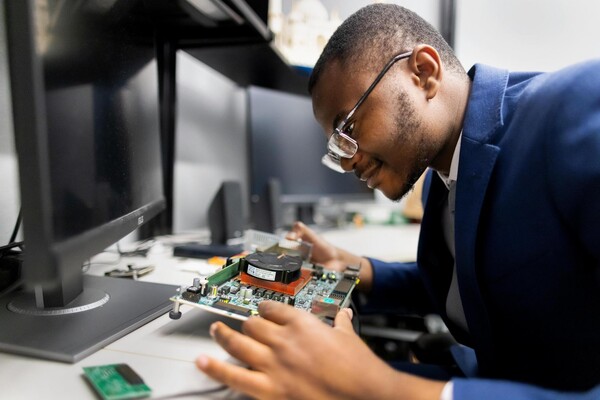
Fluid Silicon, a platform from President’s Sustainability Prize winner Nhlanhla Mavuso, allows computer chips to continuously monitor their health and self-tune as their characteristics change. The technology has the potential to reduce energy usage in data centers and improve reliability in mission-critical applications.