Connecting a star’s chemical composition and planet formation
Along with developing a new statistical method for studying exoplanets, researchers from Penn found that the majority of stars in their dataset are similar to the sun, implying that many stars in the Milky Way could host their own Earthlike planets.
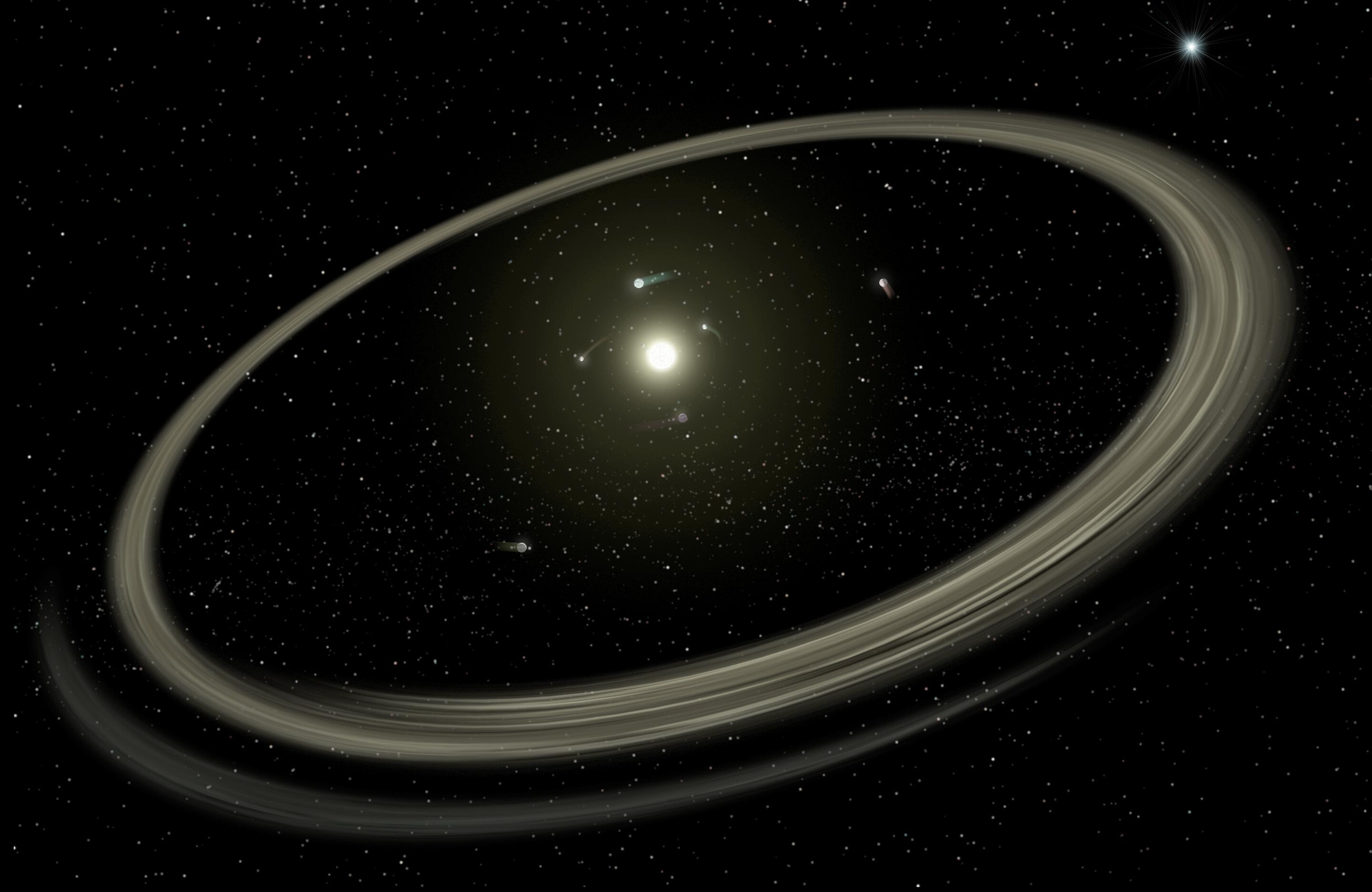
An artist’s concept of a young star circled by planets and rings of dust that arise when newly formed, rocky planets collide with one another. A new study presented at the 238th American Astronomical Society conference describes a new method for quantifying the relationship between a star’s chemical composition and planet formation, work that could help researchers identify individual stars that have a higher likelihood of hosting planets. (Image: NASA/JPL-Caltech)
Researchers from Penn’s Department of Physics and Astronomy have developed a new method for better understanding the relationship between a star’s chemical composition and planet formation. The study was led by recent graduate Jacob Nibauer for his senior thesis with Bhuvnesh Jain and was co-supervised by former Penn postdoc Eric Baxter. The researchers found that the majority of stars in their dataset are similar in composition to the sun, somewhat at odds with earlier work and implying that many stars in the Milky Way could host their own Earth-like planets. These results were presented at the 238th American Astronomical Society conference and also published in The Astrophysical Journal.
The most common technique for finding exoplanets, ones that exist outside of the solar system, involves the transit method, when an exoplanet moves between its star and the observer and causes a dip in the star’s brightness. While most of the known exoplanets have been discovered using this method, this approach is limited because exoplanets can only be detected when their orbit and the observer are perfectly aligned and have short enough orbiting periods. The second most powerful technique, the radial velocity or Doppler method, has other limitations in its ability to find planets.
This raises the question, If planets can’t be detected around a star, can their existence be inferred by studying the host star? The researchers found that the answer to this question is a qualified yes, with new methods helping astronomers better understand how the formation of exoplanets is related to the composition of the star they orbit.
“The idea is that planets and stars are born out of the same natal cloud, so you can imagine a scenario where a rocky planet locks on to enough material to leave the late stellar surface depleted in those elements,” says Nibauer. “The goal is to answer whether planet-hosting stars look different than stars with no planets, and one way to do that is to search for signatures of planet formation in the composition of the stellar surface. Fortunately, the composition of a star, at least of its outer layers, can be inferred from its spectrum, the distribution of light intensity over different frequencies.”
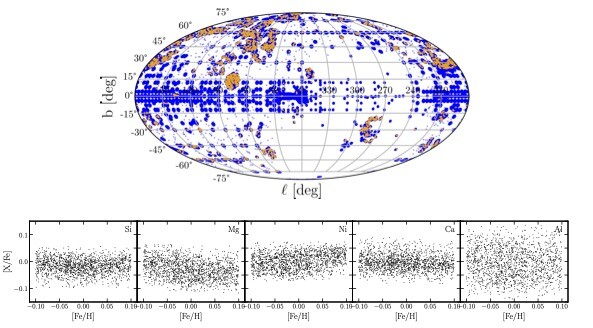
To do this, the researchers used data from the Apache Point Observatory Galactic Evolution Experiment (APOGEE-2), focusing on 1,500 Milky Way galaxy stars with chemical composition data for five different elements. Nibauer’s novel contribution was to apply Bayesian statistics to measure the abundance of five rock-forming, or “refractory”, elements and objectively separate populations of stars based on their chemical compositions.
A projection of data from APOGEE, with orange points indicating stars used in this analysis (top) and the abundance ratios of a subset of chemical elements relative to iron in the population of Sun-like stars (bottom). (Image credit: Jacob Nibauer)
Nibauer’s method allows researchers to look at stars with low signal-to-noise ratios, or where measurement background can be larger than the star’s own signal. “This framework, rather than focusing on a star-by-star basis, combines measurements across the entire population allowing us to characterize the global distribution of chemical abundances,” says Nibauer. “Because of that, we’re able to include much larger populations of stars compared with previous studies.”
The researchers found that their dataset neatly separated stars into two populations. Depleted stars, which make up the majority of the sample, are missing refractory elements compared to the not-depleted population. This could indicate that the missing refractory material in the depleted population is locked up in rocky planets. These results are consistent with other smaller, targeted studies of stars that use more precise chemical-composition measurements. However, the interpretation of these results differs from previous studies in that the sun appears to belong to a population which makes up the majority of the sample.
“Previous studies were sun-centric, so stars are either like the sun or not, but Jake developed a methodology to group similar stars without referencing the sun,” says Jain. “This is the first time that a method which ‘let the data speak’ had found two populations, and we could then place the sun in one of those groups, which turned out to be the depleted group.”
This study also provides a promising avenue to identify individual stars which may have a higher likelihood of hosting their own planets, says Nibauer. “The long-term goal is to identify large populations of exoplanets, and any technique that can place a probabilistic constraint on whether a star is likely to be a planet host without having to rely on the usual transit method is very valuable,” he says.
And if Milky Way stars being depleted is the norm, this could mean that the majority of these stars could be orbited by Earthlike planets, opening up the possibility that stars that are “missing” heavier elements simply have them locked up in orbiting rocky exoplanets, though other possible connections to exoplanets are also being explored. “This would be exciting if confirmed by future analyses of larger datasets,” says Jain.
The complete list of co-authors for The Astrophysical Journal article includes Jacob Nibauer, Eric J. Baxter, and Bhuvnesh Jain from Penn; Jennifer L. Van Saders from the University of Hawaii; Rachael L. Beaton from Princeton University; and Johanna K. Teske from the Earth and Planets Laboratory Carnegie Institution of Washington.
On the move: Water quality and antimicrobial resistance testing goes mobile
Penn researchers have developed a mobile field laboratory allowing them to test water quality and track antimicrobial resistance in and around San Cristóbal in the Galápagos.
Penn researchers Vanessa and Alexis North are studying one of the largest collections of Egyptian blue objects ever found in the ancient Near East, shedding new light on how the world’s first synthetic pigment may have traveled far beyond Egypt.
A new role for dental providers? Rethinking where vaccines are given
Vaccinations have traditionally been administered in primary care settings or pharmacies. However, for about a decade, some states have authorized dentists to administer vaccines, and many others did so during the COVID-19 pandemic. The effectiveness of this approach has led some countries and states to expand or consider expanding the role of dental providers in delivering routine vaccines, including those against COVID-19 and the human papillomavirus (HPV), and in providing vaccine education.
Penn student develops a way for computer chips to run more efficiently
Fluid Silicon, a platform from President’s Sustainability Prize winner Nhlanhla Mavuso, allows computer chips to continuously monitor their health and self-tune as their characteristics change. The technology has the potential to reduce energy usage in data centers and improve reliability in mission-critical applications.