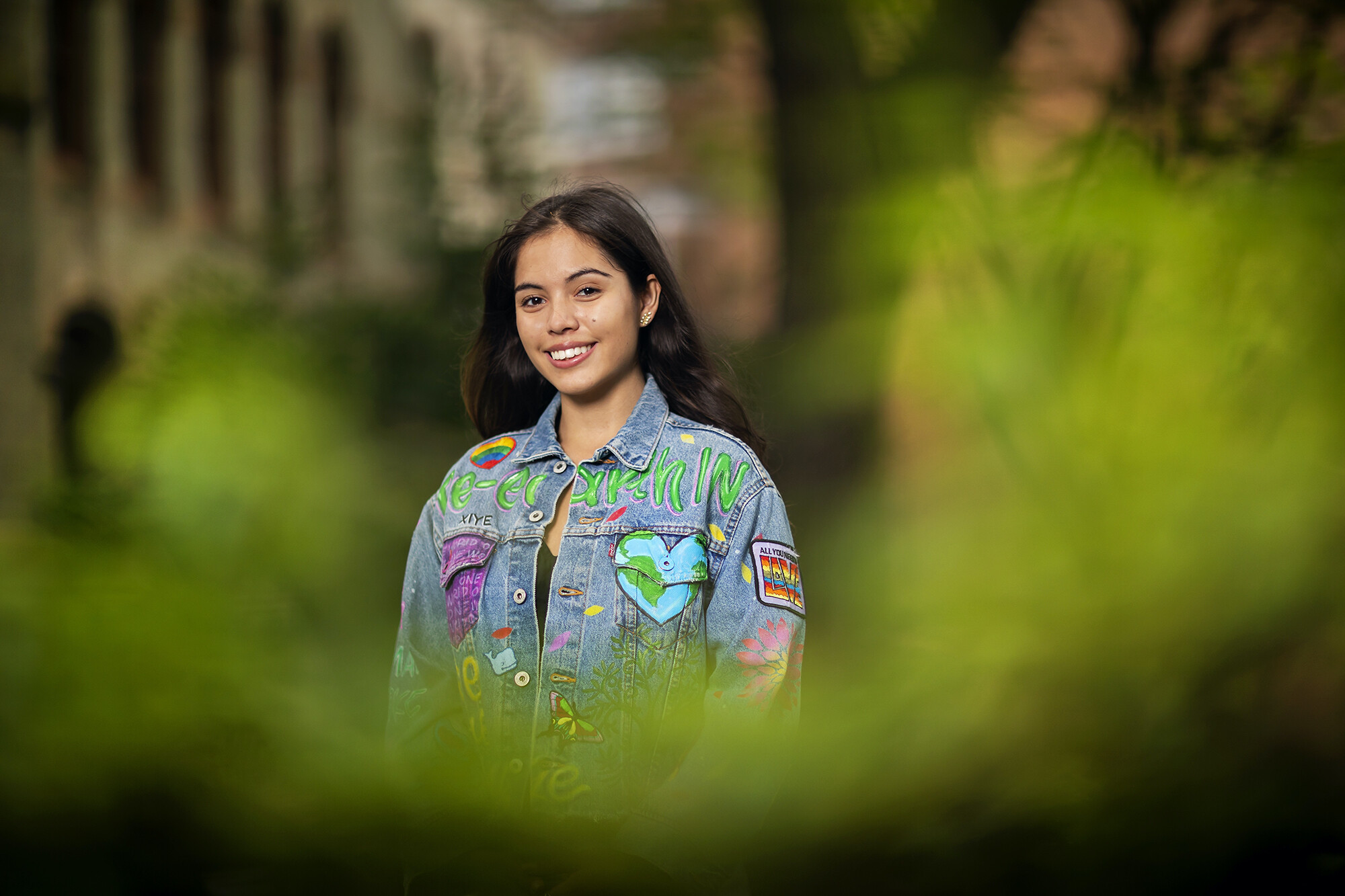
In a Q&A with Xiye Bastida, the second year describes how she’s bringing climate activism to her college experience, how her Indigenous background influences her path, and why storytelling and protecting Earth go hand in hand.
Second year Xiye Bastida, from San Pedro Tultepec, Mexico, has participated in Greta Thunberg’s Fridays for the Future movement. She and friends began the Re-Earth Initiative aimed at “reimaging the future, reconnecting with the planet, and redefining collaboration.” Despite six years of environmental activism under her belt, Bastida says she’s just getting started.
When unprecedented rainfall caused the Mexican town of San Pedro Tultepec to flood in 2015, climate change landed on Xiye Bastida’s doorstep.
“For me that was a turning point,” says Bastida, now a Penn sophomore. “I saw all of this—the flooding in my hometown but also wildfires, hurricanes—as the second wave of the climate crisis that we were told wouldn’t come until the end of the century. I realized I had to be part of the solution.”
In the six years since, Bastida has become a full-fledged climate activist. She participated in Greta Thunberg’s Fridays for the Future movement, building a New York City chapter that eventually organized 300,000 students across the city to strike in the name of climate change.
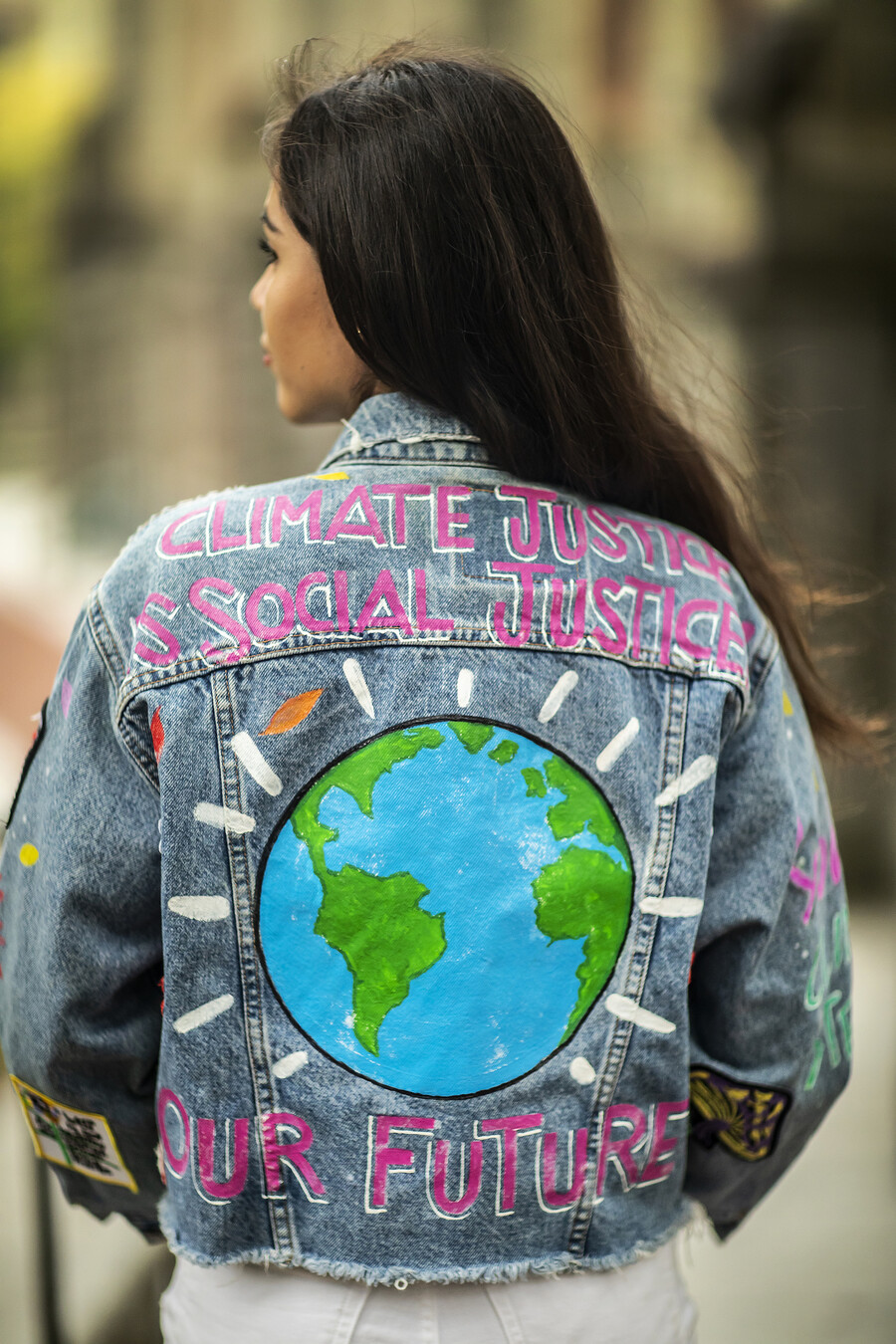
During the pandemic, she and friends started Re-Earth Initiative, a nonprofit aimed at “reimaging the future, reconnecting with the planet, and redefining collaboration,” as well as highlighting the work of groups often overlooked in the fight for the environment.
In 2020, Bastida contributed a chapter to “All We Can Save,” an anthology about climate change written by 60 women making a difference. That book became the centerpiece of Penn’s New Student Orientation Second-Year Reading Experience and the University’s Climate Week keynote, which Bastida moderated.
Penn Today spoke with Bastida about what it’s like being a college student when your reputation precedes you, plus how she’s bringing her climate activism to Penn, how her background has influenced her path, and why storytelling and protecting Earth go hand in hand.
What spurred you to get involved in the climate movement at such a young age?
My parents have been part of the environmental movement since they were in their 20s. I was raised with a lot of sensibility when it comes to caring about the environment, caring about Mother Earth. My dad is Otomi, which is an Indigenous group in central Mexico, so I was also raised with that Indigenous cosmology of reciprocity, of taking care of Mother Earth. Growing up with that lens, I was socialized differently than most people. Not everyone saw the world the way I was raised to see the world.
In your essay for ‘All We Can Save,’ you describe the idea of using storytelling as a tool. What do you mean by that?
Storytelling is a major part of most Indigenous cultures around the world. That’s how we’re socialized, with stories about the past, the present, and the future. We have special “youth and elder circles,” where the elders in the community tell the youth stories about our creation, our culture, about the way the community works. That inter-generational passage of wisdom and knowledge is really important. We gain a lot of knowledge from those stories.
A lot of the culture and tradition we have comes from the immediate ecosystem, the immediate surroundings. A really beautiful example is that in Otomi, the word for “skin” is the same as the word for the outer layer for the Earth. So just in language, you can see the connection between us, our skin, and the skin of the Earth. If we hurt the skin of the Earth, we’re also hurting ourselves.
How do you think the approach Indigenous communities take to caring for the Earth could work for anyone and in any place?
This worldview should not be limited to certain groups if it’s a worldview that will help us. It’s just a shift in culture. Obviously, it’s easier said than done. But I think that’s what we need, a shift in how we perceive our role in the world, the role of our legacy and our history.
With something like the climate crisis, we already know how we have failed to keep our planet, our air, and our water clean and how we can learn from that and move forward. The climate crisis touches every sector. It doesn’t matter where you are, where you live, what you work on, which means every sector has the possibility to be a part of the solution.
How do you plan to continue your climate work here at Penn?
I’m taking all the climate-related classes I can. Environmental Ethics; Energy, Oil, and Global Warming; Environmental & Energy Economics and Policy. Every class that has environment, climate, anything of the sort, I’ve taken it, or I will take it. After being in the movement for so long, you sometimes think there is nothing more to learn, but every day I am surprised by how much I can learn, how much of this I bring to my work and my speeches. I’m really happy that Penn offers these types of classes. I also plan on joining student climate initiatives.
How does it feel to have written part of a book that your classmates at Penn have now read?
When I first saw the book that was chosen for the Second-Year Reading Experience, I thought it was a breakthrough that we were reading a book about climate solutions through a feminist lens. I was excited. I was also scared or nervous that people would be like, ‘Oh my gosh, she goes here.’ I have been stopped on Locust Walk several times, saying, ‘Are you the climate girl?’ I usually don’t know how to react, so I usually say, ‘Yes, that’s me. I hope you enjoyed the book.’ Or ‘If you have any questions let me know.’
In high school, when I started my activism, some people couldn’t understand it. People here appreciate it; they are very respectful of it. I like how engaged, responsive, and receptive people seem to be. It makes me feel like all the work I’ve done resonates with my peers, which is one of the most important parts of the movement. Ultimately, it’s about making this movement—that is for all of us, really—resonate with the people you represent.
Xiye Bastida, from San Pedro Tultepec Mexico, is a sophomore in the College of Arts and Sciences. She is majoring in Environmental Studies with a concentration in policy.
On the move: Water quality and antimicrobial resistance testing goes mobile
Penn researchers have developed a mobile field laboratory allowing them to test water quality and track antimicrobial resistance in and around San Cristóbal in the Galápagos.
Penn researchers Vanessa and Alexis North are studying one of the largest collections of Egyptian blue objects ever found in the ancient Near East, shedding new light on how the world’s first synthetic pigment may have traveled far beyond Egypt.
A new role for dental providers? Rethinking where vaccines are given
Vaccinations have traditionally been administered in primary care settings or pharmacies. However, for about a decade, some states have authorized dentists to administer vaccines, and many others did so during the COVID-19 pandemic. The effectiveness of this approach has led some countries and states to expand or consider expanding the role of dental providers in delivering routine vaccines, including those against COVID-19 and the human papillomavirus (HPV), and in providing vaccine education.
Penn student develops a way for computer chips to run more efficiently
Fluid Silicon, a platform from President’s Sustainability Prize winner Nhlanhla Mavuso, allows computer chips to continuously monitor their health and self-tune as their characteristics change. The technology has the potential to reduce energy usage in data centers and improve reliability in mission-critical applications.