Naskapi connections: Restorative research in the Penn Museum collection
Blog post by anthropologist Margaret Bruchac about a Native child’s hunting coat attracts students to study items made by their ancestors.
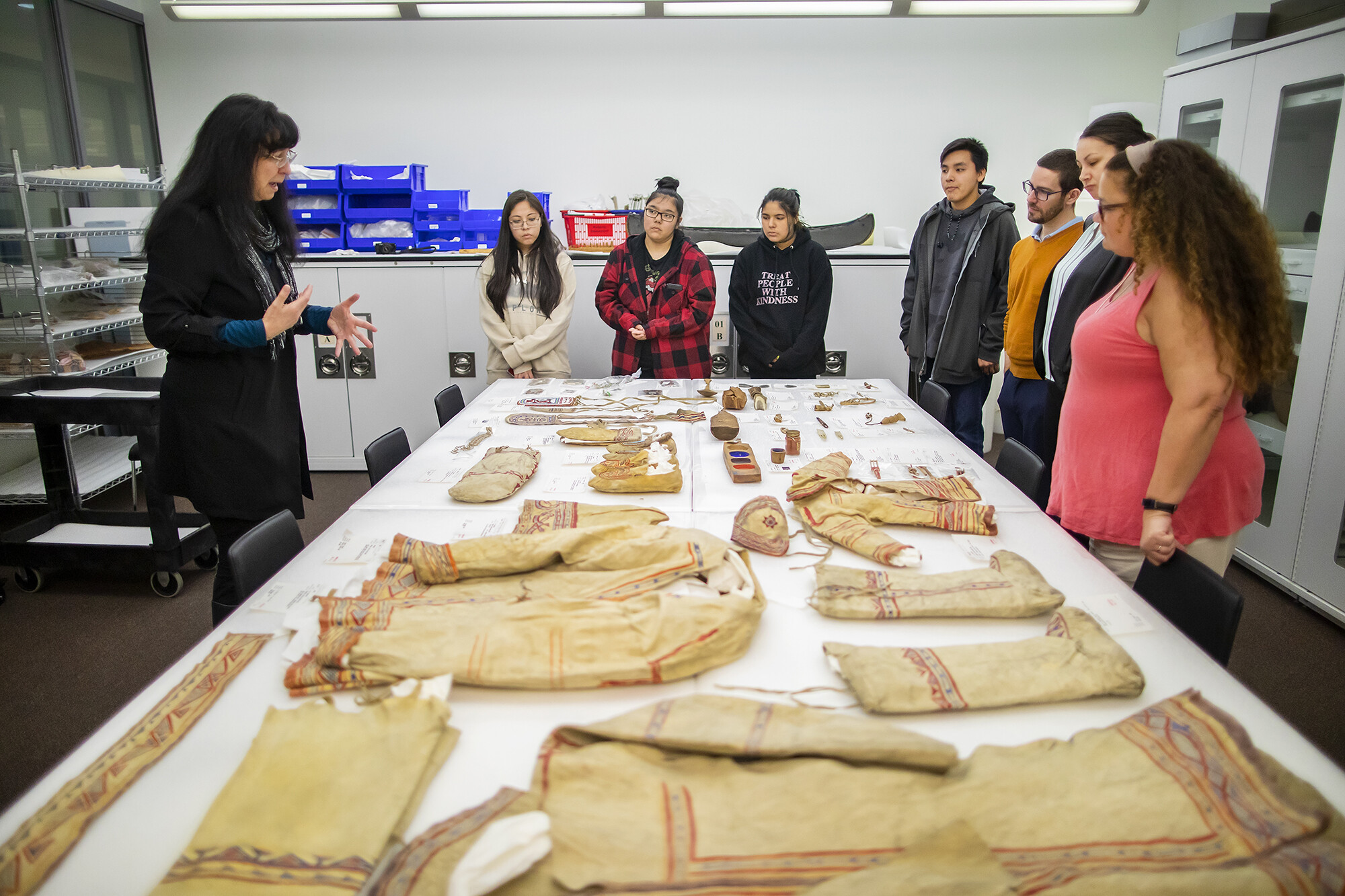
Penn anthropologist Margaret Bruchac, left, speaking with visitors from the Naskapi Nation in Canada about the Penn Museum’s collection of more than 400 objects from their community acquired in the 1930s by Frank Speck, a founder of Penn’s Anthropology Department.
Evocative objects used by Indigenous people long ago, such as painted clothing made of animal skins, beaded belts, woven baskets, along with the tools they used to create them, are the focus of research and outreach by Penn anthropologist Margaret Bruchac.
In blogs, research articles, and social media, Bruchac writes about these items, now in museum collections, as carriers of knowledge, connections to the living past. One of her main recovery projects, The Wampum Trail, is to survey historic wampum belts in museums in Europe and North America. Her goal is to reconnect them with their Native communities.
“What happened to these objects? Why did they leave Native hands? I happen to believe all of that is traceable. It is like unraveling a mystery,” says Bruchac, an associate professor in the School of Arts and Sciences who has been at Penn since 2013.
She examines the material details, traces of raw materials from the environment, aspects of culture and technologies, stories about the people who wore or used these objects. These are all clues to their histories.
“How can we bring Indigenous communities back in touch with these objects that are significant to them?” she asks. “How can we listen to the stories painted into these seemingly silent objects, see the work of these elders' hands, consider the knowledges embedded here that could yet be recovered, the songs that could be reanimated, the relationships that could be restored?”
Bruchac involves her Penn students in the effort to connect with Native communities through a Museum Anthropology course she teaches each year focused on the Penn Museum collection. Known for its vast collection from the Americas, the Museum stewards more than 400,000 cultural items from Native North America.
She works with students to select, investigate and write about interesting objects for the Museum’s blog, reaching beyond the brief descriptions recorded on exhibit labels and index cards. A Native child’s hunting coat and cap made of caribou skin caught the attention of Ben Kelser, who took the class in the fall of 2018 when he was a senior.
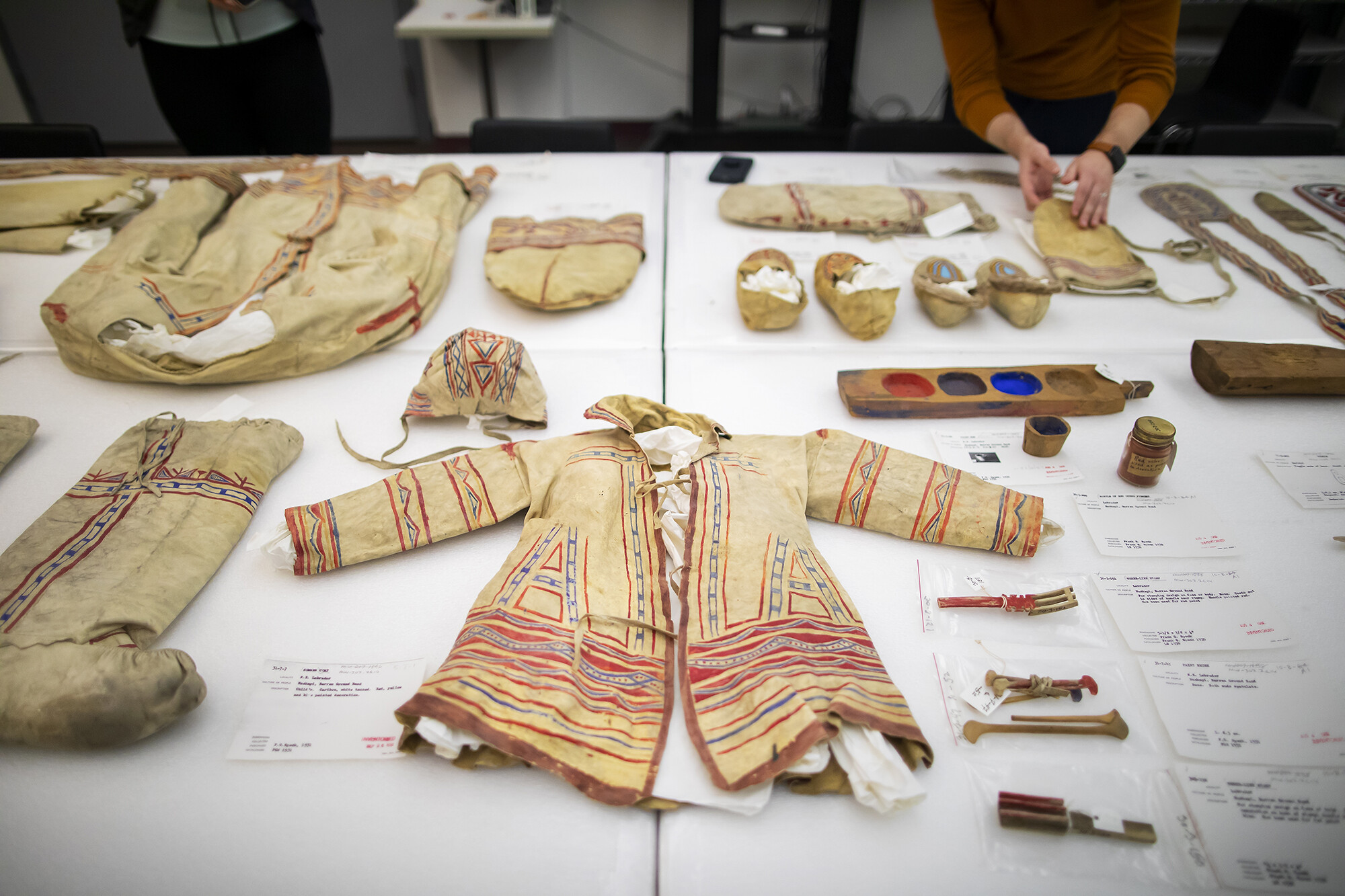
A painted Naskapi child’s hunting coat and cap made from caribou skin was the subject of a Museum blog post.
Highly decorated and in nearly perfect condition, the coat and cap are among about 400 objects in the Museum’s collection from Canada’s Naskapi Nation. The objects were acquired in the early 1930s by Frank Speck, one of the founders of Penn’s Anthropology Department.
“The research process itself was so engaging that I would have remembered these objects for the rest of my life even without writing a paper,” says Kelser, a psychology major who graduated from Penn last May.
He and Bruchac composed a blog post that happened to catch the attention of Jill Goldberg, director of Naskapi liaison for the Central Quebec School Board, which works closely with the Naskapi Education Committee in the present-day Naskapi Nation in Kawawachikamach, Quebec.
Goldberg was determined to visit Philadelphia to see these objects in person: “This is about giving these students a chance to reconnect with their story.”
I felt like my grandfather was there
With funding from the Naskapi Education Committee, principal Joseph Whelan, assistant principal Shannon Uniam, and Goldberg brought all four students in the 2020 graduating class of Jimmy Sandy Memorial School to the United States early this spring. They traveled to Philadelphia, Washington, D.C., and New York City, with the two days at the Penn Museum as the centerpiece of the experience.
Uniam and her students are all Indigenous Naskapi, members of a First Nations band that has occupied sub-Arctic hunting territories in present-day eastern Canada for generations.
Historically, the Naskapi and Innu people lived across present-day Quebec and Labrador. The combined pressures of European colonization and decline of the George River caribou herd eventually forced the Barren Ground band of Naskapi to the decision, in the 1970s, to settle on reserve lands near the mining town of Schefferville. There is only one road to the village, and the area is surrounded by bodies of water. The trip to Philadelphia was the first outside the country for Uniam and her students.
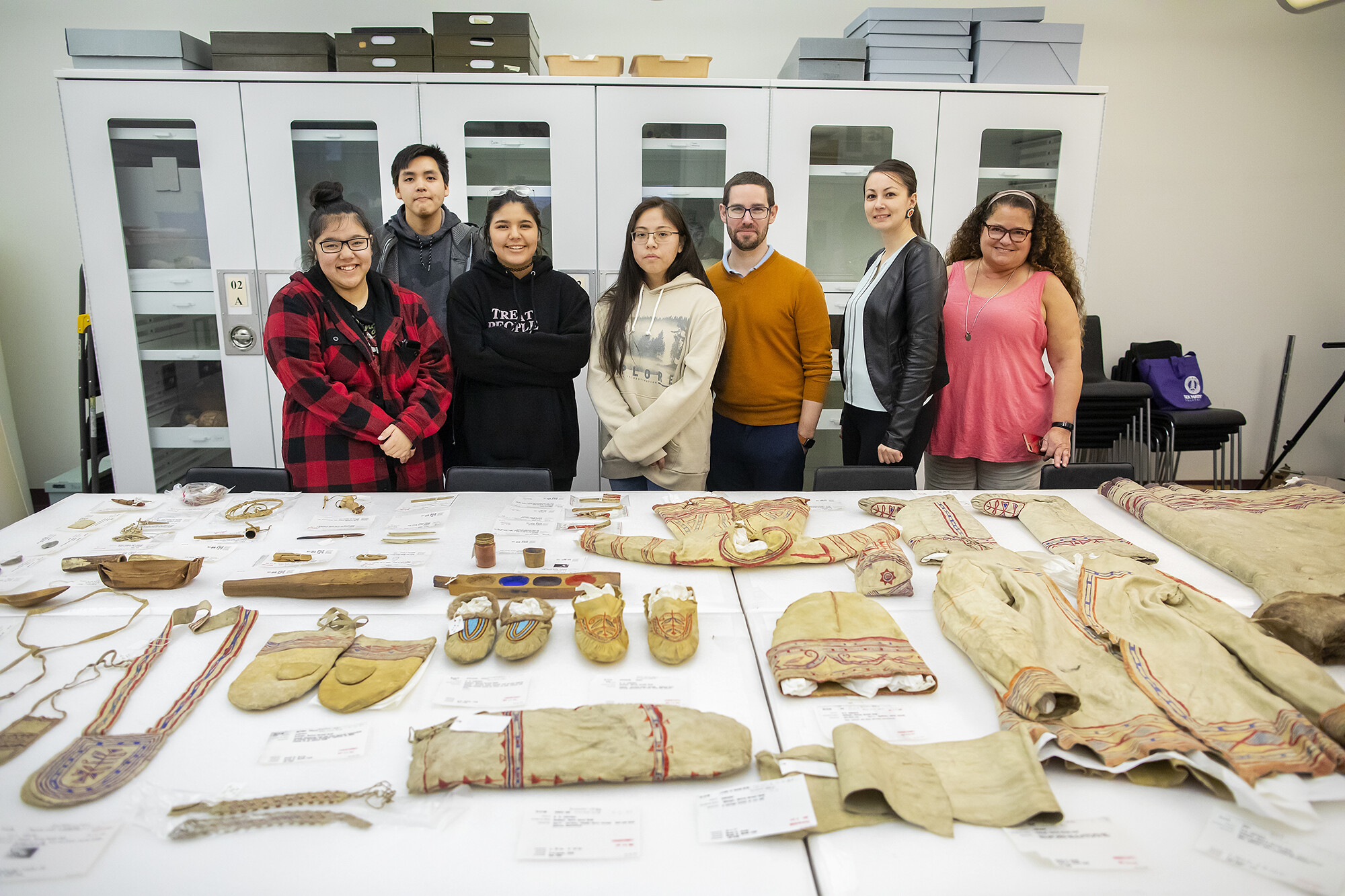
At Penn, their primary interest was the Naskapi material collected by Speck. As the group was escorted to a collections study room in the storage area of the Museum, Uniam looked through the window and gasped. More than 100 artifacts, made by her Naskapi ancestors nearly 100 years ago, were carefully laid out on a large table.
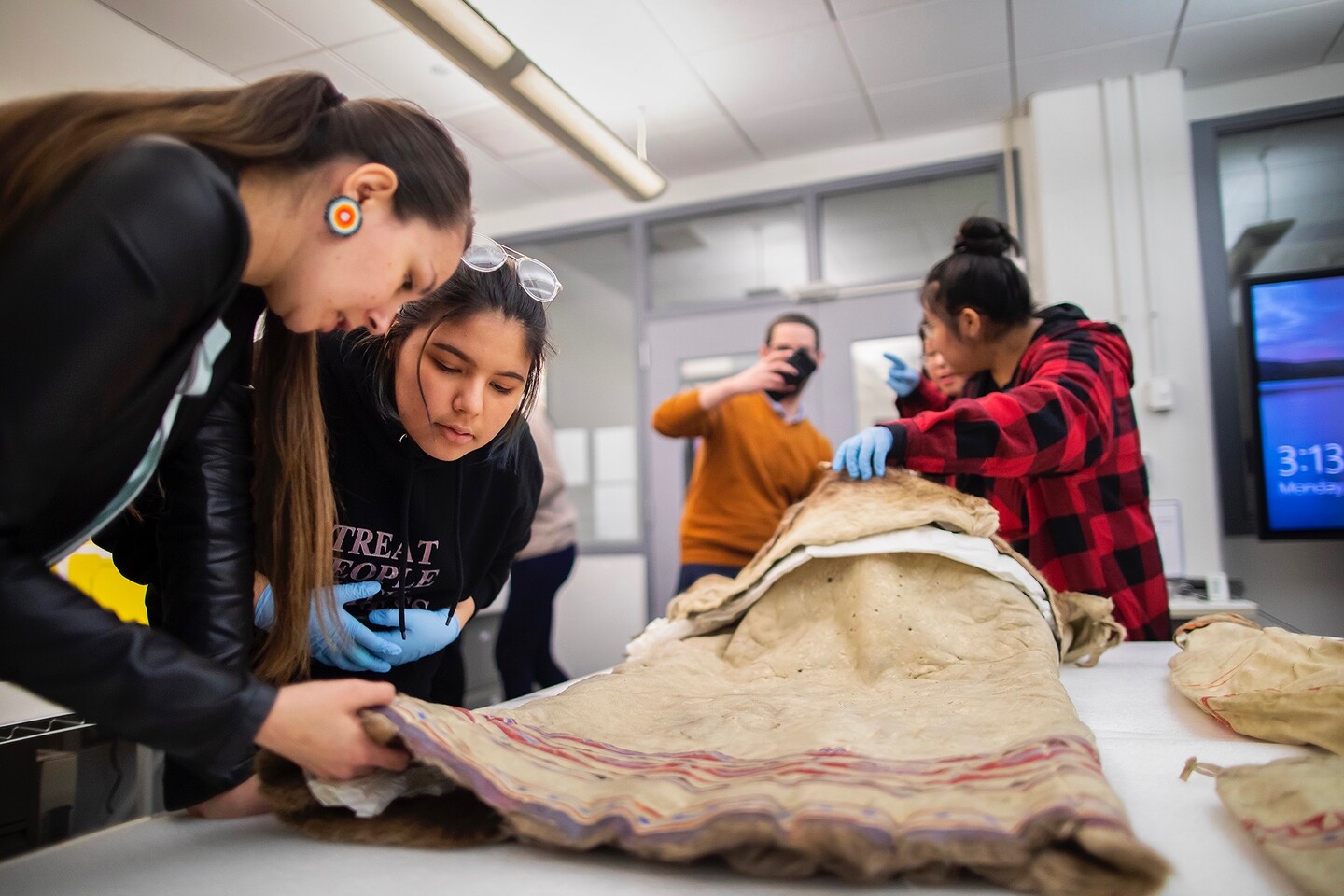
Shannon Uniam, left, assistant principal of the Jimmy Sandy Memorial School, was especially interested in a fur-lined Naskapi dress made from caribou skin.
It was the first time she had seen such a wide variety of everyday items from her people, including hunting garments made of caribou hide painted with natural pigments, along with the tools that created them.
“The first thing I thought about as I walked in was my grandfather, and the first thing I saw were the leggings. They were right there,” she says. “I was kind of shocked. I felt like my grandfather was there with me.”
Such a personal encounter is what Bruchac hopes for, “being or becoming a connecting link between generations, between institutions and communities,” she says. “There was a moment where I could sense that my role, as a translator or interpreter or perhaps even a scout, was to reach with one hand into Speck’s collections and with the other hand into the future and out to communities that might be seeking that connection.”
Letting things speak to you
The group met with several Museum staff, including Curator Lucy Fowler Williams, senior keeper of the American Collections, who gave them a tour of the Native American Voices exhibition, and Bill Wierzbowski, assistant keeper, who showed them the behind-the-scenes storage of the Native American objects. The visitors also learned about object conservation, the Museum archives, and the Native American Graves Protection and Repatriation Act.
But the main event was spending time with a large portion of the Naskapi collection.
“These objects were just silent, living dormant on shelves, observed by students or faculty now and then. But to have them with the descendants of the community who created them, literally wakes them up,” Bruchac says. “For me this work is not just research; it is about restorative relationships.”
Bruchac says Speck was known for collecting not just the fine finished products but also well-worn coats and clothing and the things from everyday life: wooden paint pots and pigments, tools and brushes, tobacco pipes and pouches, jewelry and games.
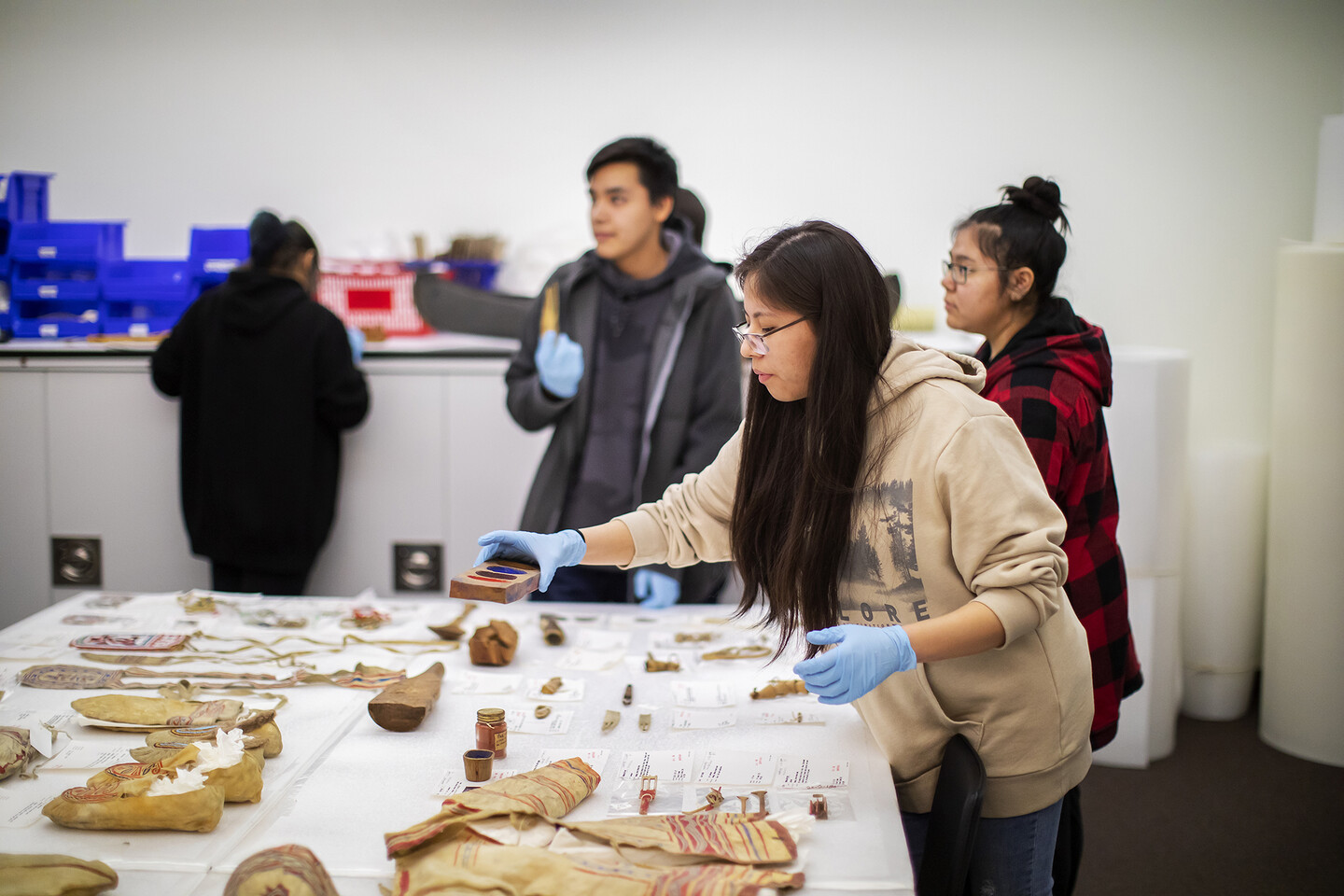
Stephanie Mach, a doctoral student in anthropology and a Museum academic coordinator, had chosen a variety of those items for the First Nations visitors to see and touch during their visit.
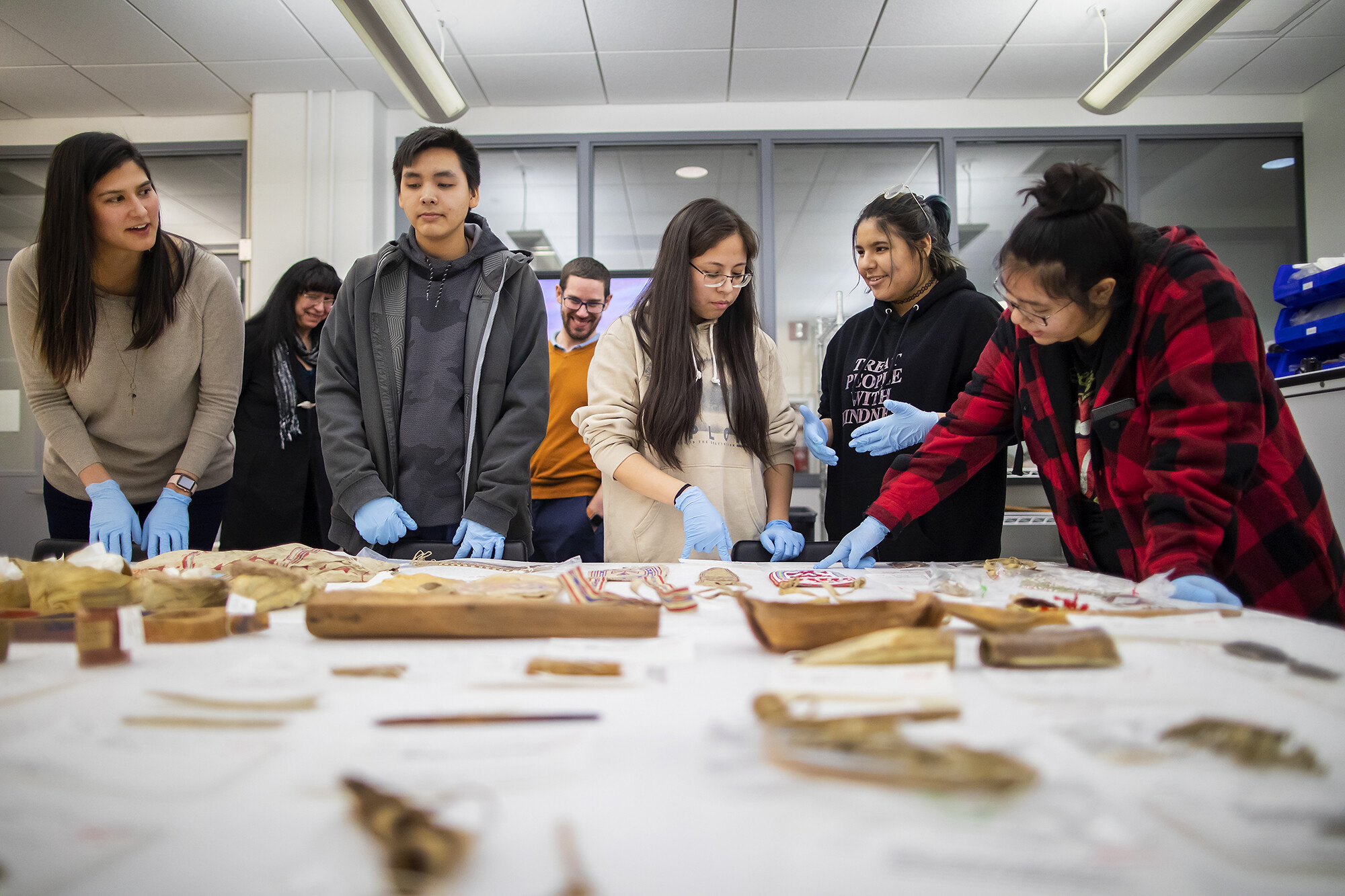
Stephanie Mach, left, a Penn doctoral student and Museum educator, chose the more than 100 objects for the visitors to examine during their visit.
“Feel free to walk around. You can take as many pictures as you want,” Mach told the visitors as they entered the room in the Museum’s Mainwaring Collections Storage Wing.
“Start by letting things speak to you. Because what often happens is that memories that you don’t know you have will be recovered and provoked by these objects,” Bruchac said to them. “You might even sense connections with the people who made them, in a way that isn’t always easy to explain.”
The grandparents and great-grandparents of these visitors likely spoke with Speck, and it is quite possible that the objects they were looking at were made and used by their direct ancestors, Bruchac says.
Mach asked: “Would you like to hold them?”
Yes, they did. Gently picking up the hem of a coat, holding a moccasin, examining a wooden paint palette, for nearly two hours the visitors examined the dozens of objects. Mach helped Uniam pick up a thick winter hunting dress, with a fur-lined matching cape. “It’s so beautiful to see,” Uniam said as she held her arms out to see the length of the sleeves.
Proud and happy
The coat and cap described in Kelser’s blog was a favorite of student Laura-Louise Mameanskum. She explained her thoughts in the Naskapi language, translated to English by Uniam. “She can imagine what she saw like a young child, who is now an elder, or perhaps passed away. It could have been one of her relatives because she has a big family, really most of the community,” Uniam translated.
Among the items collected by Speck were tools such as natural pigments and wooden paint pots and markers.
The school has 250 students in the town of about 900 people. But none of these students had seen Naskapi items like these, except for a few items in a display case at school. Mameanskum said she felt “a little embarrassed” that she didn’t know before that they existed. “I am proud and happy that we had a chance to see the artifacts,” she said in English.
A small black canoe is what spoke to student Seth Nabinacaboo because it reminded him of when he goes out canoeing with his family. For Rachel Nattawappio-Pien, the high moccasins, or mukluks, reminded her of her grandmother. “She used to make stuff like that all the time,” she said, overcome with emotion. Uniam explained that her Inuit grandmother was well-known in the community for her handmade artisanal works.
Holding the large mukluks was emotional for Uniam as well. “When I first saw those, I thought, ‘is this my ancestor’s?’” Her grandfather told her a story about wearing similar leggings when he was a young boy going to hunt in the midwinter, trudging through muck and slush, desperate to find something to feed the family. “I can imagine what he went through, looking at those leggings,” she said. “So soaked, so cold, and he was so young.”
The other story her grandfather told was about a dream he had as a boy, not long after his parents died: He was lifted by an eagle, and when he looked down he was wearing snowshoes. Uniam also wears snowshoes, often when she goes hunting. She asked Bruchac and Mach if they could see some snowshoes?
Mach led the group to a collections storage room with banks of floor-to-ceiling storage cabinets. Pulling out one drawer after another, marveling at the Naskapi and Innu objects, they found two pairs of round snowshoes from the early 1900s that they were allowed to hold and examine up close.
“I kind of felt something looking at the artifacts. I’m so glad we had the chance to come here and see this,” Uniam said.
Carry it forward
The experience was emotional for Bruchac as well, because so much of her research is directed at identifying and recovering Indigenous cultural heritage. She says she is especially interested in reaching the Native communities and collections she came to know through research for her book “Savage Kin,” which examines the relationships between Indigenous peoples and early 20th century anthropologists, including Speck.
She hopes the visit by the Naskapi is the beginning of a long-term relationship with that community and that perhaps they can help the Museum better understand the collection it is preserving.
“So what I’m really excited about is what happens next,” Bruchac told the group at day’s end. “Now these objects have been introduced to you, but it’s a technology that needs young hands and young minds and young hearts to carry it forward and to help keep the stories alive.”
The group that visited the Penn Museum to see the Naskapi Nation collection, from left: Rachel Nattawappio-Pien, Seth Nabinacaboo, Deleah Vachon, Laura-Louise Mameanskum, Joseph Whelan, Shannon Uniam, Jill Goldberg.
On the move: Water quality and antimicrobial resistance testing goes mobile
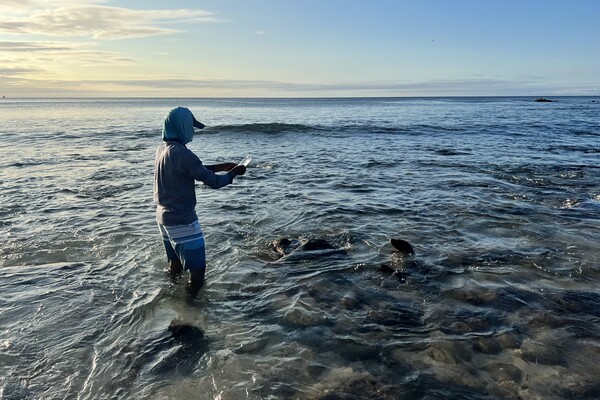
Penn researchers have developed a mobile field laboratory allowing them to test water quality and track antimicrobial resistance in and around San Cristóbal in the Galápagos.
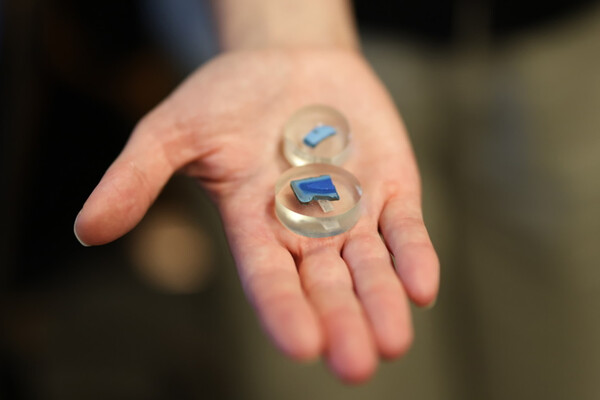
Penn researchers Vanessa and Alexis North are studying one of the largest collections of Egyptian blue objects ever found in the ancient Near East, shedding new light on how the world’s first synthetic pigment may have traveled far beyond Egypt.
A new role for dental providers? Rethinking where vaccines are given
Vaccinations have traditionally been administered in primary care settings or pharmacies. However, for about a decade, some states have authorized dentists to administer vaccines, and many others did so during the COVID-19 pandemic. The effectiveness of this approach has led some countries and states to expand or consider expanding the role of dental providers in delivering routine vaccines, including those against COVID-19 and the human papillomavirus (HPV), and in providing vaccine education.
Penn student develops a way for computer chips to run more efficiently
Fluid Silicon, a platform from President’s Sustainability Prize winner Nhlanhla Mavuso, allows computer chips to continuously monitor their health and self-tune as their characteristics change. The technology has the potential to reduce energy usage in data centers and improve reliability in mission-critical applications.