In a new Spanish-language book, Annenberg School for Communication professor Sandra González-Bailón and a veteran El País journalist examine how platforms amplify voices, distort realities, and redefine our democracies.
2 min. read
What are the effects of social media on our social, political, and personal lives? How do echo chambers deepen polarization, and how do algorithms fuel extremism?
Jordi Pérez Colomé and Sandra González-Bailón at the Madrid Book Fair.
(Image: Courtesy of Annenberg School for Communication)
In “El Vuelco: Historia personal y política de cómo las redes han cambiado el mundo para siempre,” (“The Upheaval: A Personal and Political History of How Networks Changed the World Forever”), a new Spanish-language book by Carolyn Marvin Professor of Communication and Sociology Sandra González-Bailón and El País journalist Jordi Pérez Colomé address these questions through research and personal experience to challenge popular narratives about social networks and society. Their book examines how online technologies—from social media to AI—transformed political power over the last three decades.
“We challenge the idea that algorithms alone control what we see,” says González-Bailón. “Networked minorities are the real drivers of change because of their disproportionate impact on content creation and visibility.”
“We were driven by a shared frustration with how metaphors are used and misused to describe the social impact of technology, from social media to AI,” she explains. “So we decided to write a book that strips away the clichés and looks at the underlying evidence.”
On the move: Water quality and antimicrobial resistance testing goes mobile
Penn researchers have developed a mobile field laboratory allowing them to test water quality and track antimicrobial resistance in and around San Cristóbal in the Galápagos.
Penn researchers Vanessa and Alexis North are studying one of the largest collections of Egyptian blue objects ever found in the ancient Near East, shedding new light on how the world’s first synthetic pigment may have traveled far beyond Egypt.
A new role for dental providers? Rethinking where vaccines are given
Vaccinations have traditionally been administered in primary care settings or pharmacies. However, for about a decade, some states have authorized dentists to administer vaccines, and many others did so during the COVID-19 pandemic. The effectiveness of this approach has led some countries and states to expand or consider expanding the role of dental providers in delivering routine vaccines, including those against COVID-19 and the human papillomavirus (HPV), and in providing vaccine education.
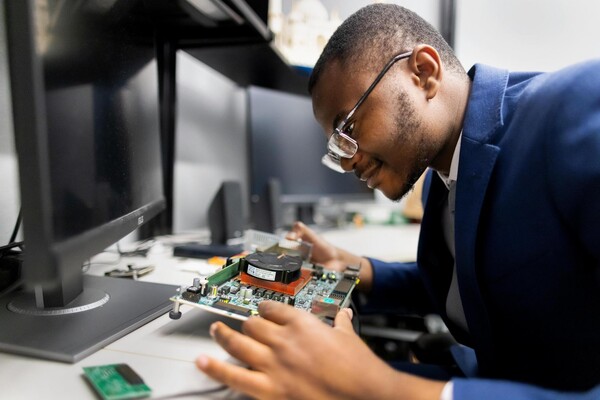
Penn student develops a way for computer chips to run more efficiently
Fluid Silicon, a platform from President’s Sustainability Prize winner Nhlanhla Mavuso, allows computer chips to continuously monitor their health and self-tune as their characteristics change. The technology has the potential to reduce energy usage in data centers and improve reliability in mission-critical applications.