A long-unseen archive centered on an 18th-century Mughal woman will soon be publicly accessible, thanks to the work of religious studies professor Megan Robb and a team of Penn students.
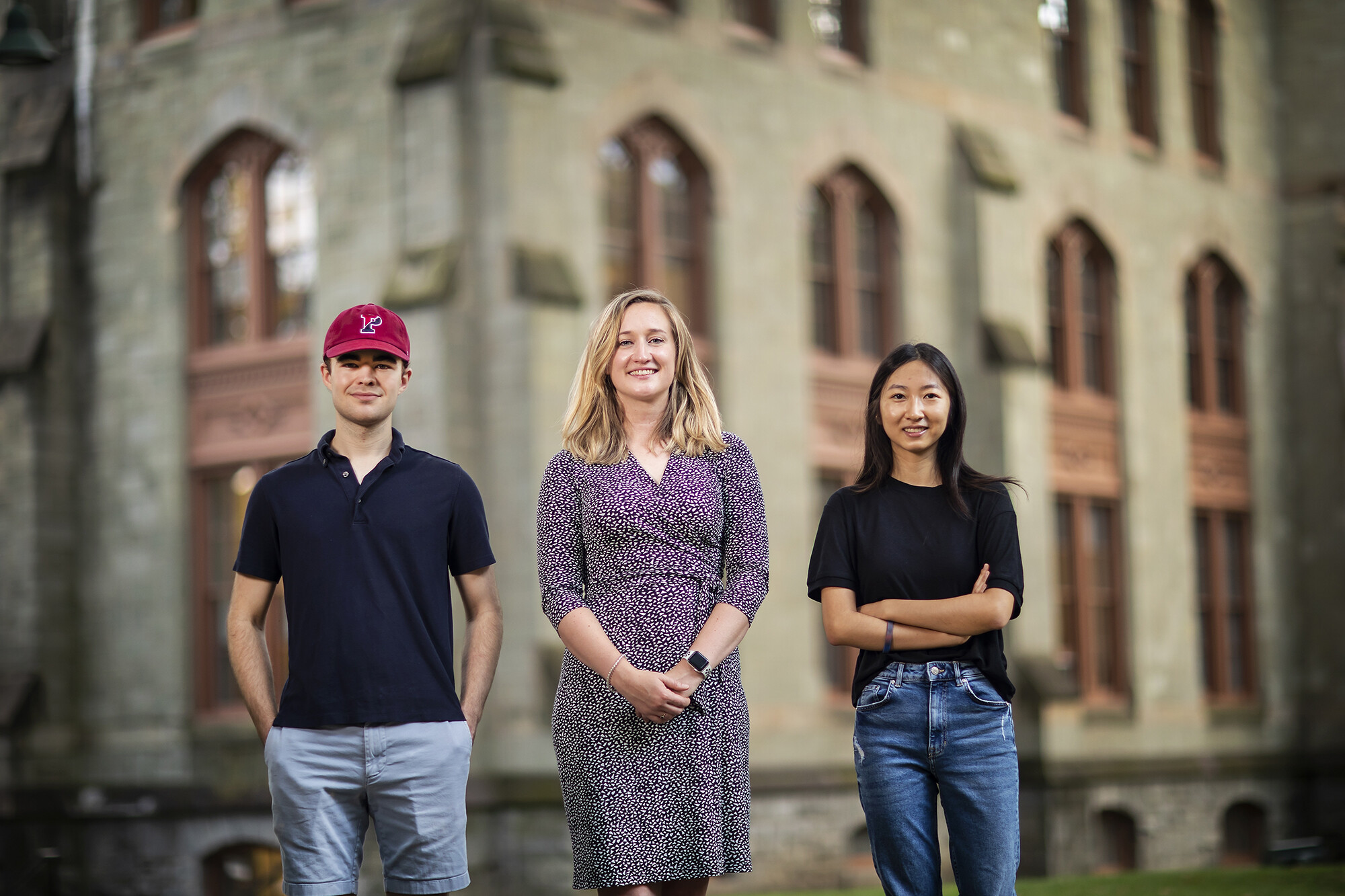
Professor Megan Robb (center) worked with a team of students including Michael Goerlitz (left) and Juliana Lu (right) to create a digital archive centered on Elizabeth Sharaf-un-Nisa, an 18th-century Mughal woman who cohabited with a European man working for the East India Company, bearing children, marrying him, and ultimately living out the remainder of her life in England.
“It was serendipity,” says Megan Robb, of how she discovered the archives of Elizabeth Sharaf-un-Nisa. Robb, now the Julie and Martin Franklin Assistant Professor of Religious Studies, was a lecturer at the University of Oxford when she read a newsletter entry noting that an English family had a collection of letters—either in Persian or Urdu, the family wasn’t sure—that they wanted translated. “As soon as I saw these letters, my jaw dropped,” Robb says. “The rarity of having a collection of 18 long and juicy letters, written in hand, perfectly preserved from the 18th century, was astonishing. I mean, this was a real treasure trove.” Robb, who at the time specialized in Urdu, says she became determined to improve her Persian “to make sure that I could learn to read them properly.”
Robb’s quest continued from that first encounter in 2015 to the present day, with the help of advisors in India, specialists in Mughal Persian, and Penn students, including graduate students Max Johnson Dugan, who headed up the project’s digital design, and Ali Noori and Hallie Nell Calhoun Swanson, Mughal Persian specialists, as well as undergraduates Michael Goerlitz of Scranton, Pennsylvania, and Juliana Lu of Dallas, who worked on the archival project this summer through the Penn Undergraduate Research Mentoring Program (PURM).
The project is the first part of a digital collaboration with Sneha Krishnan at the University of Oxford called “Unstable Archives,” which explores gender and empire in South Asia. Robb’s team has spent the summer perusing the archives of Sharaf-un-Nisa Khanum, an 18th-century Mughal woman who was born in what is now Bihar, India. Sharaf-un-Nisa ended up living and having children with Gerard Gustavus Ducarel, a European man working for the East India Company. She moved with him back to England, then married him and lived in England with her children for the rest of her life, a move that was “very rare at the time” says Robb. Later, Sharaf-un-Nisa changed her name to Elizabeth, the same name as her mother-in-law.
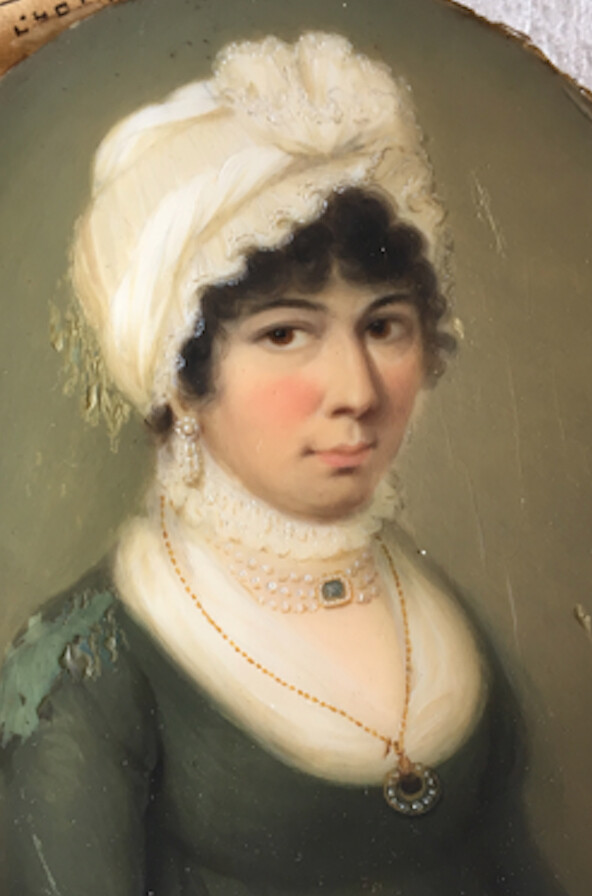
A miniature portrait included in the archive shows the rich jewelry and markedly fair skin of Elizabeth Sharaf-un-Nisa, which probably made her more acceptable to English counterparts, says Robb. An inscription in in Elizabeth Sharaf-un-Nisa’s penmanship book reads, “The people of Europe are fair. The people of Asia are dark and fair.”
Elizabeth Sharaf-un-Nisa had six living children, including two sons, one of whom survived to adulthood. The family looking to get this collection of letters translated are his descendants, the Palmer family. Robb began meeting with them to discuss the project. “The more we met, and the more I visited their home, the bigger the archives became,” says Robb. “And the harder it became to deny that this archive was extremely special and extremely valuable for historians.
“What’s fascinating about Sharaf un-Nisa’s archives,” says Robb, is the lack “of information about a very common phenomenon in 18th century: European men in India taking on mistresses, or bibis, which was a word that was used to refer to the women that accompany European men, providing domestic help, giving them sexual services as well, sometimes also developing relationships and mutual attachments.”
These relationships are important for the historiography of South Asia, Robb says. On one hand, they become vilified in the 19th century, when “European men consorting with local women becomes completely unacceptable,” says Robb. This turned into a “huge emphasis on exporting European women out to India to provide more suitable companionship for European men, as part of this new, burgeoning, racialized anxiety of the imperial presence in India,” she says.
The house in Newland, Gloucestershire, where Elizabeth Sharaf un-Nisa lived with her son Philip. (Image: Megan Robb)
On the other hand, Robb says, there is an impulse to sentimentalize these relationships and characterize them as a “kind of utopian, ‘love conquers all’” moment before European empires became “completely married to ideas of racial superiority of white people,” she says, “which is very problematic, not least because a lot of these women weren’t women at all. They were girls.
“The woman that we are researching for this project for instance, was 12 when she was brought into the household of Gerard Gustavus Ducarel,” who was in his late 20s at the time,” says Robb. She warned her students that some of the material could be sensitive and to be cognizant of the power dynamic behind some of the more romantic letters.
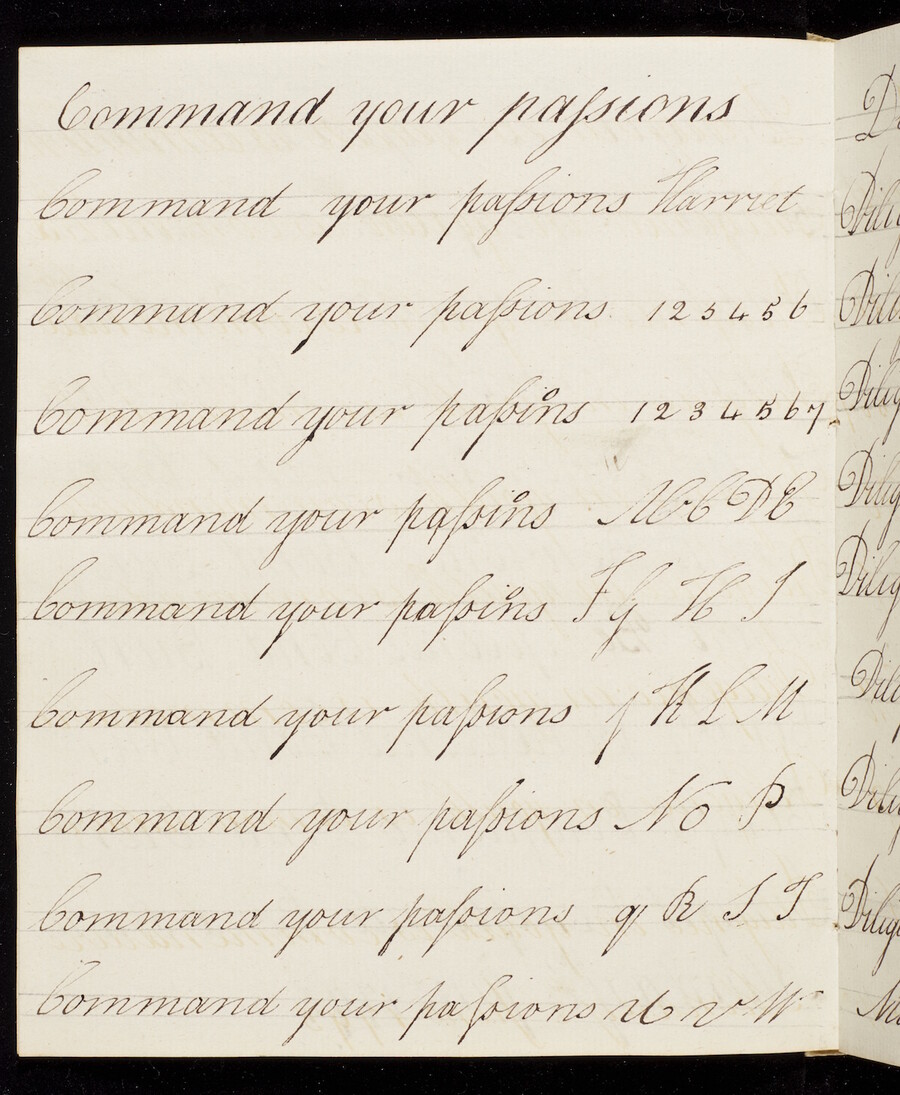
Elizabeth Sharaf-un-Nisa’s penmanship journal included phrases, either chosen by her or given to her to copy, like “command your passions,” written here.
One of Lu’s tasks was to transcribe the penmanship notebook that Sharaf-un-Nisa used to practice her handwriting, dutifully copying out English phrases and forms of expression. The mistakes and misspellings “really humanized her and showed me that she was a real person and she lived, and she wasn’t just a page in a history book.”
In addition to the penmanship journal, the archive contains letters between Sharaf-un-Nisa and her husband, letters from her brothers to her husband pleading for patronage, and letters from the brothers to Sharaf-un-Nisa, asking her to intervene on their behalf. There were clearly business and patronage relationships between the family members, Robb says, “implying that maybe there was a distinct advantage for her family in brokering a relationship with a European man. It is also clear from the brothers’ growing desperation that this advantage dissipated after Ducarel left India.”
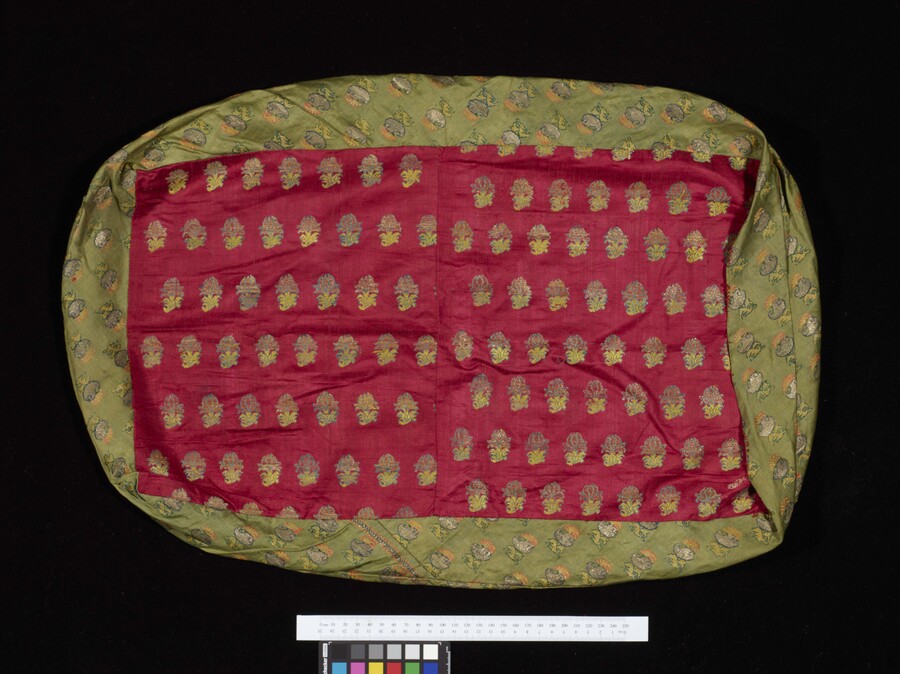
These South Asian textiles have been reworked into an English parlor cushion, a tangible example of Elizabeth Sharaf-un-Nisa’s dual identity.
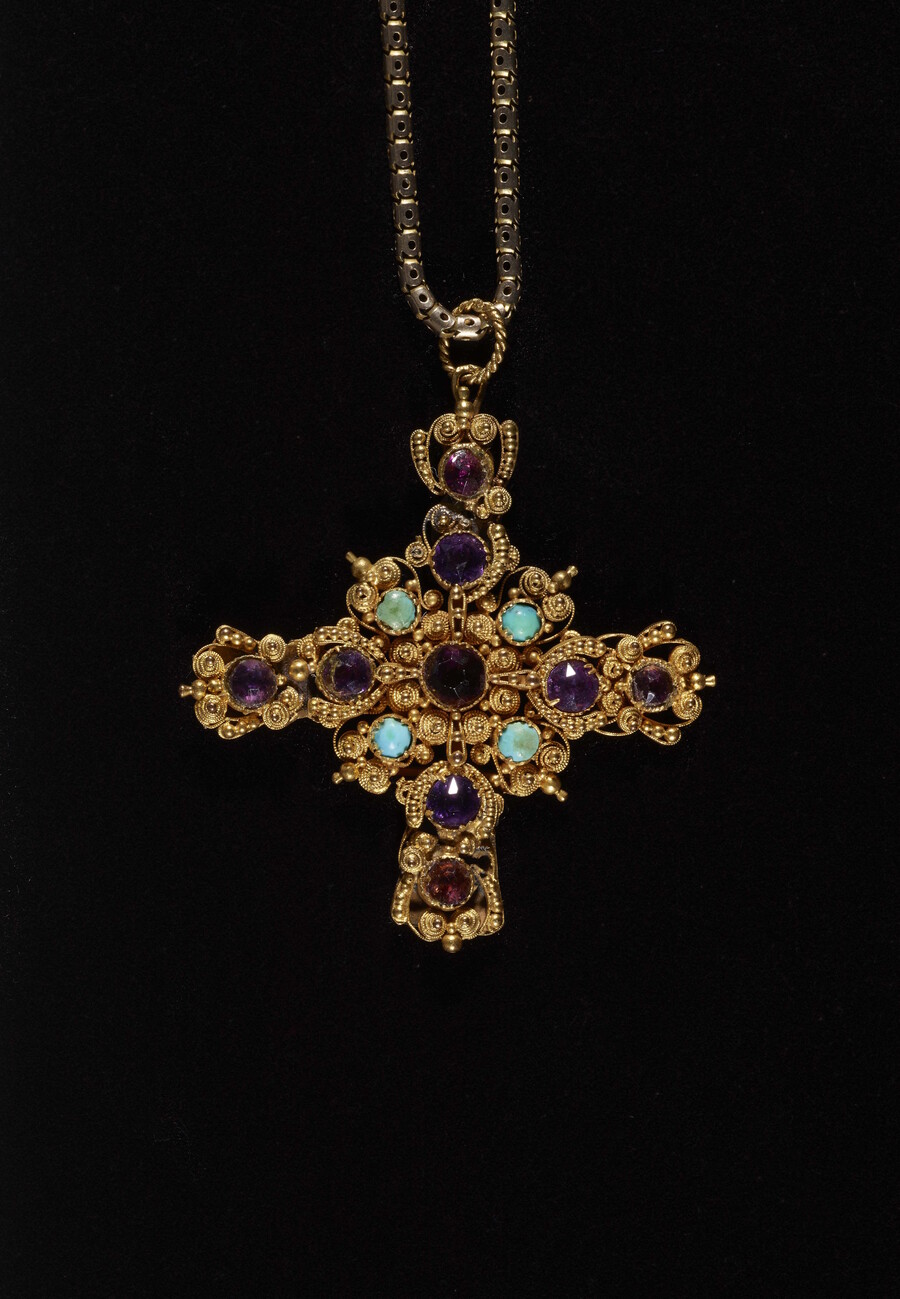
The archive also includes Mughal and European jewelry, perfume bottles, painted portraits, and textiles that Sharaf-un-Nisa wore, in addition to South Asian textiles that she repurposed into English parlor cushions. “And so you have in this really material, physical, visceral way,” says Robb, “evidence of how a woman from South Asia was repurposing aspects of her heritage on the subcontinent to acclimate to her life in England.”
It’s rare to find an archive with these kinds of materials, particularly organized around a South Asian woman, at a time when evidence of these women—and their relationships to European men—was rarely recorded or was deliberately erased, says Robb. The archive was digitized during the spring and summer, and Robb and the team are deciding how to record and present the data in order to provide accurate context for readers that best represents the Sharaf-un-Nisa material in a public-facing digital archive to be housed by the Penn Libraries on the OPenn database.
“I am a history major and found the archival work to be a wonderful component of my summer,” says Goerlitz, a junior. He says that he chose the work on this project because he was curious about historical and archival research, as well as interested in both the time period and region involved. “I’ll admit it was very satisfying to find a piece of relevant information after scouring through thousands of digitized images,” Goerlitz says. “I’ve developed an appreciation for archival materials and academics who study them.”
The students, Robb says, “have been brilliant. I have been so impressed with their proficiency and work ethic, especially considering the fact that the entire internship was conducted virtually. They constantly exceeded my expectations.” Both students helped to finalize metadata, but, while Goerlitz conducted archival work, Lu, a sophomore who plans to major in cognitive science and computer science, was interested in the digital humanities side of the project, thinking about how to convey content through digital systems.
The archive is complex, Robb says, not just rich in material but also the perspective on Sharaf-un-Nisa’s life, which was complex. South Asian consorts were neither slaves nor equals, often managing to “operate in this middle range of agency,” Robb says. “They were living in this ambivalent hybrid space, where in some ways, they were really fighting for their lives to survive in a new cultural context.” They were also “able to become English in a way that was strategic but at the same time wasn’t just superficial,” Robb says. “She really became a version of English. What do we do with all this really rich complexity? And how does that push research forward on early empire?”
The archive contains several examples of Elizabeth Sharaf-un-Nisa's jewelry, including this crucifix. While all physical objects will remain in residence with the family, the digital archives will showcase both transcribed letters as well as artifacts.
Dugan, one of the three graduate students working on the project, says there’s a dearth of information on this topic, especially publicly-available, primary-source information. “To have a project be so open and accessible about such an understudied subject is just extraordinary,” he says. A graduate student in his fifth year, Dugan studies Islam in material and visual culture. “I’d known about this project for a year and a half or so and was really interested,” says Dugan. “I’m really interested in this moment where modernity is coming into being. The categories that we use now to think about the world in terms of race, in terms of gender, in terms of colonial powers and empires—those things are being formulated” during the time when this archive was collected and written, he says.
One of the questions that intrigued him was how to show both the material that was saved, along with what wasn’t saved. There is a 10-year gap in letters pertaining to Sharaf-un-Nisa, corresponding to the time before she came to England. Robb says this omission was intentional and may indicate that Ducarel and his mother destroyed sensitive letters that explained Sharaf un-Nisa’s origins to protect the family’s respectability. The team discussed how the digital project should illustrate those silences, methodologies that Dugan found useful. “It’s just a really interesting place as a graduate student to think about how you would put together a digital project,” Dugan says. “It’s great to be able to get in on the ground floor of a project like this and kind of think about its trajectories and directions in the future.”
Past undergraduates who have worked on the project through the PURM program include Fisher Taylor in the summer of 2019 and Gabriella Morace in the summer of 2017, both of whom have since graduated.
On the move: Water quality and antimicrobial resistance testing goes mobile
Penn researchers have developed a mobile field laboratory allowing them to test water quality and track antimicrobial resistance in and around San Cristóbal in the Galápagos.
Penn researchers Vanessa and Alexis North are studying one of the largest collections of Egyptian blue objects ever found in the ancient Near East, shedding new light on how the world’s first synthetic pigment may have traveled far beyond Egypt.
A new role for dental providers? Rethinking where vaccines are given
Vaccinations have traditionally been administered in primary care settings or pharmacies. However, for about a decade, some states have authorized dentists to administer vaccines, and many others did so during the COVID-19 pandemic. The effectiveness of this approach has led some countries and states to expand or consider expanding the role of dental providers in delivering routine vaccines, including those against COVID-19 and the human papillomavirus (HPV), and in providing vaccine education.
Penn student develops a way for computer chips to run more efficiently
Fluid Silicon, a platform from President’s Sustainability Prize winner Nhlanhla Mavuso, allows computer chips to continuously monitor their health and self-tune as their characteristics change. The technology has the potential to reduce energy usage in data centers and improve reliability in mission-critical applications.