Penn researchers are studying the propensity of SARS-CoV-2 to cross between species, and they are working to protect people, pets, and wildlife from COVID-19 infection.
Humans aren’t the only species susceptible to COVID-19. A growing number of other animal species have become infected, posing a threat to the health of wildlife and domesticated animals, and in some cases exacerbating threats to people.
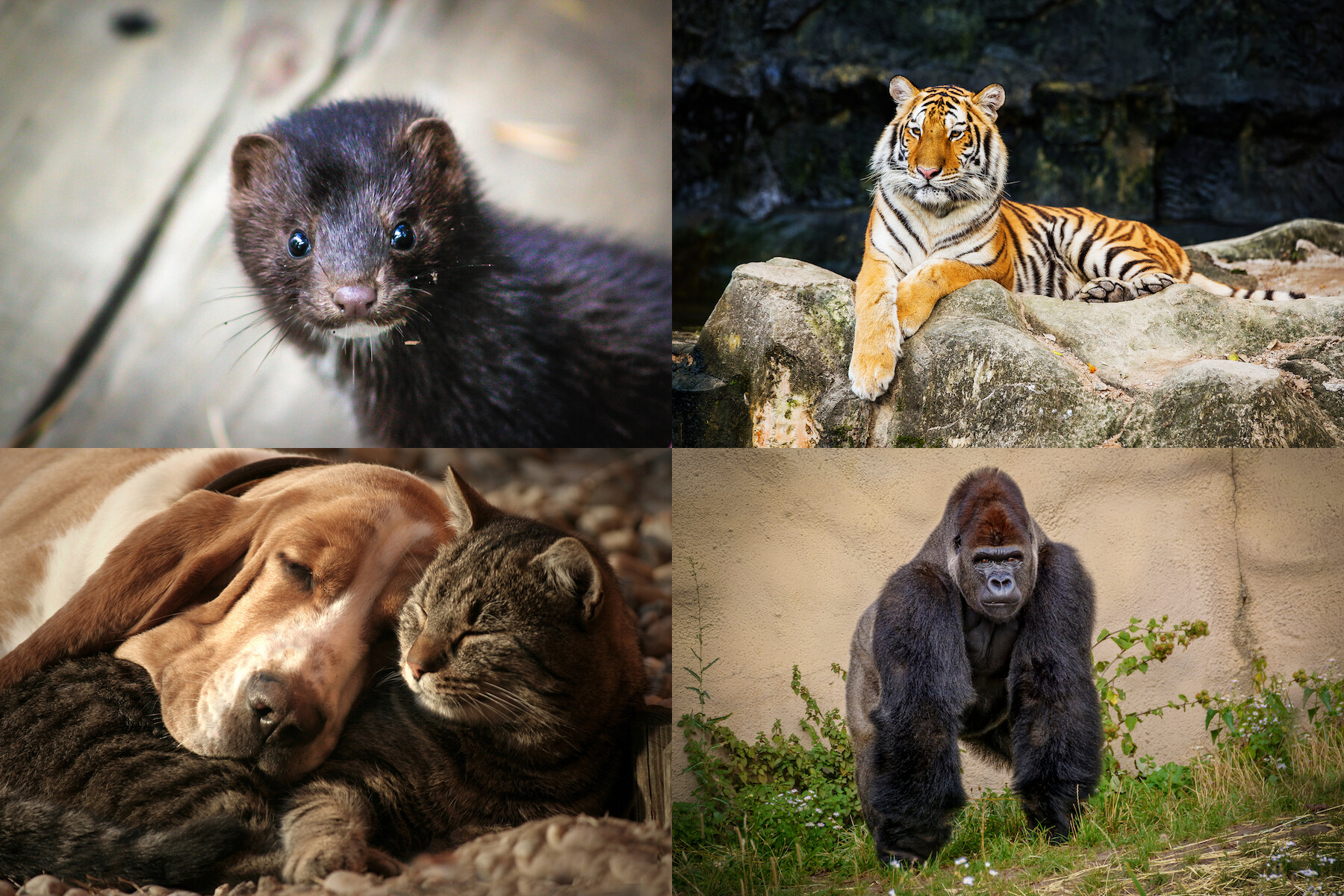
Last month, it was gorillas. Before that, it was mink. And earlier still, tigers and lions. All of these species have been confirmed to have had a diagnosis of COVID-19, infection with the SARS-CoV-2 virus.
The World Health Organization stated this week that the coronavirus “most likely” jumped from wildlife to humans. Though the precise species of origin is still unknown, the risk of zoonotic transmission, or continued crossing between species, is real. What that means for wildlife, pets, and, of course, human health is somewhat mysterious, but researchers at Penn are working to shed light on the risks of species-to-species disease movement, while mitigating further transmission.
“It’s scary to think of the spread of a disease from wildlife to humans because if there is spillover back into wildlife populations that could make it hard to contain,” says Eman Anis, an assistant professor at the School of Veterinary Medicine.
The birth of SARS-CoV-2
At the start of the pandemic, speculation about the origin of the SARS-CoV-2 virus abounded. Most of it lingered on bats and pangolins (a type of scale-covered mammal), and both species remain candidates for hosting the virus before it moved to humans. “We didn’t find out where the original SARS virus came from for quite a few years,” says microbiologist Susan Weiss of the Perelman School of Medicine, a leading expert on coronaviruses. “So, it’s perhaps not surprising that we haven’t pinpointed where this virus came from.”
Scientific teams are busy conducting that work, investigating viruses circulating in bats, pangolins, and other wildlife populations in China near the initial outbreak in Wuhan and elsewhere and also seeing whether these various species harbor antibodies that can block the SARS-CoV-2 virus from binding to their target, the ACE2 protein, which is present on human cells.
Last year, upon learning that bats were a leading suspect in passing COVID-19 to humans, Anis grew concerned about the possibility of bats in rehabilitation facilities being infected. “Bats that spend long periods of time in rehabilitation facilities with daily human interactions extend the concern for a reverse zoonosis from humans to North American bats,” she says. “This raised some concern about releasing those bats into the wild early in the pandemic,” says Anis, where they could potentially pass the disease to wild bats and establish a new reservoir of the virus.
She quickly rolled out an experiment to test samples of guano—bat poop—for SARS-CoV-2. Testing 100 bats in rehab facilities around Pennsylvania, she did not find any that were positive. “I was relieved to find no evidence of the virus.” But the experience also enabled her and colleagues to refine a diagnostic panel, shared last week in the Journal of Veterinary Diagnostic Information, which could be applied in further testing.
Ripple effects
Assuming SARS-CoV-2 did move from bats to humans, the transmission chain certainly didn’t end there, species-wise. In April 2020, tigers and lions at the Bronx Zoo became sick with a respiratory disease that turned out to be COVID-19. Two more zoo tigers were diagnosed with the disease in Indiana last week. In January, gorillas at the San Diego Zoo began coughing and were later confirmed to have COVID-19. A full list of animal species that have had confirmed cases of COVID-19 is kept by the United States Department of Agriculture, a record which also documents cases in snow leopards, mink, cats, and dogs.
Elizabeth Lennon of Penn Vet has been testing pet dogs and cats for coronavirus, with their owners’ permission, both as a way of understanding the spread between humans and animals and to further study how the virus behaves when it crosses from one species to another.
“One really important aspect of this disease is that it’s not just a human disease,” Lennon says. “It affects animals and can be passed back and forth between species.”
While it was early in the pandemic, and testing supplies were limited and prioritized to be used on people, Lennon was able to get momentum going for her study through the fall, and now she and Weiss are beginning to study the virus extracted from some animals in Penn’s Biosafety Level-3 laboratory.
Though Lennon’s study is still underway, she notes that earlier findings from Wuhan and Italy suggested that the percentage of pet dogs and cats that had antibodies to SARS-CoV-2 roughly mirrored the positivity rates in the human population.
“So, we know that animals are getting exposed, mounting immune responses, and getting infected in some places,” Lennon says.
So far research has supported the idea that both cats and dogs are susceptible to COVID-19, although less so than humans. Cats appear more susceptible than dogs.
“People are driving the spread of this disease, not pets, but what we want to ask is could pets, in certain circumstances, be more susceptible and shed large amounts of virus,” says Lennon. “For example, if a pet is immunocompromised, that is something that raises the risk of severe disease in people, so is it the same in animals?” The findings could help inform disease prevention strategies in animal shelters, veterinary facilities, and even pet owners’ homes.
Precautionary principle
Perhaps no domesticated animal species has borne a greater burden from COVID-19 than mink. Just recently, Poland, one of the largest mink-producing countries in Europe, reported its first positive COVID-19 case in farmed mink. And in November, the Danish government opted to cull 17 million of the animals after outbreaks were identified on hundreds of mink farms in the nation, Europe’s largest mink producer. Sequence data from virus samples from the mink told a concerning tale.
“Not only did the disease spread between mink on the farms,” Lennon says, “but also—and they showed this with sophisticated sequencing—mink actually spread it back to human workers on the mink farms. So, we’ve had this full loop made.”
The virus acquired mutations as it spread. With new, more contagious variants steadily making their way around the globe, the mink outbreak generated understandable fear.
“I think they were taking precautions to protect human health,” says Scott Weber, a veterinarian and wildlife communications liaison with Penn Vet’s Wildlife Futures Program. “They wanted to minimize any spread from mink to humans and, with vaccines coming out, they didn’t want any possibility that a new mutation would make any vaccine less effective.”
Penn Vet has played a role in ensuring mink farms in Pennsylvania do all they can to protect against infection. Together with the Pennsylvania Game Commission the Wildlife Futures Program co-created a threat assessment for the state’s mink farms, offering updated information about what was known about the disease to date, as well as guidance measures to take to further reduce risks to both animals and humans.
And while certified mink farms must maintain a secure barrier between their facility and wildlife, Weber says, that barrier was apparently breached in Utah, where a wild mink was found through active surveillance to be infected with COVID-19 in December, after disease outbreaks affected mink farms in the same area. The case sparked worry that the disease could pose serious risks to wildlife populations especially if it begins to circulate in wildlife and causes disease outbreaks in other closely related species, such as the endangered black-footed ferret. Black-footed ferrets are considered so vulnerable that some of the population was inoculated with trial vaccines against COVID-19 in the summer of 2020.
Despite this single case, Weber says it’s unlikely wild mink will become a major reservoir of coronavirus. “One advantage we have is that mink are pretty solitary in the wild,” he says.
Testing and vaccines
As vaccines slowly roll out to human populations at greatest risk of contracting COVID-19, scientists are developing vaccines that can protect animals, too. At Penn, veterinary researchers are collaborating with medical scientists, including Drew Weissman, a leader in developing the mRNA technology backing the two COVID-19 vaccines currently approved for use in the U.S., to do just this, for the good of agricultural industries and perhaps pets as well.
Researchers are also keeping their eye on animal populations and taking close note of what they’re seeing. “Active surveillance is very important,” says Anis. “It will help us learn more about the spread of the virus and whether there’s spillover into more animals from humans.”
In labs across the Penn campus, they’re joining forces to take a close look at the virus, as it affects different creatures and takes different forms through mutations. Evidence suggests that SARS-CoV-2 has a propensity to mutate that exceeds many other known viruses. Though the newer strains inspiring caution currently do not appear to have arisen from animals, the possibility remains.
“We still have a lot to learn about this virus,” says Anis. “While we learn, we need to be taking all the precautions that we can to keep wildlife from getting it.”
Eman Anis is an assistant professor of microbiology in the School of Veterinary Medicine at the University of Pennsylvania.
Elizabeth Lennon is the Pamela Cole Assistant Professor of Internal Medicine at Penn’s School of Veterinary Medicine.
Scott Weber is wildlife communications liaison and senior research investigator for the Wildlife Futures Program in Penn’s School of Veterinary Medicine.
Susan Weiss is professor and vice chair of microbiology and co-director of the Center for Research on Coronavirus and Other Emerging Pathogens in Penn’s Perelman School of Medicine.
On the move: Water quality and antimicrobial resistance testing goes mobile
Penn researchers have developed a mobile field laboratory allowing them to test water quality and track antimicrobial resistance in and around San Cristóbal in the Galápagos.
Penn researchers Vanessa and Alexis North are studying one of the largest collections of Egyptian blue objects ever found in the ancient Near East, shedding new light on how the world’s first synthetic pigment may have traveled far beyond Egypt.
A new role for dental providers? Rethinking where vaccines are given
Vaccinations have traditionally been administered in primary care settings or pharmacies. However, for about a decade, some states have authorized dentists to administer vaccines, and many others did so during the COVID-19 pandemic. The effectiveness of this approach has led some countries and states to expand or consider expanding the role of dental providers in delivering routine vaccines, including those against COVID-19 and the human papillomavirus (HPV), and in providing vaccine education.
Penn student develops a way for computer chips to run more efficiently
Fluid Silicon, a platform from President’s Sustainability Prize winner Nhlanhla Mavuso, allows computer chips to continuously monitor their health and self-tune as their characteristics change. The technology has the potential to reduce energy usage in data centers and improve reliability in mission-critical applications.