In a Q&A, criminologist John MacDonald discusses his new book, grounded in years of research on the positive effects of remediation like fixing up abandoned lots and houses.
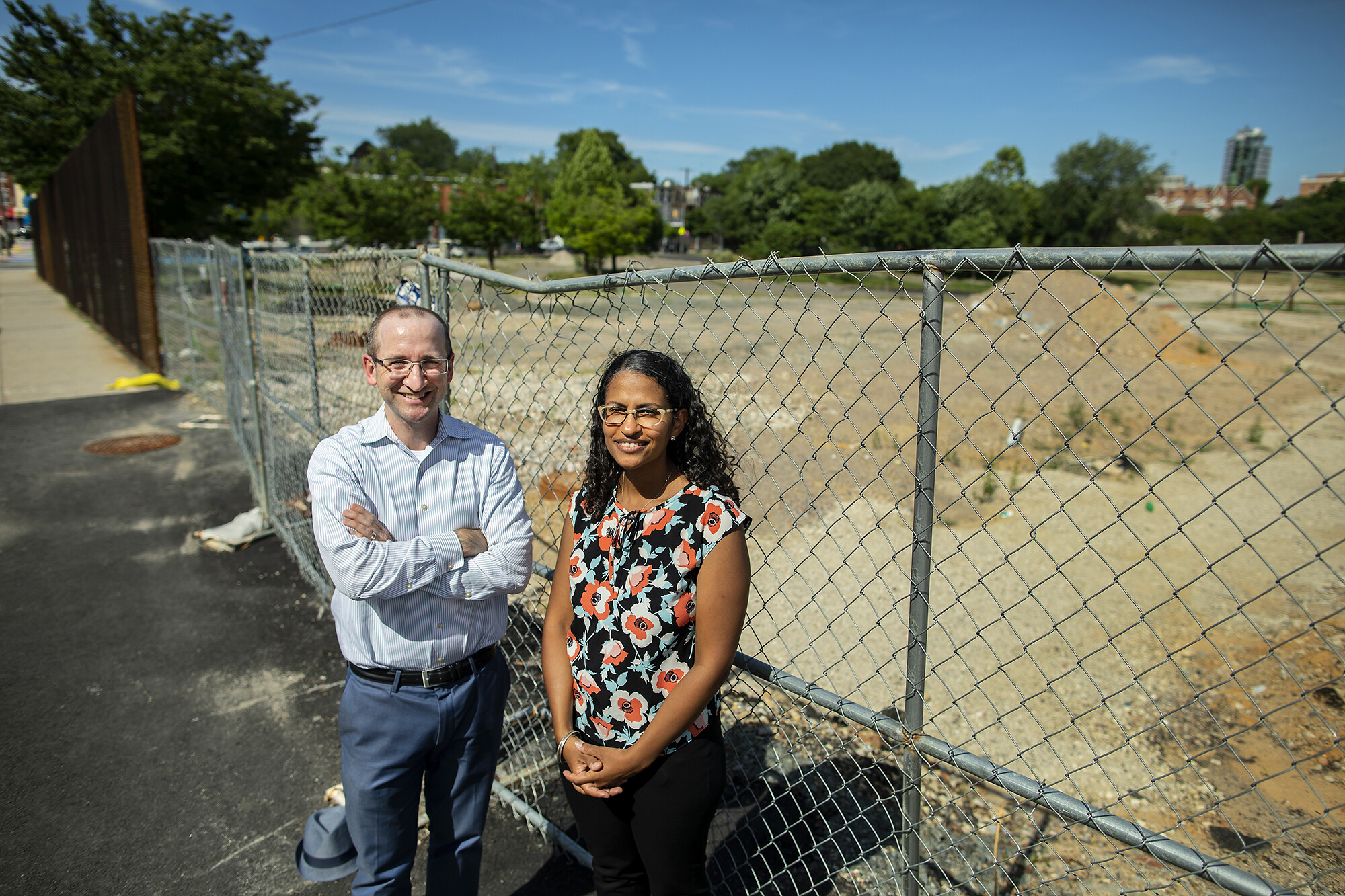
Penn Medicine’s Eugenia South, seen here with John MacDonald of the Department of Criminology, studies the effect of chronic stress and neighborhood environment on health outcomes. South’s latest pilot, Nurtured in Nature, follows work from the pair showing that cleaning up vacant lots leads to a signifiant decrease in gun violence and less stress for local residents. (Pre-pandemic photo)
It seems intuitive: Fix up vacant lots and abandoned houses and a neighborhood becomes safer. For years, Penn criminologist John MacDonald, with colleagues from the University and elsewhere, has been studying the effects of such interventions, finding strong data to support them.
A 2018 Proceedings of the National Academy of Sciencespaper he published with Charles Branas of Columbia University and others showed, for example, that neighborhoods with cleaned-up lots experienced 29% less gun violence, 22% fewer burglaries, and a 30% drop in issues like illegal dumping. Another paper, co-authored by Eugenia South of Penn Medicine and others published in JAMA Open Network, found that greening such lots significantly decreased feelings of depression and “poor mental health” for those who lived nearby.
Ongoing work on remediating abandoned houses shows promise. MacDonald has already heard from people in those neighborhoods that even minimal upkeep on the residences—fixing windows and doors, picking up yard trash and debris—makes a difference. “The general sense it creates when you’re living next door is very powerful,” he says.
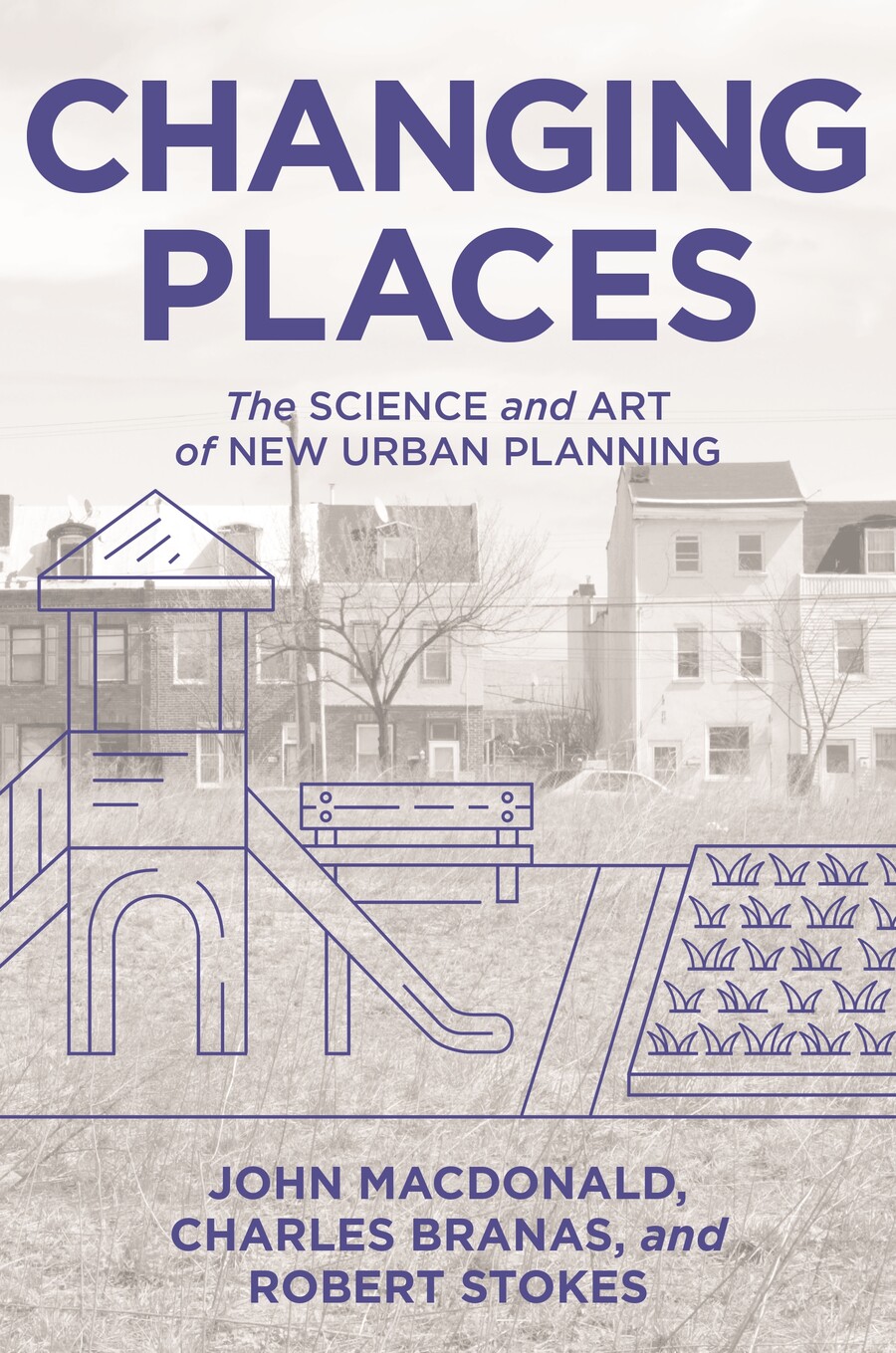
Now MacDonald, Branas, and Robert Stokes of DePaul University have published a book on the subject, “Changing Places: The Science and Art of New Urban Planning,” building on this research. Penn Today spoke with MacDonald about the new work and what direction he sees this line of research taking.
For some time, you’ve studied the effect of remediating vacant lots and dilapidated spaces. What facet of this research does the book cover?
The central theme is that changing places is transformative; it matters. There is scientific evidence for some of these changes, and we can bring this into planning how cities are designed, redesigned, and retrofitted. We’re basically trying to connect some of the evidence that we’ve marshaled from place-based experiments in the field, where we’ve changed the physical design and management of spaces.
Can you offer an example or two of what you mean?
A lot the work we’ve done in Philadelphia, programs run by the Philadelphia Horticultural Society (PHS), found that redoing vacant lots really helps reduce crime and serious gun violence in neighborhoods, and it improves mental health and reduces measures of stress. We’ve also been looking at what happens when you remediate abandoned, vacant houses.
Focusing more on health, work on transportation planning has shown that introducing more easily accessible rails, through things like light rail transit, substantially increases people’s daily exercise and can reduce some of the problems associated with the obesity epidemic in the United States. Walking a couple extra miles a day over the course of a year adds up, and it’s way more sustainable for people to remain active if it’s part and parcel of their daily routine, rather than something that requires extra effort. Changing the physical environment in strategic ways can make it more productive for people and more accessible and lead to greater social connections.
It sounds like the book could be geared toward a pretty broad audience. At whom is it directed specifically?
The audience is an educated public, practicing planners, policymakers, community groups that will advocate for changing places. We do see it as a broad audience. Urbanists, people who are interested in the urban landscape and how to make it better—that tends to be a pretty large swath of people. The book itself touches on criminology, urban planning, public health, economics, and psychology.
What are some takeaways for people who want to realize the changes you describe?
It starts with pilot testing programs or interventions that can be scaled. You start small but with the intention that it’s something that could be brought to scale on a larger level, whether that’s remediating vacant spaces or enforcing an ordinance in the city. Philadelphia, for instance, has an ordinance that requires homeowners to put working doors and windows on every house. That can be scaled, if you have a mechanism in play that allows a collection of revenue and the infrastructure to run these organizations.
Could something like the Philadelphia windows and doors ordinance really make a difference?
We’ve remediated about 60 homes with the Philadelphia Redevelopment Authority. They’ve installed working windows and doors on abandoned houses, and in a few cases repaired porch roofs. The idea is to have the house look like someone is living there and to prevent water leaking in and any additional damage that happens when a home is left completely vacant. We’re also working with PHS contractors to pick up trash and debris in the yard on a monthly basis. We should be done with data collection by the end of spring, and we’ll have some early results then. Anecdotally, community members have already told me how much they appreciate someone coming by to take care of the houses.
Could the theory the book lays out apply to any city?
Yes, any city. Any city going through planning decisions about how it manages its urban environment could benefit from some form of an urban research lab. That could be as small as 150,000 people to cities as big as New York City. Obviously the bigger the city, the more potential places could be tested. But this is something any city can do as long as it has some access to scientists.
That circles back to what you said earlier, about incorporating scientific principles into urban planning. Is that the main point you want to drive home?
The idea is to try to get this message out there and hopefully create a movement in urban planning, to not just embrace changing places but really embrace the idea of using science to help guide the evidence.
On the move: Water quality and antimicrobial resistance testing goes mobile
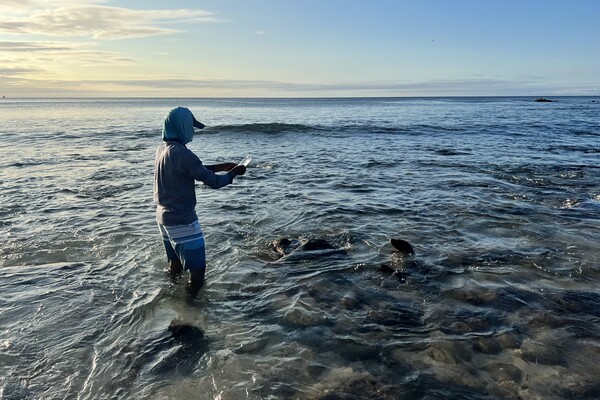
Penn researchers have developed a mobile field laboratory allowing them to test water quality and track antimicrobial resistance in and around San Cristóbal in the Galápagos.
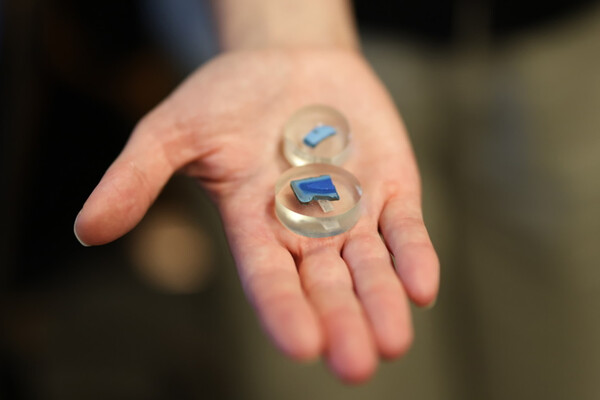
Penn researchers Vanessa and Alexis North are studying one of the largest collections of Egyptian blue objects ever found in the ancient Near East, shedding new light on how the world’s first synthetic pigment may have traveled far beyond Egypt.
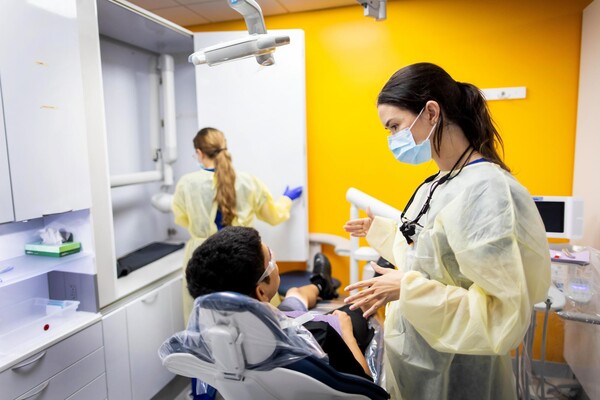
A new role for dental providers? Rethinking where vaccines are given
Vaccinations have traditionally been administered in primary care settings or pharmacies. However, for about a decade, some states have authorized dentists to administer vaccines, and many others did so during the COVID-19 pandemic. The effectiveness of this approach has led some countries and states to expand or consider expanding the role of dental providers in delivering routine vaccines, including those against COVID-19 and the human papillomavirus (HPV), and in providing vaccine education.
Penn student develops a way for computer chips to run more efficiently
Fluid Silicon, a platform from President’s Sustainability Prize winner Nhlanhla Mavuso, allows computer chips to continuously monitor their health and self-tune as their characteristics change. The technology has the potential to reduce energy usage in data centers and improve reliability in mission-critical applications.