The curious case of ancient bear bones at a Mississippi dig site
Penn and UNC Chapel Hill researchers theorize that the considerable black bear remains indicate an animal that was a food source and considered close kin to the people who lived there 1,300 years ago.
Megan Kassabaum is an assistant professor in the Department of Anthropology in the School of Arts & Sciences at the University of Pennsylvania and the Weingarten Assistant Curator for North America at the Penn Museum.
It’s not unusual to find animal bones like deer and fish at pre-contact Native American sites in the Lower Mississippi Valley. But what Penn archaeologist Megan Kassabaum wasn’t expecting to find were so many bones from black bears.
“When we saw how much bear there was,” she says, “we just couldn’t ignore it.”
Kassabaum has been conducting research in this part of the United States for more than a decade. At a site in southwestern Mississippi called Feltus, she and colleagues uncovered the remains of several large meals, which included a significant number of bear bones. “The presence of this animal bone at archaeological sites that predate contact with Europeans is fairly unusual,” says Kassabaum.
This led the research team down a rabbit hole. What explained the bears’ presence? Was there actually more here compared to other sites or did it just seem that way? Did the Native populations eating the bear—in this case, members of an archaeological culture called Coles Creek—just like the way it tasted, or was there something more behind it? What did the bears represent, and how were they connected to other remains?
To begin answering these questions, Kassabaum and her colleagues collected as many samples as possible. Working with faunal analyst Ashley Peles, a doctoral candidate at the University of North Carolina at Chapel Hill, they examined the bones and other archaeological materials from the excavations. To better understand the specific meaning of the bear, they also consulted pertinent historical documents.
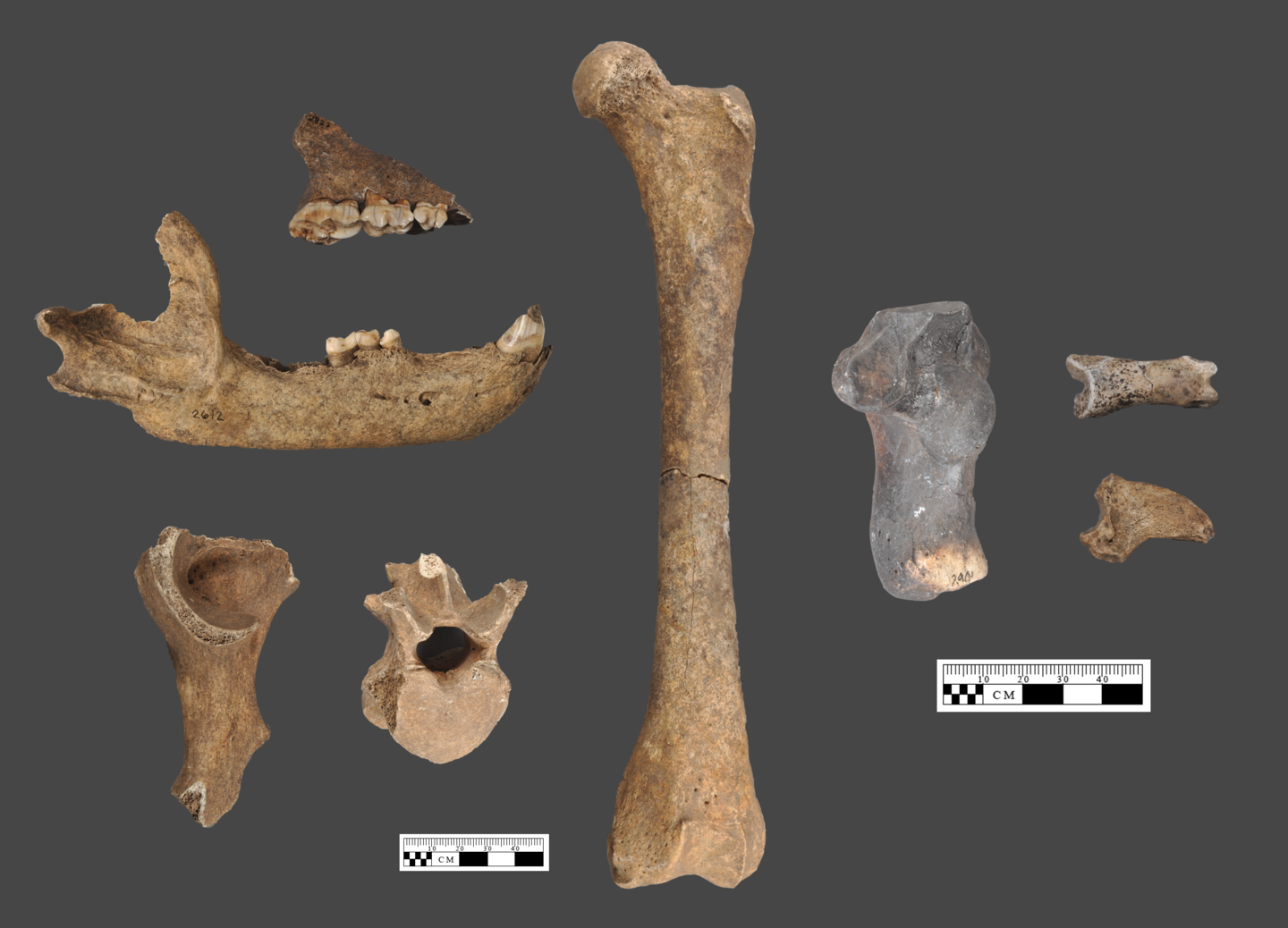
Bear bones found at a site in southwestern Mississippi called Feltus. (Image: Ashley Peles)
From this extensive analysis, Kassabaum and Peles theorized that around 1,300 years ago, the Coles Creek people were eating bear as part of festive celebratory meals, not for day-to-day consumption. They also believe that, beyond serving as a feasting food, the animals held a special place of kinship for this group. The researchers have published their findings in a series of papers and book chapters.
“Much like we eat certain foods at certain times of year or only in combination with other foods, these were meaningful. I think bear was likely consumed, but only under those special circumstances,” Kassabaum says. “By consuming this animal that you’re so closely related to, it’s possible that people were purposefully strengthening the bond between bears and humans.”
Understanding the remains
The work at Feltus began in 2006. At the time, Kassabaum was a doctoral student at UNC Chapel Hill interested in understanding the significance of mounds found at early Native settlements. Though the size and form of these mounds vary, during the period that Kassabaum studies, they generally include flat-topped mounds arranged around a central plaza. Feltus has four, large earthen mounds.
For six years, a team of archaeologists including Kassabaum worked on the mounds. “I’d been excavating, trying to see what material remains were left behind to answer questions about how they were built, who was building them, and what they could tell us about what they meant to the folks who built them,” she says. “The bear research emerged out of that.”
During the analysis phase of this research, the store of bear remains quickly grew. It became evident that the team had stumbled on something interesting. But was it unique? Kassabaum, at this point an assistant professor in the Department of Anthropology at Penn, decided to collaborate with Peles, who specializes in identifying and analyzing animal bones.
“Other people had looked at the bones, and it seemed like there was a lot of bear here,” Peles says. “But from a scientific perspective, we needed to make sure we’d counted all the bones and compared the site to others in the region. You want to make sure that what you think you’re seeing is actually there.”
Peles got to work tabulating the bones and looking for patterns. Soon, she was convinced: “Sometimes you think something, and you start gathering data and realize it isn’t true,” she says. “But in this case, we were able to say that the Coles Creek people definitively had a significant amount of bear bone, and the region as a whole had more than other regions as well.”
A special relationship
From there, Peles and Kassabaum looked further into the data. At Feltus, digging underneath, inside of, and on top of the mounds revealed that the type of bear bones present changed over time. The earliest remains included bear skull fragments, leg and arm bones, hand and toe bones, even wrist bones. “Initially, we see fairly equal representation of the various parts of the bear,” Kassabaum says. Later, however, it’s mostly just bones from the animals’ hands and feet.
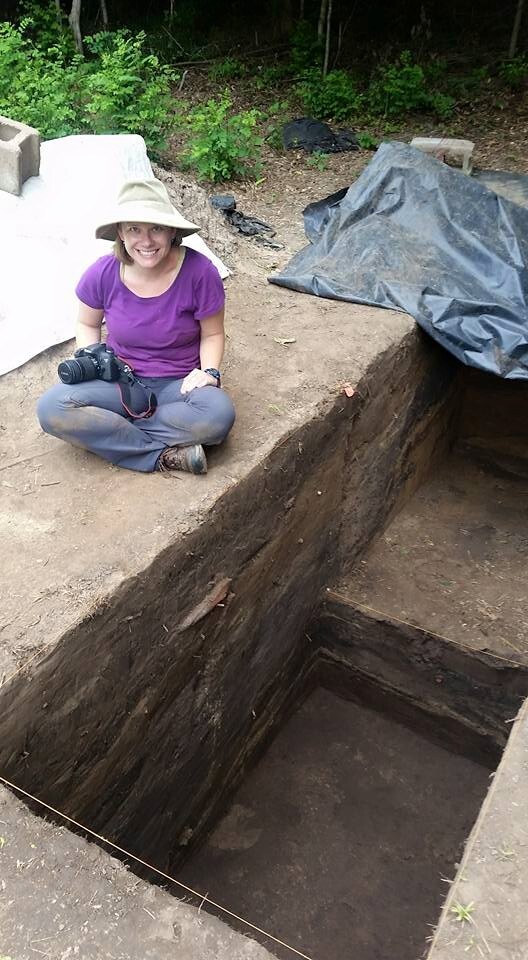
Kassabaum conducting field work at an archaeological site. (Image: Meg Kassabaum)
Meg Kassabaum
They also analyzed what else was around. “It looks like people were having a pretty big feast. There were lots of deer bones, a fair amount of fish, along with cougar and owl bones, other things you don’t normally see,” Peles says. “Bear is something that we generally don’t see at sites, either.”
That’s likely because they’re dangerous and hard to hunt, Kassabaum says. “If your options are between fish and bear, it doesn’t make a lot of sense to hunt bear because they weren’t the easiest way to get the most amount of meat.”
To Kassabaum, that meant the people of Coles Creek had a relationship with bears that went beyond simple sustenance. Looking at the animal behavior literature, she found countless described links between these animals and humans. They walk on two feet. They eat a relatively similar diet. They have one or two babies at a time, offspring they care for and reprimand in ways that humans do as well.
Kassabaum also read accounts of what Native peoples told European explorers about their feelings on and knowledge about bears. “Across the board, they’re consistently described as the most humanlike of animals,” she says. “And there are many stories where there’s a blurred line between bears and human beings.” Some traditions even call bears “grandmother,” “brother,” or “cousin” to signal kinship.
“My overall thinking about these mound sites had been that these were places where populations living throughout the region could come together and assert their sameness. They would come together to feast, make the mounds bigger, and create or strengthen kinship ties,” Kassabaum says. “It became clear the presence of the bears wasn’t just as a food source but another part of the kin group, to reestablish the kinship.”
The future of the work
The researchers still have more to learn about the role of bear for the Coles Creek people. Beyond the meat, bear contains a significant amount of oil, so they’re trying to understand how the substance was used, if at all.
Peles has a theory that the bear paws were considered a delicacy, which could explain why at the Feltus site hand and foot bones are found in greater numbers later in the historical timeline. “I think they’re consuming the paws on mound summits in a much more dramatic way than in some of the other contexts where we’re seeing the entire bear represented,” she says.
Most of Kassabaum’s recent excavations have taken place at Smith Creek, another Mississippi site about 35 miles from Feltus. She’s found bear remains there as well.
“The goal will be to get a lot more of that faunal data analyzed,” she says. “Does the change from all types of bear bone to just the hands and feet hold as a broader pattern signifying how people interacted with bear and how their beliefs about bears changed? It will be interesting if we see similar patterns at Smith Creek.” She thinks they will, but, like with all archaeological work, knowing for sure takes time.
“Trying to figure out the meaning behind all of this is the hardest part,” Peles adds. “But that’s the part you really want to know.”
On the move: Water quality and antimicrobial resistance testing goes mobile
Penn researchers have developed a mobile field laboratory allowing them to test water quality and track antimicrobial resistance in and around San Cristóbal in the Galápagos.
Penn researchers Vanessa and Alexis North are studying one of the largest collections of Egyptian blue objects ever found in the ancient Near East, shedding new light on how the world’s first synthetic pigment may have traveled far beyond Egypt.
A new role for dental providers? Rethinking where vaccines are given
Vaccinations have traditionally been administered in primary care settings or pharmacies. However, for about a decade, some states have authorized dentists to administer vaccines, and many others did so during the COVID-19 pandemic. The effectiveness of this approach has led some countries and states to expand or consider expanding the role of dental providers in delivering routine vaccines, including those against COVID-19 and the human papillomavirus (HPV), and in providing vaccine education.
Penn student develops a way for computer chips to run more efficiently
Fluid Silicon, a platform from President’s Sustainability Prize winner Nhlanhla Mavuso, allows computer chips to continuously monitor their health and self-tune as their characteristics change. The technology has the potential to reduce energy usage in data centers and improve reliability in mission-critical applications.