Penn astronomer weighs in on the discovery of seven new exoplanets
About 39 lightyears away—or around 229 trillion miles—there sits a small, faint star called TRAPPIST-1 in the constellation Aquarius. Last year, this tiny, relatively nearby star made headlines when astronomers announced they had found three Earth-sized exoplanets orbiting close to the star in its habitable zone.
Now, astronomers have announced that they have detected a total of seven Earth-sized planets with a tight orbit around TRAPPIST-1. They believe that three of the seven planets in this compact system might have the potential to harbor life.
Stars like TRAPPIST-1, a red dwarf, are among the most common stars in the universe. According to Cullen Blake, an assistant professor in the Department of Physics & Astronomy in the School of Arts & Sciences, these new findings demonstrate that these small, abundant stars are actually extremely efficient at making planets.
“It teaches us something about how planets form,” Blake says. “It means that, overall, there must be even more planets in our galaxy than we thought. Given this, we’d almost be shocked if there weren’t many planets orbiting some of these stars.”
The astronomers detected these planets by watching the star for a slight dimming caused by a planet passing in front of it.
“They were waiting for these little dips to happen,” Blake says. “The number of days between the dips tells them the period of the planet, and the size of the dip tells them the planet’s size.”
Although this method is great at getting the radius of the planets, figuring out their mass is a bit more difficult. But there’s another way to detect exoplanets. As a planet orbits its star, it exerts a slight tug on the star, creating a “wobble.”
While planets such as Earth and Jupiter travel around the sun, their gravitational influence causes the sun to move ever so slightly. Rather than waiting for planets to transit a star, some astronomers, including Blake, hope to detect them by measuring this slight tug.
Not only does this method allow scientists to detect exoplanets, it enables them to get a more precise measurement of the planet’s mass through the gravitational effect it has on its star.
Using a 70-centimeter telescope in southern Arizona called Minerva-Red, and an instrument scientists are currently developing to detect these wobbles, Blake hopes Penn’s Minerva project will be able to make equally exciting discoveries. He is also involved in NEID, a $10 million, next-generation facility that Penn and Penn State scientists are preparing to build in Arizona.
Unlike other telescopes, which are optimized for the same wavelengths as the human eye, technologies like Minerva-Red will see in the infrared, making them a good fit for investigating red dwarfs.
“Because these little stars are so cool, they emit most of their radiation at much longer wavelengths, and Minerva-Red is optimized to work at those longer wavelengths,” Blake says. “That’s a unique capability that it will have.”
On the move: Water quality and antimicrobial resistance testing goes mobile
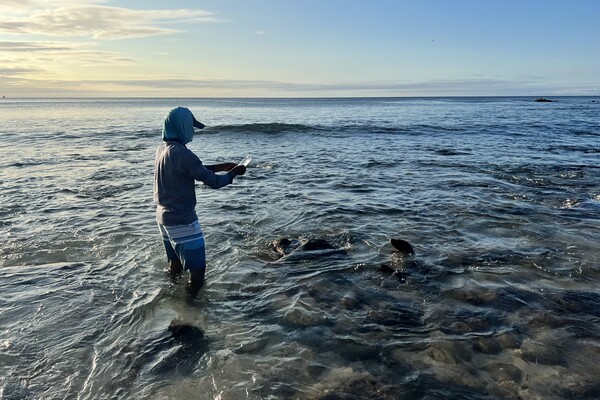
Penn researchers have developed a mobile field laboratory allowing them to test water quality and track antimicrobial resistance in and around San Cristóbal in the Galápagos.
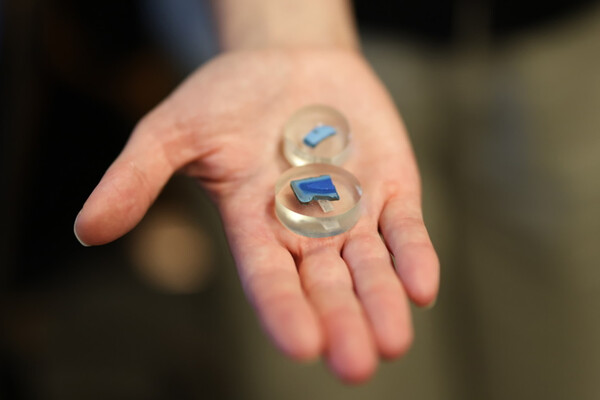
Penn researchers Vanessa and Alexis North are studying one of the largest collections of Egyptian blue objects ever found in the ancient Near East, shedding new light on how the world’s first synthetic pigment may have traveled far beyond Egypt.
A new role for dental providers? Rethinking where vaccines are given
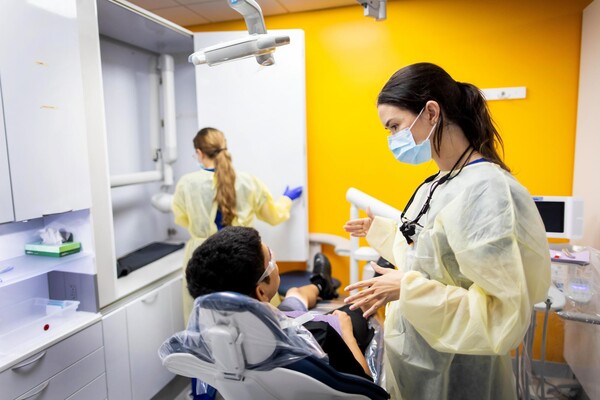
Vaccinations have traditionally been administered in primary care settings or pharmacies. However, for about a decade, some states have authorized dentists to administer vaccines, and many others did so during the COVID-19 pandemic. The effectiveness of this approach has led some countries and states to expand or consider expanding the role of dental providers in delivering routine vaccines, including those against COVID-19 and the human papillomavirus (HPV), and in providing vaccine education.
Penn student develops a way for computer chips to run more efficiently
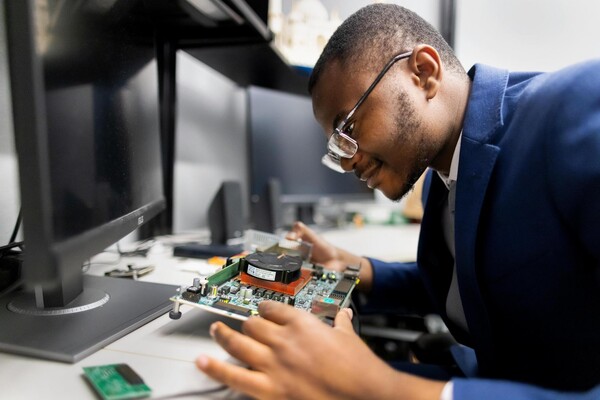
Fluid Silicon, a platform from President’s Sustainability Prize winner Nhlanhla Mavuso, allows computer chips to continuously monitor their health and self-tune as their characteristics change. The technology has the potential to reduce energy usage in data centers and improve reliability in mission-critical applications.